Midjourney vs Nano Banana vs Ideogram: Which AI Image Generator Should You Pick?
All three make good images now. What separates them is who owns the result, who can see it while you work, and whether you can predict the bill — and on that last one there's a clear winner.
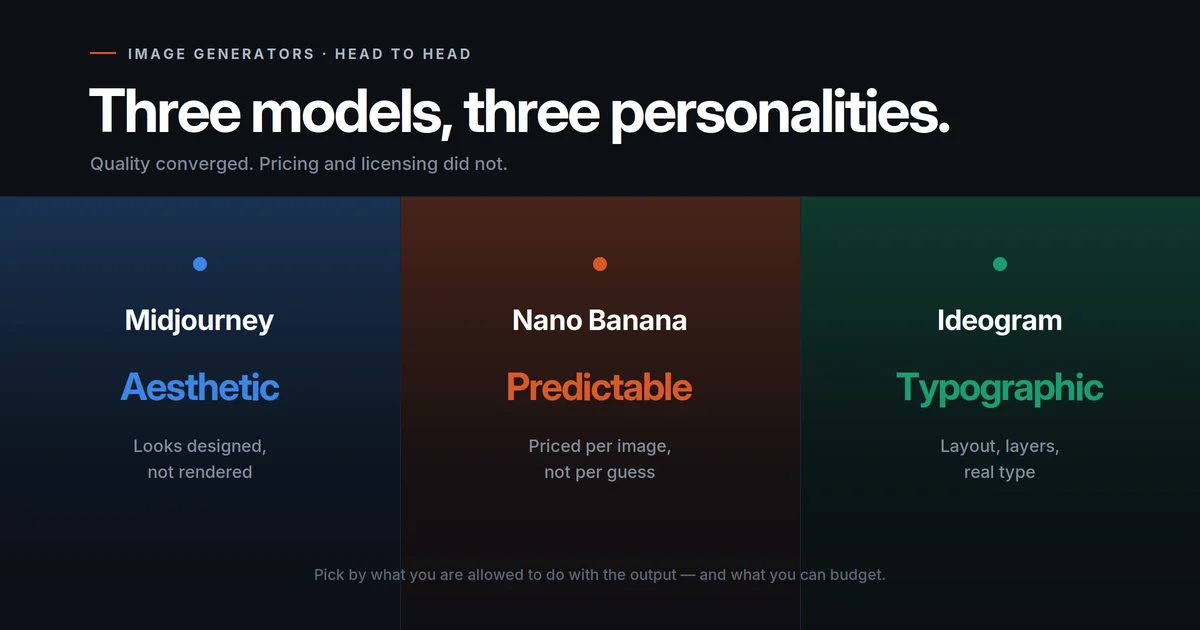
Ask three image generators for the same thing today and you’d struggle to pick a winner blind. The quality gap that made these comparisons interesting two years ago has mostly closed. All three of these produce images good enough to ship.
So the comparison has to move somewhere more useful: who owns the output, who can see it while you’re working, and whether you can predict what it costs. Those three questions have wildly different answers, and they’re what should actually decide your choice.
One note on a name you might be looking for. DALL·E isn’t in this comparison because it no longer exists — OpenAI shut it down in May 2026 and folded image generation into its GPT Image line. If you landed here looking for it, the closest equivalent is covered at the end.
The short version
| Midjourney | Nano Banana | Ideogram | |
|---|---|---|---|
| Best at | Looking designed | Doing what you asked, cheaply | Type and layout |
| Free tier | Effectively none | Yes, via the Gemini app | Yes, weekly credits |
| Entry price | $10/mo | $0.034–$0.134 per image | $20/mo, or free |
| Can you predict the bill? | No — GPU minutes | Yes — published per image | No — credits not published |
| Who owns the output | You — unless your company earns over $1M/yr and you’re not on Pro | You, per Google’s terms | You, on every tier including free |
| Private by default | No — Pro ($60) and above only | Yes | No on free; yes from Plus ($20) |
| API | No official one | Yes | Yes — plus self-hostable open weights |
Midjourney — the one with taste
Midjourney still produces the most designed-looking output of the three. Ask the others for “a lonely lighthouse” and you get a competent rendering; ask Midjourney and you get something with a point of view. That isn’t nostalgia — it’s a real and durable difference in the aesthetic prior.
V8.2 has been the default since late July 2026, and the V8 Edit Model added instruction-based editing, outpainting and multi-image reference. Style control remains the deepest here — style references, moodboards, personalization. Niji 7 is still the best anime model available anywhere.
Pricing: Basic $10 · Standard $30 · Pro $60 · Mega $120, roughly 20% off annually. You’re buying GPU time rather than images, which is genuinely harder to budget. Extra time runs $4/hour.
The two things that should worry you.
First, everything you make on Basic and Standard is public. Your generations appear in the community gallery where anyone can see and remix them. Stealth mode — described as best-efforts, not a guarantee — starts at Pro, $60/month. If you do client work, NDA work, or anything unannounced, your real entry price isn’t $10.
Second, and this catches businesses out constantly: if you work at a company grossing over $1,000,000 a year, you must be on Pro or Mega to own what you make. Read that carefully — it’s a condition on ownership, and it keys off your employer’s revenue, not your spend. A designer at a large firm on a $10 plan does not own the output.
There’s also no official API, and Midjourney is currently defending a copyright suit brought by Disney, Universal and Warner Bros. It offers no IP indemnity.
Nano Banana — the one you can actually budget
“Nano Banana” is the nickname that stuck to Google’s Gemini image models, and the name is now used more than the official one. There are three of them, which is the first thing to get straight:
- Nano Banana Pro (Gemini 3 Pro Image) — the flagship. $0.134 per image at 1K–2K, $0.24 at 4K.
- Nano Banana 2 (Gemini 3.1 Flash Image) — the workhorse. $0.045 at 0.5K, $0.067 at 1K, $0.101 at 2K, $0.151 at 4K.
- Nano Banana 2 Lite — the cheap one. $0.0336 per 1K image.
Batch processing halves all of those.
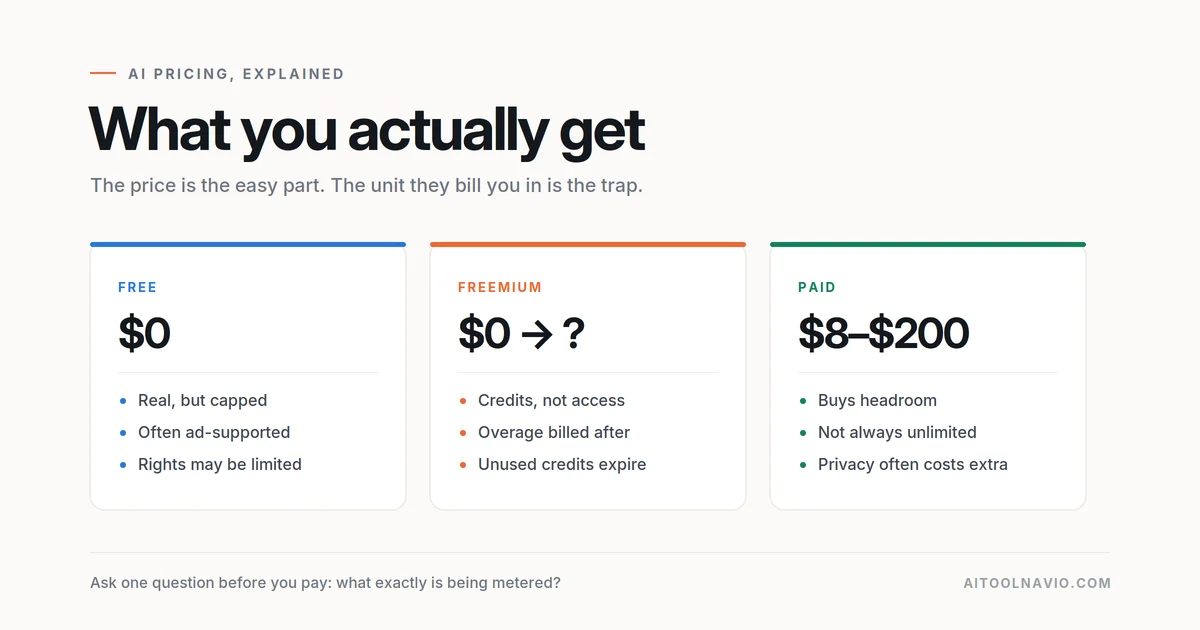
Now notice what just happened: you know exactly what an image costs. You can multiply it by your monthly volume and get a number. Neither of the other two in this comparison lets you do that — Midjourney sells you GPU minutes whose per-image yield varies with the job, and Ideogram’s own documentation declines to publish how many credits an image consumes.
For anyone generating at volume, that transparency is worth more than a marginal quality difference. It’s the difference between a line item and a surprise.
What it’s actually good at: instruction-following. Give it six requirements and it tends to satisfy all six rather than the three it found most interesting. It handles text in images competently, editing is conversational and reliable, and 4K output is available natively. On quality-per-dollar it is currently the strongest option in the category.
Access: free through the Gemini app for consumers, free-tier access via Google AI Studio for developers, and paid per-image through the API. That free on-ramp matters — it’s the easiest of the three to evaluate properly without spending anything.
The weaknesses: the house style is competent rather than distinctive — it renders what you asked for, where Midjourney interprets it. Google’s model naming is genuinely confusing, with three overlapping “Nano Banana” products plus formal Gemini names that don’t match the nicknames. And Google has shown it will retire products with short notice, so don’t build an irreplaceable pipeline on one model version.
Ideogram — the one built for design work
Ideogram built its reputation on rendering text inside images when nothing else could. That moat has largely closed — the other two handle text-heavy briefs competently now — but Ideogram responded by moving somewhere more defensible.
Ideogram 4.0, released June 2026, shipped as open weights under a commercial license and added the feature that genuinely differentiates it: bounding-box layout control, where you specify where elements sit on the canvas. Nothing else here does that. It also added native transparency and layered output, which matters enormously if images go into a real design pipeline rather than a blog post.
So the honest 2026 positioning isn’t “the one that can spell.” It’s the one built for design work — multilingual type, dense small text, layout you control, transparent backgrounds.
Pricing: Free (weekly slow credits) · Plus $20 · Pro $60 · Team $30/user, with roughly 25–30% off annually. Top-up credits are $4 a pack and expire a year after purchase.
Its free tier is the most commercially generous here — Ideogram’s terms grant the same commercial rights on every tier, so a free user owns and can sell their output. The catch matches Midjourney’s: free generations are public, and private mode starts at Plus.
The real weakness is that you cannot budget it. Ideogram doesn’t publish how many credits an image costs — its docs say cost depends on model, speed, resolution and tool, and warn against relying on static tables. Set against Google publishing a price to four decimal places, that’s a hard contrast.
What actually decides it
If you generate at volume
Nano Banana, and it isn’t close. It’s the only one of the three where you can forecast spend before committing. Start with Nano Banana 2 at $0.067 an image and move up to Pro only where the output justifies double the price.
If you do client or confidential work
Your floor is Midjourney Pro at $60, Ideogram Plus at $20, or Nano Banana at any tier. On cheap Midjourney and free Ideogram your work is public while you’re making it — a detail people discover after the fact.
If you work at a company over $1M revenue
Midjourney Pro or Mega, or use one of the others. Neither Google nor Ideogram applies a revenue threshold.
If images go into a design file
Ideogram — transparency, layers and layout control are what stop you rebuilding the image in Figma afterwards.
If it needs to be beautiful more than accurate
Midjourney, still. Nothing else has the same instinct.
If you need indemnification
None of these three. Adobe Firefly is the only major generator offering IP indemnification on qualifying plans, trained on licensed content. If your legal team asks who covers you when a claim arrives, that’s the answer — and it’s a different answer from all three tools in this title.
The ones you should also know about
- GPT Image 2.5 — OpenAI’s current line and the true successor to DALL·E, in two flavors: Flare for speed, Sunburst for editing precision. Excellent instruction-following and cleanest ownership terms of anything here. Bundled into paid ChatGPT tiers, so if you already subscribe you have it. Token-billed, so harder to forecast than Google’s flat per-image pricing.
- FLUX from Black Forest Labs — pick this when product or character consistency is the whole job; it takes up to ten reference images.
- Stable Diffusion — free, local, unfiltered, infinitely tunable. Free commercially under $1M annual revenue.
- Recraft — the only one here that outputs true editable vectors.
- Qwen-Image — the strongest open-weight image model as of September 2026, with native transparent-background output. Check the license before commercial use.
- Leonardo AI — strong for game and concept art workflows.
And a note on platform risk: Reve, a well-regarded generator, shut down in September 2026 — generation stopped on the 27th, with downloads available only until 31 October. DALL·E went the same way in May. If your workflow depends on one vendor, keep your prompts and outputs somewhere you control.
The verdict
Nano Banana is the default recommendation for most people in 2026. It’s the cheapest credible option, the only one with a price you can multiply, it has a real free tier, and its instruction-following is the best of the three. Start here unless you have a specific reason not to.
Midjourney if the image is the product and it has to look good — and budget $60, not $10, the moment the work is for someone else.
Ideogram if the image contains type or goes into a design file, where its layout control and transparency save you real work downstream.
Don’t choose on sample galleries. Every vendor’s gallery is its best work. Run the same three real briefs through all three free or cheap tiers and compare what you get.
Go deeper
- Full listings: Midjourney · Ideogram · FLUX · Stable Diffusion · Recraft
- Browse all image generation tools and design tools
- Why credit-based pricing is so hard to budget
- Compare two generators side by side
FAQ
What is Nano Banana?
It’s the nickname for Google’s Gemini image models, now used more widely than the official names. There are three: Nano Banana Pro (Gemini 3 Pro Image) at $0.134 per image, Nano Banana 2 (Gemini 3.1 Flash Image) from $0.045, and Nano Banana 2 Lite at $0.0336 per 1K image.
Which AI image generator is cheapest?
Nano Banana, by a clear margin, and it’s also the only one of the three that publishes a per-image price you can forecast from. Nano Banana 2 Lite is $0.0336 an image at 1K, halved again with batch processing.
Which AI image generator is best for text in images?
Ideogram remains the specialist, particularly for multilingual type, dense small text and controlled layout. But Google’s and OpenAI’s models now handle most text-heavy briefs competently, so test rather than assume.
Can I sell images made with Midjourney?
Usually yes — but if you or your employer gross over $1,000,000 a year, Midjourney’s terms require a Pro or Mega plan for you to own the output. The threshold is based on company revenue, not what you spend.
Is DALL·E still available?
No. OpenAI shut down DALL·E 2 and DALL·E 3 on 12 May 2026. Its successor is GPT Image 2.5, available through ChatGPT and the API.
Are my Midjourney images private?
Not on Basic or Standard. Generations appear publicly in the community gallery. Stealth mode begins on the Pro plan at $60/month, and is described as best-efforts rather than guaranteed.
Which image generator offers legal indemnification?
Of the major options, Adobe Firefly — it offers IP indemnification on qualifying plans and states it trains only on licensed content. Midjourney, Google and Ideogram do not offer users an IP indemnity.
Liked this? We do one every Friday.
The week's new AI tools, what each one actually does, and the ones worth your time — written the same way as this post.
One email a week · unsubscribe in one click