New AI Tools Worth Trying This Month — September 2026
Dozens of things launched. Most you can't use, or shouldn't yet. Here's the filtered list — plus the ones that quietly died.
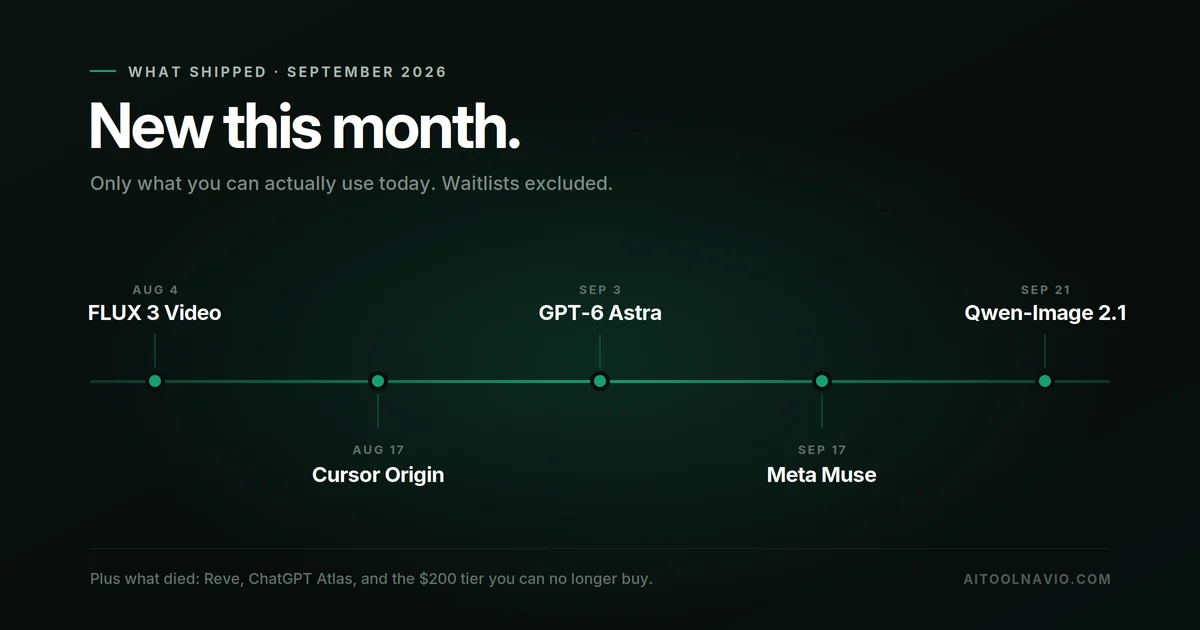
Roughly forty things launched in the last six weeks. You can actually use about a dozen of them.
The gap between those two numbers is what this roundup is for. A lot of what gets written up as a “launch” is a waitlist, a research announcement with no product, a US-only beta, or a feature locked behind a tier you’re not on. All of it generates headlines. None of it generates anything you can open tonight.
So: what shipped, what’s genuinely free, what died, and — the section nobody else writes — what you should ignore for now, and why.
The five that actually matter
1. Meta Muse — the best free thing this month
Launched 17–19 September. A personal agent for Mac and iPhone that acts inside your actual apps — files, Mail, Messages, Calendar, Notes — with per-resource permissions and a confirmation step before anything destructive.
Free, with roughly 100 million tokens a week. That’s not a demo allowance; that’s a real budget. It’s the most capable free tool to arrive in months, and it grew faster in its first two weeks than ChatGPT’s mobile app did.
Two caveats: it’s US-only at launch, and Amazon blocked it from Amazon.com on 20 September over how it handles credentials. Expect more of those blocks as agents start touching real accounts — it’s the defining friction of this product category right now.
2. GPT-6 “Astra” — the new reference point
Launched 3 September. OpenAI’s frontier model, and the thing everything else this month gets measured against. It reaches the free and Go tiers, so you can try it without paying.
The genuinely notable detail is in OpenAI’s own safety documentation: it’s the first model rated Critical for cybersecurity capability under their preparedness framework, alongside large improvements in prompt-injection robustness. Both facts belong in the same sentence — more capable, and more carefully fenced.
One practical note: demand was heavy enough that OpenAI paused new signups to its $200 Pro tier on 10 September, and it’s still paused. The $100 Pro tier remains open. If a guide tells you to buy the $200 plan, it’s out of date.
3. Qwen-Image 2.1 — the open-weight image model to beat
Released 21 September. A 7B model doing generation and editing in one, with native transparent-background output, local edits, composition from up to ten reference images, and 2K output. Downloadable and free to run.
Transparency in an open model is the real news — it’s the feature that turns generated images into something you can drop into a design file without cutting them out first.
Check the license before commercial use. It’s widely described as open source, but the actual terms aren’t clearly stated and at least one analysis suggests commercial restrictions. Fine for personal and experimental work today.
4. ElevenLabs Studio 4.0 — one timeline for AI video
Launched 21 September. An AI-native video editor where generation, voice (10,000+ voices, 32+ languages), music and sound effects live on a single timeline, with frame-accurate editing and an agent that produces a first cut for you to fix.
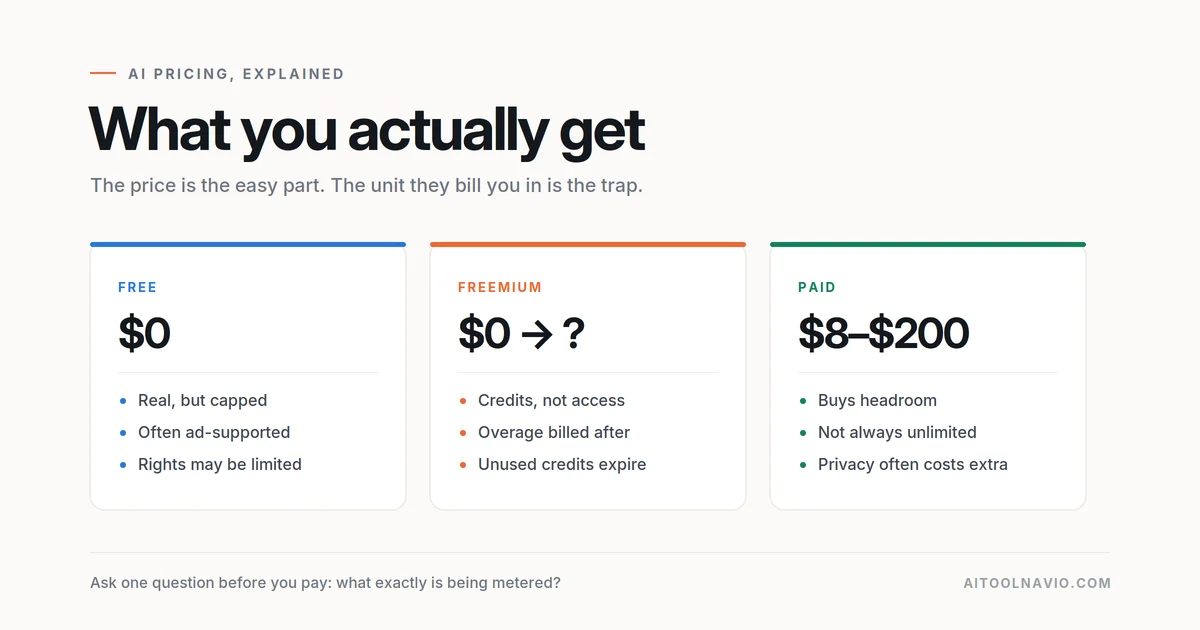
On free: 10,000 credits a month and no commercial license, so treat free as evaluation only. The real entry point is $6/month, which includes commercial rights — a low bar for what you get. ElevenLabs is already in the directory.
5. Cursor Origin — Git hosting built for agents
Announced 17 August. Cloud code hosting from the Cursor team, aimed squarely at GitHub and designed for repositories where most commits are agent-authored.
It’s an early beta with no published pricing, so this is one to watch rather than migrate to. But the premise is interesting: if agents write most of your commits, the review and hosting layer probably shouldn’t be designed around humans typing.
Also worth your time
- Gemini 3.8 Live (15 Sept) — two audio-to-audio models for voice agents, one of which reasons in the background mid-conversation. Free tier via Google AI Studio.
- Gemini 3.5 Transcribe (26 Aug) — dedicated speech-to-text across 85+ languages with speaker separation and custom vocabulary. Free tier available. Genuinely useful if you transcribe lectures or interviews.
- ChatGPT add-in for Microsoft Word (17 Sept) — available globally on all tiers including free. The least glamorous item here and possibly the most used.
- GPT Image 2.5 (8 Sept) — two image models, Flare for speed and Sunburst for editing precision. API only, around $0.036 an image at default quality.
- Lyria 3.5 (3 Sept) — full-length song generation with real duration control. Free via AI Studio.
- Runway plugins for Premiere Pro and After Effects (8 Sept) — Runway’s model set inside the editors people actually cut in. Paid plans only, but the most practically useful Runway release in a while.
- FLUX 3 Video (4 Aug) — up to 20 seconds at 720p native with native audio and dialogue. Usage-priced at about $0.17 a second.
- Grok 4.7 (21 Sept) — xAI’s new flagship, positioned at roughly half the price of comparable models.
- Claude Docs and Claude Slides (16 Sept) — Claude‘s chat and Cowork apps merged, with document and slide creation in beta. Pro and Max only.
Genuinely free, no asterisk
Filtering the whole month down to what costs nothing and isn’t crippled:
- Meta Muse — ~100M tokens/week, US only
- Qwen-Image 2.1 — open weights, run locally (check license for commercial work)
- Gemini 3.8 Live, 3.5 Transcribe, Lyria 3.5 — free tiers via Google AI Studio
- ChatGPT Word add-in — all tiers, including free
- DeepSeek V4.1-Flash and other open-weight drops — free to self-host
Everything else worth trying this month costs something, and the cheapest meaningful entry is ElevenLabs at $6.
What died this month
The section that’s more useful than the launches, because it tells you where the risk is.
- Reve — the image generator stopped accepting new work on 27 September; downloads remain available until 31 October. Its API shut down back in mid-August. If you have work there, export it now.
- ChatGPT Atlas — OpenAI’s macOS browser, killed on 9 August after roughly 292 days. Folded into a Chrome extension and the desktop app. The Windows, iOS and Android versions never shipped at all.
- ChatGPT Pro $200 — not dead, but you can’t buy it. New signups paused since 10 September.
- Model retirements: Imagen 4 endpoints closed 17 August, o3 left ChatGPT on 26 August, and the DALL·E GPT was retired on 30 August.
Four shutdowns in six weeks, including a browser that lasted under a year from a company with effectively unlimited money. Keep your prompts, your outputs and your data somewhere you control.
The business story: Stripe bought OpenRouter
16 August, for over $7 billion — a roughly fivefold step-up from OpenRouter’s valuation only months earlier. OpenRouter is the gateway a lot of developers use to route between models without rewriting code.
Why it matters beyond the headline: payments infrastructure buying model-routing infrastructure is a bet that agents will be paying for things, and that whoever sits between the model and the transaction owns a valuable position. Also in the window: Bending Spoons acquired Airtable for $1.285 billion.
Don’t bother yet
All of these were written up as launches. None is something you can go and use today.
- The UMG × ElevenLabs licensed music platform — announced 10 September and reported by several outlets as if it had shipped. ElevenLabs’ own post says it is “now in development.” No date, no waitlist, nothing to sign up for.
- OpenAI’s 1 August “Astra” research announcement — a research result about open maths problems, with no model and no availability. Easy to confuse with the 3 September GPT-6 Astra launch. They’re different things.
- Cursor Origin — early beta, no published pricing.
- Claude Projects (redesigned) — “select Pro and Max users” only.
- Claude Docs and Slides — beta, Pro and Max only.
- Kimi K2.8 — preview only.
- Runway Enhance Frame Rate — top-tier plans only, despite the coverage.
If you try one thing
Meta Muse, if you’re on a Mac in the US — it’s free, it’s genuinely new in kind rather than degree, and an agent with real permissions on your own machine is worth forming your own opinion about rather than reading someone else’s.
If you’re not, Gemini 3.5 Transcribe through AI Studio. Free, unglamorous, and it solves a problem you actually have.
Keep up
FAQ
What is the newest AI tool right now?
As of late September 2026, Qwen-Image 2.1 (21 September) and ElevenLabs Studio 4.0 (21 September) are the most recent significant releases. Meta Muse for Mac, from 17 September, is the most notable free launch.
What is GPT-6 Astra?
OpenAI’s frontier model, launched 3 September 2026. It reaches the free and Go tiers. It’s the first model OpenAI rated Critical for cybersecurity capability under its preparedness framework, alongside significant robustness improvements.
Why can’t I subscribe to ChatGPT Pro?
OpenAI paused new signups to the $200 Pro tier on 10 September 2026 because of demand following the Astra launch. The $100 Pro tier, Plus, Go, Business and Enterprise are unaffected.
Is Meta Muse free?
Yes — free to download with roughly 100 million tokens a week. It’s US-only at launch, and Amazon blocked it from Amazon.com on 20 September over credential handling.
What happened to Reve?
The image generator shut down. Its API ended in mid-August 2026, generation stopped on 27 September, and downloads remain available until 31 October. Export anything you need before then.
What’s the best free AI tool launched this month?
Meta Muse, if you’re on a Mac in the US. Otherwise Gemini 3.5 Transcribe via Google AI Studio, which is free and handles 85+ languages with speaker separation.
Liked this? We do one every Friday.
The week's new AI tools, what each one actually does, and the ones worth your time — written the same way as this post.
One email a week · unsubscribe in one click