The Best AI Tools for Lawyers and Legal Research in 2026
Every serious legal research platform now has AI in it, and 2,046 court cases now involve citations that don't exist. Both things are true. Here's how to use the first without joining the second.
Two things are true about legal AI in 2026, and most articles only tell you one of them.
The first: the tools have got genuinely good. Every major research platform now has AI built in, contract review inside Word actually works, and the best systems cite to primary sources you can click through and check.
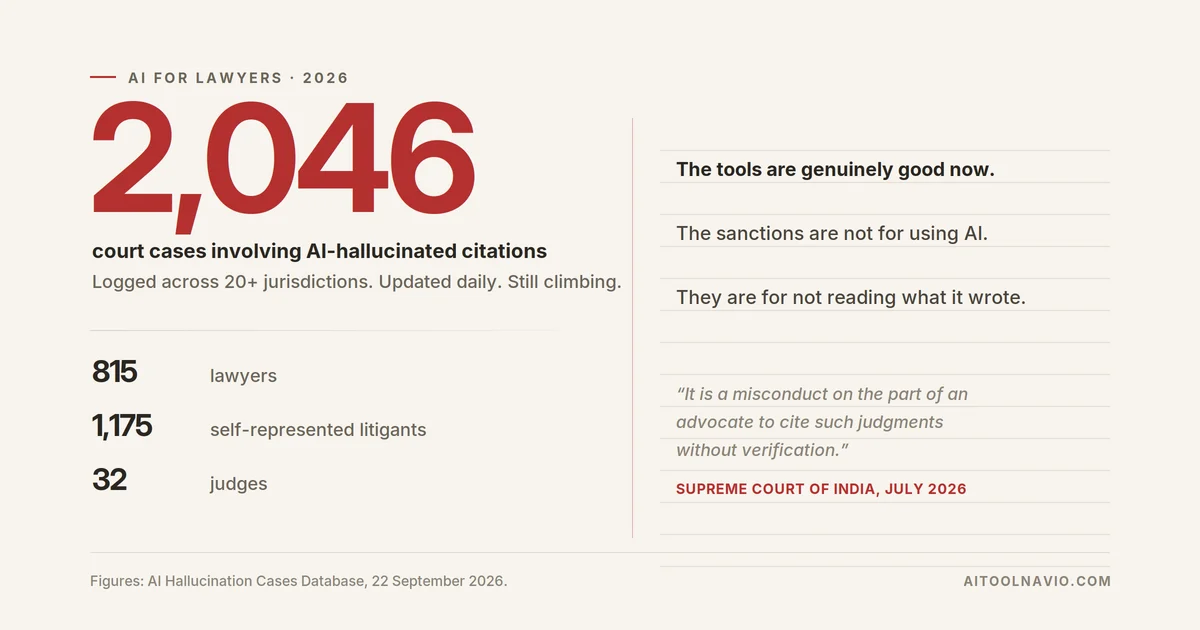
The second: 2,046 court cases worldwide now involve AI-fabricated citations, and the number climbs daily. Sanctions have moved from a telling-off to five-figure penalties, struck briefs and disciplinary referrals.
The connection between those two facts is not what people assume. Almost none of those 2,046 cases were caused by a tool failing. They were caused by somebody filing work they hadn’t read.
So this guide does both jobs: what to use, and how not to end up in the database.
This is an overview of tools and publicly reported cases, not legal advice. Your professional obligations come from your own bar or regulator, and you should read their guidance directly.
Start here: what the numbers actually say
The running tally is maintained publicly and updated daily. As of 22 September 2026 it holds 2,046 cases across more than twenty jurisdictions — the United States leads with 1,397, then Canada (218), Australia (112), Israel (57), Brazil (41), and India with 15.
The breakdown by who used the AI is the part nobody quotes:
- 1,175 — self-represented litigants
- 815 — lawyers
- 32 — judges
Two honest readings follow. The majority of incidents involve people without legal training, so “lawyers are recklessly using AI” overstates it. But 815 is still a lot of lawyers — and 32 judges is the genuinely alarming figure, because a hallucinated citation in a judgment propagates.
The defect is nearly always the same. Fabricated content in 1,693 cases. Misrepresented material in 856. False quotes in 549. And overwhelmingly it’s case law — 1,841 of them.
What the independent testing found
Here’s the part vendors don’t put in the brochure. When Stanford researchers audited the two biggest legal research AI products against 202 preregistered queries, they found Lexis+ AI hallucinated 17% of the time and Westlaw’s AI-Assisted Research 33% — this against marketing that had described “hallucination-free linked legal citations.”
Two caveats, both important. That testing ran in 2024, and every product named has been substantially rebuilt since. But — and this is the story — no equivalent independent audit of the 2026 products appears to exist. Vendors publish their own benchmarks; nobody neutral has checked. Treat every accuracy claim below as the vendor’s, not a finding.
Legal research platforms
The two incumbents
Thomson Reuters — CoCounsel Legal / Westlaw Advantage. The deepest integration with editorial content and KeyCite. Westlaw Advantage adds multi-step Deep Research producing a sourced report, and a Litigation Document Analyzer that flags mischaracterizations and hallucinated cases — including in your opponent’s brief, which is a genuinely clever inversion. Notably, Thomson Reuters rebuilt CoCounsel on Anthropic’s Claude. Pricing: quote only, on one-to-three-year terms.
LexisNexis — Lexis+ with Protégé. Reached general availability in February 2026, superseding Lexis+ AI. Over 300 prebuilt workflows, a no-code workflow builder, and outputs verified against Shepard’s. Runs models from Anthropic, Google and OpenAI. Pricing: quote only. If you’re reading older comparisons, “Lexis+ AI” is the previous generation.
The ones worth knowing about
vLex Vincent AI — the strongest jurisdictional coverage of any major platform, spanning 100+ jurisdictions with real depth outside the US. Beyond research it does litigation intelligence: profiling a judge, a firm, an opposing counsel. Clio acquired vLex for $1 billion in 2025, so expect tighter integration with practice management.
Bloomberg Law — the differentiator is citation design. Its AI answers carry discrete footnotes pointing at the specific text supporting each part of an answer, rather than a pile of sources at the end. That’s a meaningfully better shape for verification. And it’s included at no extra charge for existing subscribers, which makes it the only major platform not monetizing AI separately.
Midpage — builds its own primary-law database (14M+ opinions, 4M+ statutes and regulations) with on-demand PACER retrieval, so it can verify that a citation and quotation in a brief actually match the filed document. Its clever move is selling itself into general assistants — it runs as an integration inside Claude, ChatGPT and Perplexity rather than competing with them.
Paxton AI — $499/user/month, or $2,999/year, and it publishes that, which almost nobody in this category does. Aimed at small and mid-sized firms. It reports 94% on Stanford’s CaseHOLD benchmark — worth understanding that CaseHOLD measures case-holding classification, not hallucination rate. It’s a real result; it isn’t a safety score.
Alexi — litigation-focused research memos, drafting and document review. Quote-only.
Drafting, review and contracts
Harvey is the category leader by adoption — 1,300+ organizations across 60+ countries, most of the AmLaw 100, and a $11 billion valuation as of March 2026. It’s an agentic platform rather than a single tool, covering diligence, compliance, contract analysis and litigation workflows. Pricing is quote-only with a substantial seat minimum; this is not a solo-practitioner purchase.
For everyone who isn’t a large firm:
- Spellbook — contract drafting and review inside Microsoft Word, with playbook enforcement. Built for small and mid-sized firms, which is exactly the underserved segment.
- Definely — also lives in Word. Navigates defined terms and cross-references, detects errors, and traces the ripple effects of an edit through a document. Used by A&O Shearman, Slaughter and May, Dentons.
- Luminance — contract review, and distinctively, autonomous negotiation with explainability for each decision.
- LegalOn — review against prebuilt legal standards, for in-house teams.
- Ironclad — contract lifecycle management with AI layered on. A workflow system, not a research tool.
- Genie AI — the genuinely accessible one: self-serve pricing from around $75/month, templates plus AI drafting, with a free tier. For startups, SMEs and solos this is where to start.
One market signal worth registering: Harvey raised $200M at $11B in March 2026 while another well-funded contract-review company laid off around a third of its staff six months earlier. This category is consolidating sharply, not rising uniformly. Ask about a vendor’s funding position before you migrate your precedent bank into it.
India: the section most guides skip
If you practice in India, the international platforms above are largely irrelevant to your daily research. Here’s the domestic landscape.
SCC Online — the dominant Indian legal research database, roughly 150,000 users. SCC Online AI Pro entered preview in February 2026: a conversational research assistant across 4M+ judgments and 400+ databases. Institutional pricing, not published.
Manupatra — ManuWorks.ai now covers drafting, summarization, OCR, translation and document comparison, with AI Search and a Citation Verifier added in 2026. Given everything above, a built-in citation verifier is the feature to care about.
Indian Kanoon — 40M+ documents, and the core database is free, which makes it uniquely valuable to students, junior advocates and litigants. Its PRISM AI suite adds a cited research chatbot, document generation from 80+ templates, and argument tools.
CaseMine — AMICUS AI uses graph-based precedent and citation mapping across Indian and US case law. Strong for tracing how a proposition developed.
Lexlegis.ai — India’s first legal-specific LLM, trained on 10M+ Indian legal documents, offering cited case search and document analysis.
Adalat AI — courtroom speech-to-text and translation, deployed across 4,000+ Indian courts. The Kerala High Court made it mandatory in all district courts from 1 November 2025 — the first Indian state to mandate an AI tool across all trial courts.
Also running: SUVAS, which has translated 31,000+ Supreme Court judgments into regional languages, and SUPACE, a judges-only research aid.
Indian regulation — read this before you file anything
On 2 July 2026, in a matter where the NCLT had admitted an insolvency application relying on six citations — some wholly non-existent, others real cases with invented paragraphs, and none cited by either party — the Supreme Court of India set aside both the NCLT and NCLAT decisions.
The language is about as direct as apex courts get:
“It is a misconduct on the part of an advocate to cite such judgments without verification. Equally, it is a serious lapse if a judge relies on such fake or hallucinated AI-generated material as precedents.”
The Court declared “zero tolerance for the Bar as well as the Bench” and directed the Bar Council of India to constitute a committee to frame guiding principles and the disciplinary action that follows a breach.
Three practical consequences for Indian practitioners:
- India has gone further than any other apex court. Citing fabricated authority is characterized as misconduct, not error — which engages discipline, not just costs.
- The BCI rules don’t exist yet. As of today the Bar Council has issued no AI guidance for advocates. The Supreme Court has told it to. Until it does, you’re operating against a stated standard with no published procedure.
- Draft Regulations for Use of AI in Courts, 2026 are out for comment. Regulation 43 would require a declaration in any filing incorporating AI, plus reasonable diligence in verifying accuracy. AI must remain “strictly subservient to human judgment”; risk scoring and autonomous judicial decision-making would be absolutely prohibited.
Earlier Indian cases are instructive too: a Bombay High Court bench imposed ₹50,000 in costs in January 2026 for a fictitious citation, and the Bombay High Court quashed a ₹27.91 crore tax order in October 2025 where the officer had cited three non-existent decisions.
Using general assistants with client data
Claude, ChatGPT and Gemini are all now courting legal work directly, with legal-specific connectors, plugins and enterprise offerings. The capability is real. The confidentiality question is the one to get right.
The clearest illustration available: in the course of unrelated litigation, OpenAI was placed under a preservation order requiring it to retain consumer ChatGPT content indefinitely — including deleted conversations. It covered Free, Plus, Pro and Team, and exempted Enterprise, Edu and zero-data-retention API customers. That obligation ended in October 2025 and normal deletion resumed.
But the lesson survives the order: a consumer tier’s retention policy can be overridden by litigation you are not party to. If you’re putting privileged material into a tool, you want an enterprise agreement with zero data retention, not a $20 consumer subscription.
The professional guidance is aligned on this. ABA Formal Opinion 512 holds that a client’s informed consent is required before inputting information relating to the representation into a self-learning AI tool — and informed consent means explaining the specific risk, not a line in the engagement letter. The SRA requires “appropriate contractual, technical and organizational safeguards.” The Arkansas Supreme Court has warned that putting confidential information into public LLMs may breach professional obligations.
What the rules now require of you
ABA Formal Opinion 512 (July 2024) remains the controlling US guidance. Competence means a reasonable understanding of the tool’s capabilities and limits. Fees: bill for time reviewing AI output, but learning the tools is overhead, not billable. Supervisors must set policies and train staff.
California has proposed six AI-focused amendments to its Rules of Professional Conduct, including independent verification of all AI outputs with no carve-out for routine matters, and disclosure where AI use materially affects scope, cost or decision-making. Still in rulemaking.
Illinois took the opposite posture, stating AI use “may be expected, should not be discouraged,” and notably not requiring disclosure.
England and Wales: the SRA issued a warning notice on misuse of AI in August 2026 — “You remain accountable for all work and advice delivered to clients, whether or not AI has been used” — with explicit disciplinary exposure. The Bar Council updated its generative AI guidance in November 2025. And the Divisional Court established the rule that catches people out: a lawyer is not entitled to rely on their lay client for the accuracy of citations.
The five rules that keep you out of the database
- Read every case you cite. The whole case. In the leading California decision the attorney admitted he “did not read the ‘enhanced’ briefs before he filed them.” That is the entire failure mode, in one sentence.
- Verify in a citator, not in the AI. KeyCite, Shepard’s, Manupatra’s Citation Verifier. Asking the model whether its own citation is real is not verification.
- Check quotations against the source text, not just that the case exists. 549 logged cases involved false quotes from real decisions — a harder error to catch and just as sanctionable.
- Never rely on research handed to you by a client or a junior without checking it yourself. That’s now an established holding, not a courtesy.
- Know your court’s standing orders. A growing number of judges require disclosure of AI use; India’s draft regulations would require a declaration. Requirements vary by courtroom, not just jurisdiction.
One court put the standard plainly: citing even a single fake case can be sanctionable.
What to actually buy
| If you are… | Start with | Why |
|---|---|---|
| A large firm | Harvey, plus your existing Westlaw or Lexis AI tier | Scale, agents and procurement will decide it anyway |
| A small or mid-sized firm | Paxton AI or Spellbook | Published or accessible pricing, no enterprise floor |
| A solo or startup | Genie AI, plus Bloomberg Law if you already subscribe | The only self-serve options with free entry points |
| In-house | LegalOn or Luminance; Ironclad if the problem is workflow | Standards-based review beats general research |
| In India | SCC Online or Manupatra, plus Indian Kanoon | Domestic coverage the global platforms don’t have — and Indian Kanoon’s core is free |
| A student or pupil | Indian Kanoon, Semantic Scholar-style free research, and your institution’s database | Free, and you should learn to verify before you learn to delegate |
Explore the category
- Browse all legal AI tools in the directory
- India: SCC Online · Manupatra · Indian Kanoon · Lexlegis.ai · Adalat AI
- Listed here: Spellbook · Ironclad · Casetext
- Why almost no legal AI vendor publishes a price
- Compare two platforms side by side
FAQ
What is the best AI tool for legal research?
For large firms with budget, CoCounsel Legal or Lexis+ with Protégé. For small firms, Paxton AI publishes its price at $499/user/month. For non-US jurisdictions, vLex Vincent has the widest coverage. In India, SCC Online and Manupatra, with Indian Kanoon as a free complement.
Can lawyers use ChatGPT for legal work?
For general drafting and explanation, many do. For anything touching client confidences, guidance points to enterprise agreements with zero data retention rather than consumer tiers — ABA Opinion 512 requires a client’s informed consent before inputting information relating to the representation into a self-learning tool.
How many lawyers have been sanctioned for AI hallucinations?
As of 22 September 2026, 2,046 cases worldwide involve AI-fabricated citations, of which 815 involve lawyers, 1,175 self-represented litigants and 32 judges. Sanctions have ranged from costs orders to five-figure penalties, struck briefs and disciplinary referrals.
What are the rules on AI for advocates in India?
The Supreme Court held in July 2026 that citing AI-fabricated judgments without verification is misconduct, declared zero tolerance for both Bar and Bench, and directed the Bar Council of India to frame rules. The BCI has not yet issued them. Draft Regulations for Use of AI in Courts, 2026 would require a declaration in any filing incorporating AI.
Is there a free AI legal research tool?
Indian Kanoon’s core database of 40M+ Indian legal documents is free, with AI features on a premium tier. Genie AI offers a free tier for contract work. Most major platforms are quote-only with no free access.
Do AI legal tools still hallucinate?
Independent testing in 2024 found hallucination rates of 17% and 33% on the two leading platforms, against marketing that claimed otherwise. Those products have been rebuilt since, but no equivalent independent audit of the 2026 versions has been published — so verify citations yourself regardless of what a vendor claims.
Liked this? We do one every Friday.
The week's new AI tools, what each one actually does, and the ones worth your time — written the same way as this post.
One email a week · unsubscribe in one click