
Generate full songs with vocals, lyrics, and instrumentals from text prompts in minutes.

MIDIFLOW
FreeStarting price
0Popularity
About MIDIFLOW
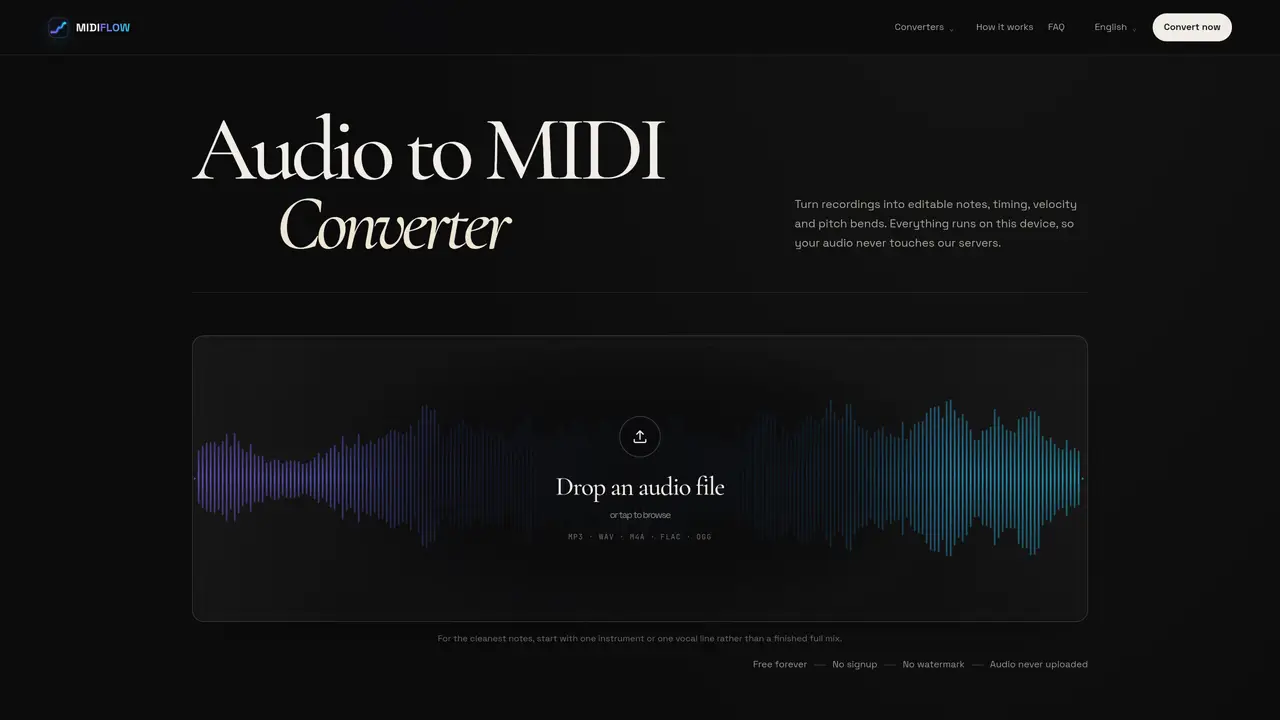
Converts audio recordings into editable MIDI data including note timing, velocity, and pitch bends. The tool processes files entirely on the user’s device without sending audio to external servers. Supported formats include MP3, WAV, M4A, FLAC, and OGG. It uses Spotify’s Basic Pitch model for transcription, which estimates note onsets, pitches, and contours locally in the browser. The output is a standard .mid file compatible with digital audio workstations like Ableton Live, Logic Pro, and FL Studio. Sensitivity controls allow adjustment to balance missed quiet notes against false positives. The tool is designed for musicians and producers who need to extract MIDI data from audio for editing or arrangement purposes.
Key features
- Local audio-to-MIDI conversion
- Supports MP3, WAV, M4A, FLAC, OGG formats
- Adjustable sensitivity for note detection
- Pitch, velocity, and timing extraction
- Browser-based processing
- Standard .mid file output
- Pitch bend detection
- No server uploads
Use cases
- Extracting MIDI from vocal recordings for editing
- Converting piano or guitar chords to MIDI for arrangement
- Transcribing solo instrument parts for further production
Pros
- Runs locally in the browser without uploading audio
- Supports multiple audio formats including MP3, WAV, M4A, FLAC, and OGG
- No account signup or watermark required
- Uses open-source transcription model (Basic Pitch)
- Outputs standard MIDI files compatible with DAWs
Cons
- Large files may exceed device memory limits
- Polyphonic material is less reliable than monophonic input
- No mobile app; requires browser access
- Transcription accuracy depends on source audio quality
Frequently asked questions about MIDIFLOW
Does MIDIFLOW upload my audio anywhere?
No. The recording is decoded and transcribed entirely within the user's browser. MIDIFLOW only downloads the transcription model and does not send the audio file to any external servers.
Which audio formats can I convert to MIDI?
The tool accepts MP3, WAV, M4A, FLAC, and OGG files. Browser codec support may vary, so standard formats like MP3 or WAV are recommended for reliability.
Can audio with chords become MIDI?
Yes, the tool supports polyphonic transcription. Clean piano or guitar chords can work, but dense arrangements are less reliable than a single melodic line.
Why did the converter add notes I cannot hear?
Strong harmonics, reverb tails, or overlapping instruments can be misinterpreted as separate pitches by the model. Adjusting sensitivity or using a cleaner solo track can help.
What information is included in the MIDI download?
The MIDI file includes detected note pitches, start times, durations, velocity, and pitch bends where they can be safely written without affecting overlapping notes.
Can I use MIDIFLOW without creating an account?
Yes. There is no requirement to sign up, pay, or provide personal information. Processing is done locally on the user's device without watermarks.