Generate speech with customizable voices in any language, and create captivating stories using natural-sounding voices.

IBM Watson Text To Speech
$1Starting price
0Popularity
About IBM Watson Text To Speech
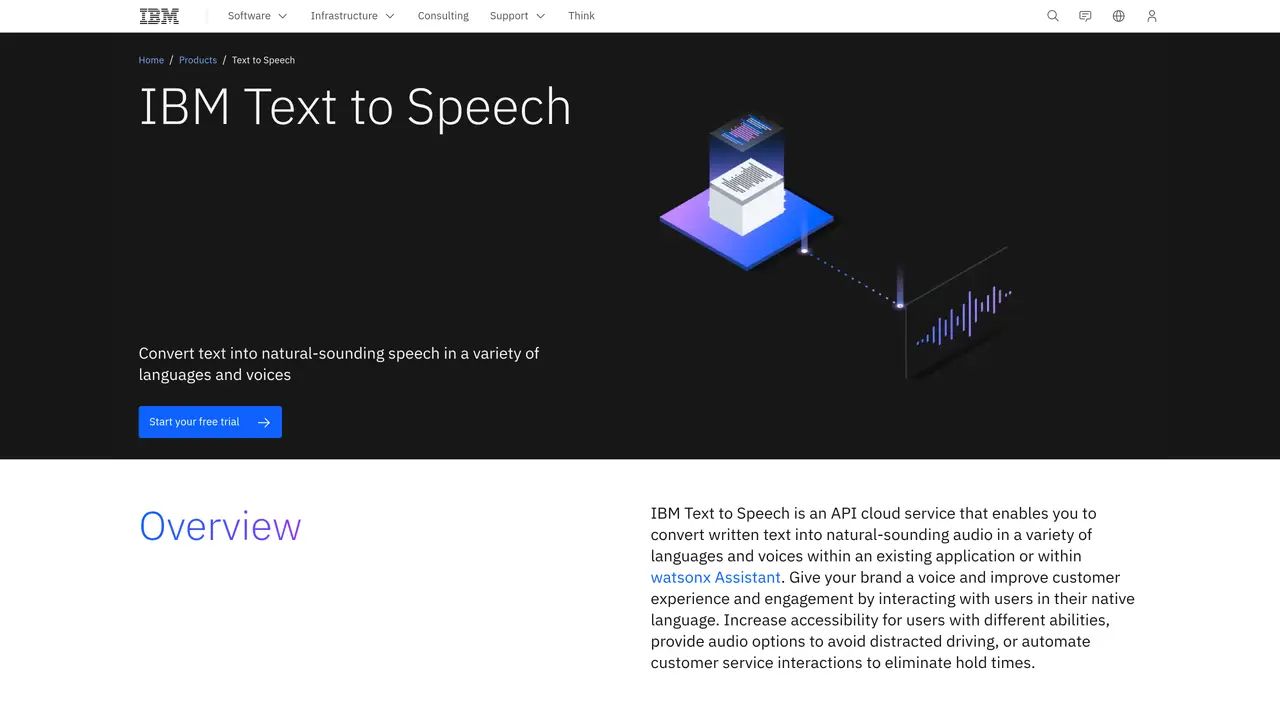
IBM Watson Text To Speech is an AI-powered service that quickly and easily converts written text into natural-sounding speech. This service allows you to create audio recordings of any document in a variety of languages and voices, making it ideal for use in business presentations, audio books, podcasts, and more. It features a wide variety of natural-sounding voices, including male and female voices, to give you the freedom to choose the perfect voice for your project. Additionally, it features real-time audio playback and a customizable interface that makes it easy to customize your recordings to suit your needs. With IBM Watson Text To Speech, you can create high-quality audio recordings quickly and easily, without any special technical skills. It’s the perfect solution for anyone who needs to create professional-sounding audio recordings quickly and with minimal effort.
IBM
Armonk, United States · Founded 1911
- Founders
- Charles Ranlett Flint, Thomas John Watson, Sr.
- Founded
- 1911
- Headquarters
- Armonk, United States
- Legal status
- Public company
Key features
- Converts written text into natural-sounding speech
- Supports multiple languages and voices
- Real-time audio playback
- Customizable interface
- No special technical skills required
- High-quality audio recordings
Use cases
- Create professional audio recordings for business presentations
- Generate audio books in multiple languages and voices
- Produce customized podcasts with real-time playback
Pros
- Converts written text into natural-sounding speech in multiple languages and voices
- Supports real-time speech synthesis with neural voices trained on human speech
- Offers custom voice creation for branded applications using minimal recordings
- Provides controllable speech attributes via Speech Synthesis Markup Language
- Includes enhanced security features with end-to-end data encryption
Cons
- Premium features, such as custom voices and high availability, require contacting sales for pricing
- Deploy Anywhere version may involve additional setup complexity for on-premises or hybrid deployments
Frequently asked questions about IBM Watson Text To Speech
What is IBM Watson Text to Speech?
IBM Watson Text to Speech is a cloud-based API service that converts written text into natural-sounding audio in multiple languages and voices. It can be integrated into applications or used with watsonx Assistant to enhance user interactions.
Who should use IBM Watson Text to Speech?
The tool suits businesses, developers, and organizations looking to improve accessibility, automate customer interactions, or create branded audio content. It is particularly useful for call centers, virtual assistants, and applications requiring multilingual support.
How does IBM Watson Text to Speech work?
The service uses deep neural networks to synthesize speech from text, offering customizable attributes like pitch, speed, and tone. It supports real-time synthesis and can be deployed on various cloud environments or on-premises.
What are the pricing models for IBM Watson Text to Speech?
IBM offers multiple pricing tiers, including a free Lite plan with limited characters, a Standard plan for businesses, and a Premium plan for large enterprises with custom voices and high availability. Deployment options like Deploy Anywhere are also available.
Can I customize the voices in IBM Watson Text to Speech?
Yes, the Premium tier allows creating custom-branded neural voices using as little as one hour of recordings. Users can also adjust speech attributes like pronunciation, volume, and expressiveness using Speech Synthesis Markup Language.
What integrations does IBM Watson Text to Speech support?
The service integrates with watsonx Assistant for voice-enabled chatbots and can be deployed on IBM Cloud Pak for Data for on-premises or hybrid cloud environments. It also supports SDKs for developers to build custom applications.