

Revolutionize transcription with unmatched accuracy, speed, and language support.
27M visits/mo+0.9%#4 Audio & Voice
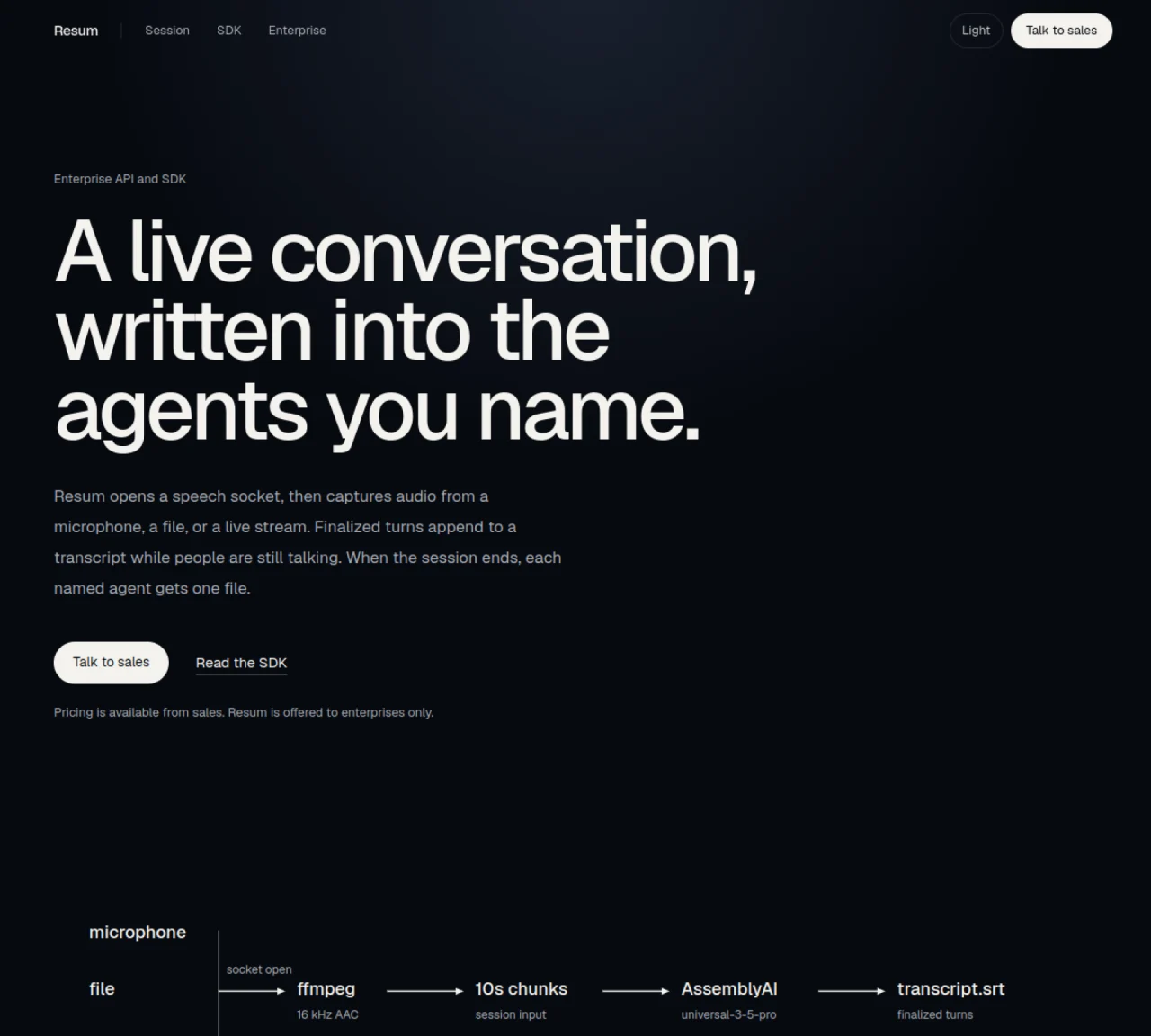
Resum provides an API and SDK for capturing live conversations and processing them with named agents. It opens a speech socket that captures audio from a microphone, file, or live stream. The system saves AAC audio bytes and appends finalized turns to a transcript while the session is active. Once the session ends, each named agent generates a file containing notes, summaries, or other structured outputs. The session follows a fixed workflow: opening a socket, capturing audio, processing turns, and writing agent files after termination. The terminal runner and API share this workflow, with control handled via commands or time limits. Audio is streamed in ten-second chunks at 16 kHz mono, and agent files are written using GPT-4o-mini after the session concludes. The tool requires specific API keys for operation and agent processing but does not log secret values.
Resum provides an API and SDK for capturing live conversations and processing them with named agents. It opens a speech socket to capture audio from a microphone, file, or live stream, saves the audio, and generates structured outputs like notes or summaries once the session ends.
Resum is designed for enterprises that need to process live conversations in real time. It is not available for self-serve purchase and requires an agreement with Viroke Technologies Inc.
Resum streams audio in ten-second chunks at 16 kHz mono. The audio is saved as AAC bytes and sent to AssemblyAI for transcription, while finalized turns are appended to a transcript in real time.
Once the session ends, each named agent generates a file containing structured outputs such as notes or summaries. These files are written using GPT-4o-mini and include details like excerpts, action items, or full summaries.
Resum requires a STT_KEY to open and run a live session. An OPENAI_API_KEY is needed only when agent files are written after the session concludes. Secret values are not logged.
To get started, contact Viroke Technologies Inc for an enterprise agreement. The SDK can then be used to open a session, capture audio, and generate agent files after the session ends.
We use essential cookies to run aitoolnavio™, and optional cookies to analyze traffic and measure our marketing. You choose what we use — optional cookies stay off unless you turn them on. See our Privacy Policy.
One short email a week: fresh tools worth trying, honest takes and the updates that actually matter. No spam, unsubscribe any time.
Revolutionize transcription with unmatched accuracy, speed, and language support.
Hardware device that records conversations and converts them into searchable transcripts, summaries, and notes.
Automate transcription, generate summaries, identify speakers, and timestamps for video-conferencing conversations.
NoteGPT – Convert Speech to Text and Text to Speech with AI
Automatically record, transcribe, take notes, and create summaries with key insights during meetings.
Transforms audio/video to summarized text, instantly, across platforms.
Transcribe and summarize audio or video recordings with AI-powered speech recognition and summarization.
Automatically transcribe meetings, create summaries, and securely store audio files in a searchable format.
Convert audio and video into text, sync transcripts with media, and edit easily.
Streamline healthcare admin tasks, and enhance patient focus with Heidi AI.
Create transcripts of meetings, voice-overs for videos, and transcribe and review customer feedback efficiently.
Wearable AI device that captures conversations and meetings, then auto-generates transcripts, summaries, action items, mind maps, and searchable notes.
Matched on what this tool does — grouped by the job you would be replacing.
matches Live audio capture from microphone, file, or RTMP stream · Real-time transcript generation with finalized turns · Named agent processing (notes, summary, etc.)
A wearable AI that captures conversations in real time, transcribes them, and turns discussions into summaries, reminders, and calendar actions.
Cloud-hosted agent harnesses exposed via a single HTTP endpoint