
OpenAI builds and deploys advanced AI models like GPT-4o for autonomous agents and workflows.

epho
0Popularity
About epho
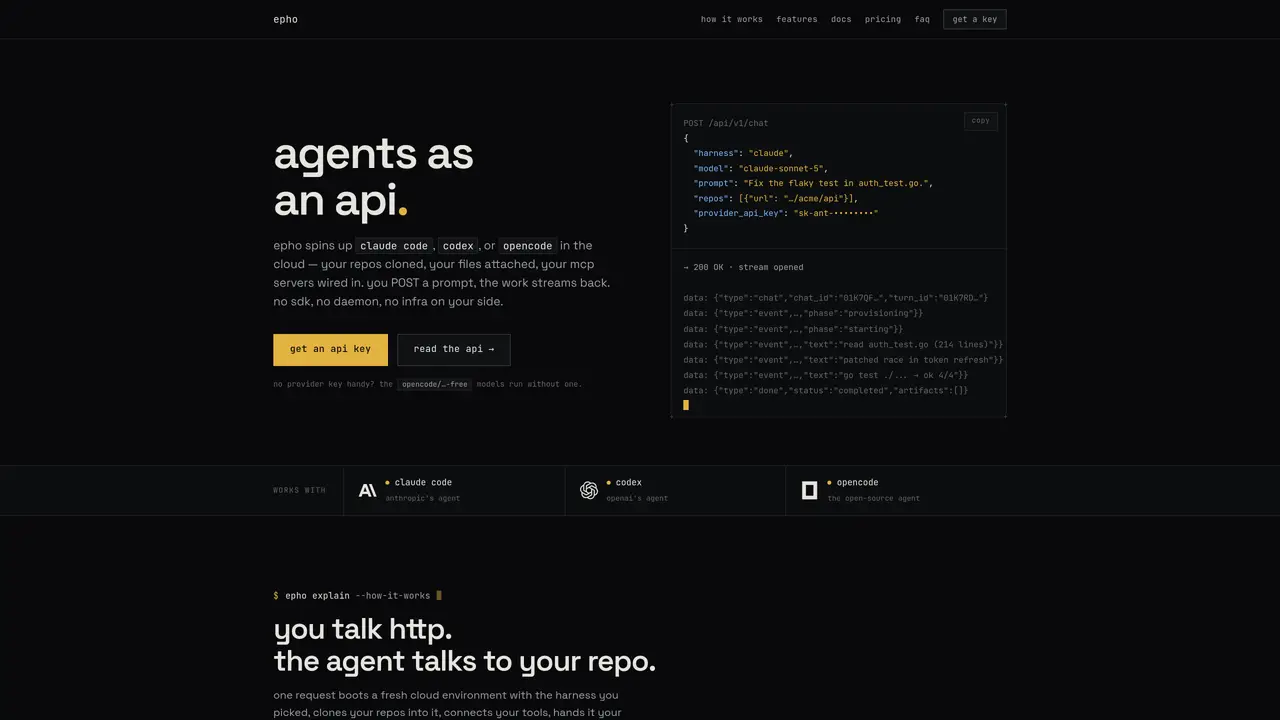
epho provides a cloud-based API that spins up agent harnesses such as Claude Code, Codex, or OpenCode in isolated sandboxes. A single POST request to /api/v1/chat boots a fresh environment, clones specified repositories, attaches input files and MCP servers, and streams back the agent’s work in real time. The service supports both synchronous streaming and asynchronous execution via /chat/async, returning durable chat IDs that can resume later with the same sandbox state. Configuration is passed in the request body, including harness choice, model, provider API key, repositories with optional tokens, input files, MCP servers, environment variables, and system prompts. Agents can run multi-turn conversations where each turn inherits the previous sandbox state, allowing incremental changes without restarting. The API accepts standard JSON and returns server-sent events containing tokens, tool calls, diffs, and final artifacts.
Key features
- POST /api/v1/chat endpoint for synchronous streaming
- POST /api/v1/chat/async for asynchronous execution
- Multi-turn chat with durable chat_id and turn_id
- Support for private repositories with authentication tokens
- MCP server integration via command or URL
- Environment variables and system prompt configuration
- Real-time streaming via text/event-stream
- OpenCode free models available without provider API key
Use cases
- Automated code review and flaky test fixes in CI pipelines
- Incremental feature development with multi-turn agent sessions
- Repository analysis using attached input files and MCP tools
Pros
- Single HTTP endpoint with no SDK or daemon required
- Supports multiple agent harnesses (Claude Code, Codex, OpenCode) with one request shape
- Streams real-time output including tool calls and edits
- Durable multi-turn conversations with persistent sandbox state
- Works with private repositories via tokens and supports MCP server integration
Cons
- Requires provider API keys for most models except OpenCode free tier
- No free tier or open-source version mentioned
- Limited to cloud-based execution (no local option)
- Maximum 32 repositories and 20 input files per request
Frequently asked questions about epho
What is epho and how does it work?
epho provides a cloud-based API that spins up agent harnesses such as Claude Code, Codex, or OpenCode in isolated sandboxes. Users send a single POST request to /api/v1/chat, which boots a fresh environment, clones specified repositories, attaches input files and MCP servers, and streams back the agent’s work in real time.
Who is epho designed for?
epho is designed for developers and teams who need to automate agent-based tasks such as code generation, testing, or file processing without managing infrastructure. It suits workflows requiring isolated, reproducible environments for AI agents.
Does epho require a provider API key?
No, epho does not always require a provider API key. Free models like OpenCode variants can run without one, though paid models may require a key to be provided in the request.
Can I resume an agent session later?
Yes, epho supports multi-turn conversations where each turn inherits the previous sandbox state. Sessions can be resumed later using the durable chat ID returned by the API.
What integrations does epho support?
epho supports integrations with repositories (via Git URLs and tokens), input files (uploaded or referenced by URL), and MCP servers (local commands or remote URLs). Environment variables and system prompts can also be configured.
How do I get started with epho?
To get started, obtain an API key from epho, then send a POST request to /api/v1/chat with a JSON body specifying the harness, model, prompt, repositories, and other optional configurations. The API streams results in real time.