
Revolutionize transcription with unmatched accuracy, speed, and language support.

VALSEA
$20/moStarting price
34KMonthly visits
26Popularity
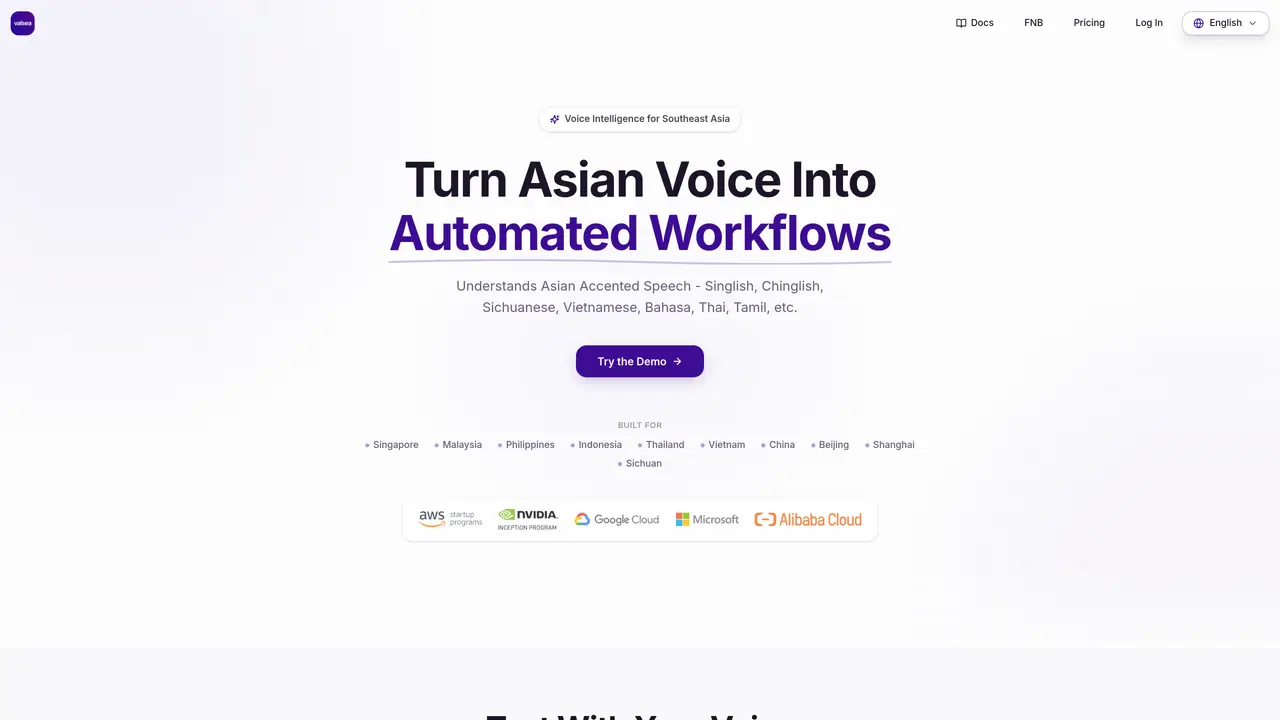
About VALSEA
VALSEA provides speech-to-text transcription and semantic analysis tailored for Southeast Asian accents and languages. It supports seven Southeast Asian languages including Singlish, Malay, Indonesian, Thai, Vietnamese, Filipino, and Tamil, as well as Mandarin, Cantonese, Korean, Japanese, and Hindi. The platform processes audio input in real time or from uploaded files, converting speech into structured data with semantic tags, intent detection, and sentiment analysis. It is designed to handle code-switching between languages and local expressions, converting them into natural, fluent English or maintaining the original language structure. The system includes workflow triggers that automate actions based on extracted meaning, such as creating support tickets, assigning tasks, or generating meeting notes. It is used in customer support, sales, service, and subtitling contexts to improve response accuracy and efficiency.
Key features
- Real-time speech-to-text transcription
- Semantic tagging and intent detection
- Sentiment analysis
- Entity and keyword extraction
- Code-switching support
- Workflow automation triggers
- Upload file or record audio input
- Multi-language support (12 languages)
Use cases
- Customer support automation for voice notes and complaints
- Meeting transcription with action item extraction
- Sales call analysis for objection handling and sentiment tracking
Pros
- Supports seven Southeast Asian languages plus major East Asian languages
- Real-time transcription with low latency (50-200ms ASR latency)
- Semantic analysis including intent, sentiment, and entity extraction
- Workflow triggers for automated actions based on speech content
- Handles code-switching and local expressions in speech
Cons
- Limited to Asian language support
- API access not yet available
- No explicit mention of free tier or pricing details
Frequently asked questions about VALSEA
What languages and accents does VALSEA support?
VALSEA supports 181 languages, dialects, and accents, with deep regional coverage including Southeast Asian languages like Singlish, Malay, Indonesian, Thai, Vietnamese, Filipino, and Tamil, as well as Mandarin, Cantonese, Korean, Japanese, and Hindi.
How does VALSEA handle code-switching between languages?
VALSEA detects and processes code-switching in real time, normalizing mixed-language conversations into structured data with semantic tags, intent detection, and sentiment analysis while maintaining natural fluency.
Can VALSEA integrate with existing workflows or applications?
Yes, VALSEA provides a single API that can be integrated into custom applications, contact centers, meeting flows, or internal workflows, allowing users to build and automate speech-driven processes.
What types of audio input does VALSEA process?
VALSEA processes audio input in real time or from uploaded files, offering both real-time transcription and batch transcription capabilities for various use cases.
What kind of semantic analysis does VALSEA provide?
Beyond transcription, VALSEA extracts meaning, intent, and entities from speech, normalizing slang, names, and context to deliver usable speech intelligence for downstream workflows.
Is there a way to test VALSEA before integrating it?
Yes, VALSEA offers a translator tool that allows users to test its capabilities for free, after which they can start building with the API for further integration.
VALSEA Website Engagement
Last Update: 9 days ago
Total Monthly Visits
0
Bounce Rate
0%
Visit Duration (avg)
0.00s
Pages Per Visit
0
Country Rank
0
Indonesia
Global Rank
0
Monthly Traffic
Traffic Sources
Traffic Share By Country
- Singapore58.6%
- India35.8%
- United States5.7%