
Generate speech with customizable voices in any language, and create captivating stories using natural-sounding voices.

OpenVoice
$0.03Starting price
0Popularity
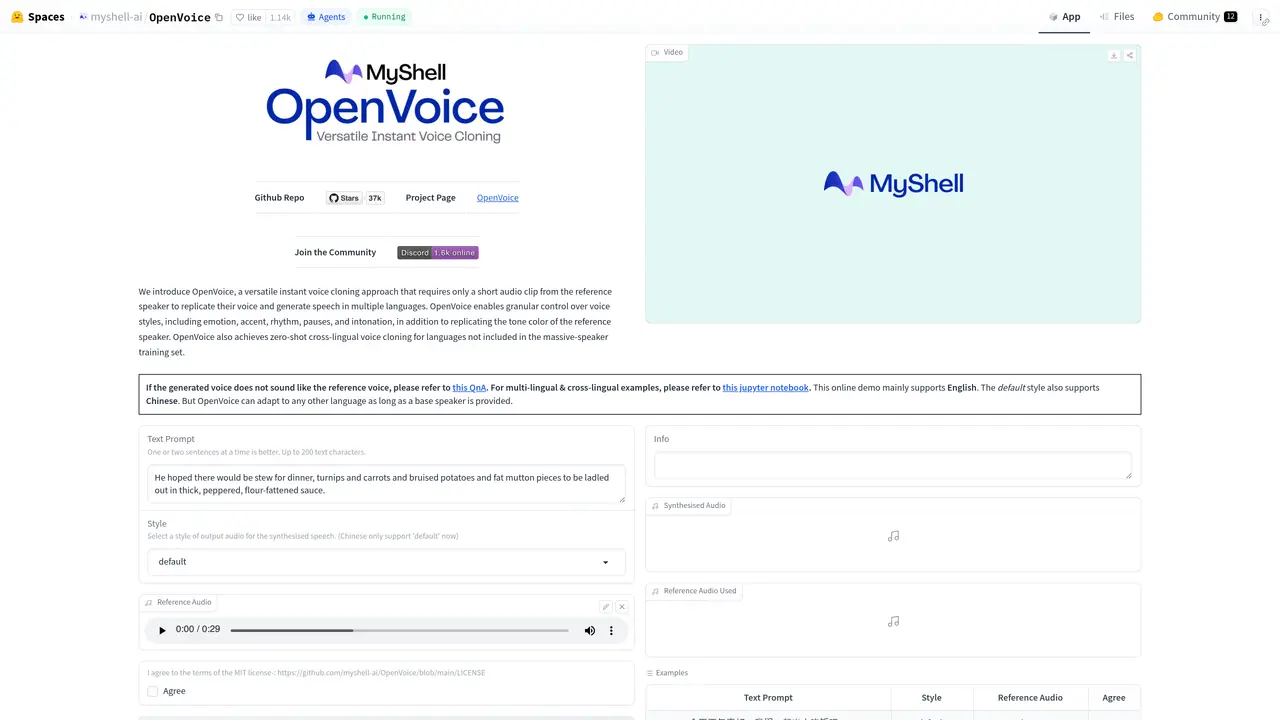
About OpenVoice
OpenVoice is an advanced instant voice cloning tool that replicates a speaker’s voice using only a short audio clip. It provides versatile control over voice styles, including emotion, accent, rhythm, pauses, and intonation, while accurately cloning tone color. The tool supports speech generation in multiple languages and accents, and uniquely achieves zero-shot cross-lingual voice cloning for languages not included in its training set. OpenVoice is designed to be computationally efficient, offering cost savings compared to other APIs with inferior performance. Its flexibility allows for precise voice style control, enabling users to showcase emotions and accents effectively. This makes it a comprehensive and accessible solution for voice cloning across diverse linguistic and stylistic parameters. Whether for professional or creative applications, OpenVoice delivers accurate and adaptable voice replication with minimal input.
Key features
- Instant voice cloning from a short audio clip
- Versatile style control (emotion, accent, rhythm, pauses, intonation)
- Accurate tone color replication
- Multilingual and multi-accent speech generation
- Zero-shot cross-lingual voice cloning
- Computationally efficient with cost savings
- Precise voice style customization
- Accessible and flexible for diverse applications
Use cases
- Creating natural-sounding voiceovers for media and entertainment
- Developing personalized AI assistants with cloned voices
- Enhancing accessibility tools with multilingual voice synthesis
Pros
- Enables instant voice cloning with minimal audio input
- Supports versatile voice style control including emotion, accent, rhythm, pauses, and intonation
- Achieves zero-shot cross-lingual voice cloning for languages not in training data
- Provides computationally efficient voice cloning with cost savings compared to other APIs
- Delivers accurate tone color replication and adaptable voice output
Cons
- May require high-quality audio input for optimal cloning results
- Cross-lingual cloning performance depends on language similarity and available data
- Limited transparency on computational resource requirements for local deployment
Frequently asked questions about OpenVoice
What is OpenVoice and what does it do?
OpenVoice is an instant voice cloning tool that replicates a speaker’s voice using only a short audio clip. It allows precise control over voice styles such as emotion, accent, rhythm, pauses, and intonation while maintaining accurate tone color replication.
Who is OpenVoice designed for?
OpenVoice is designed for creators, developers, and professionals who need accurate and adaptable voice replication for applications such as content creation, voiceovers, or multilingual speech generation.
Does OpenVoice support multiple languages and accents?
Yes, OpenVoice supports speech generation in multiple languages and accents, including zero-shot cross-lingual voice cloning for languages not included in its training set.
How do I get started with OpenVoice?
OpenVoice is available as a Hugging Face Space where users can interact with the tool directly in a browser-based interface. No installation is required to begin experimenting with voice cloning.
Can OpenVoice be integrated into other applications?
OpenVoice is accessible via its Hugging Face Space, which suggests it can be integrated into workflows that support Hugging Face Spaces or API-based interactions.
What are the main limitations of OpenVoice?
The quality of voice cloning depends on the input audio quality, and cross-lingual performance varies by language. Additionally, local deployment may require significant computational resources.