
OpenAI builds and deploys advanced AI models like GPT-4o for autonomous agents and workflows.

Agent Event Protocol
0Popularity
About Agent Event Protocol
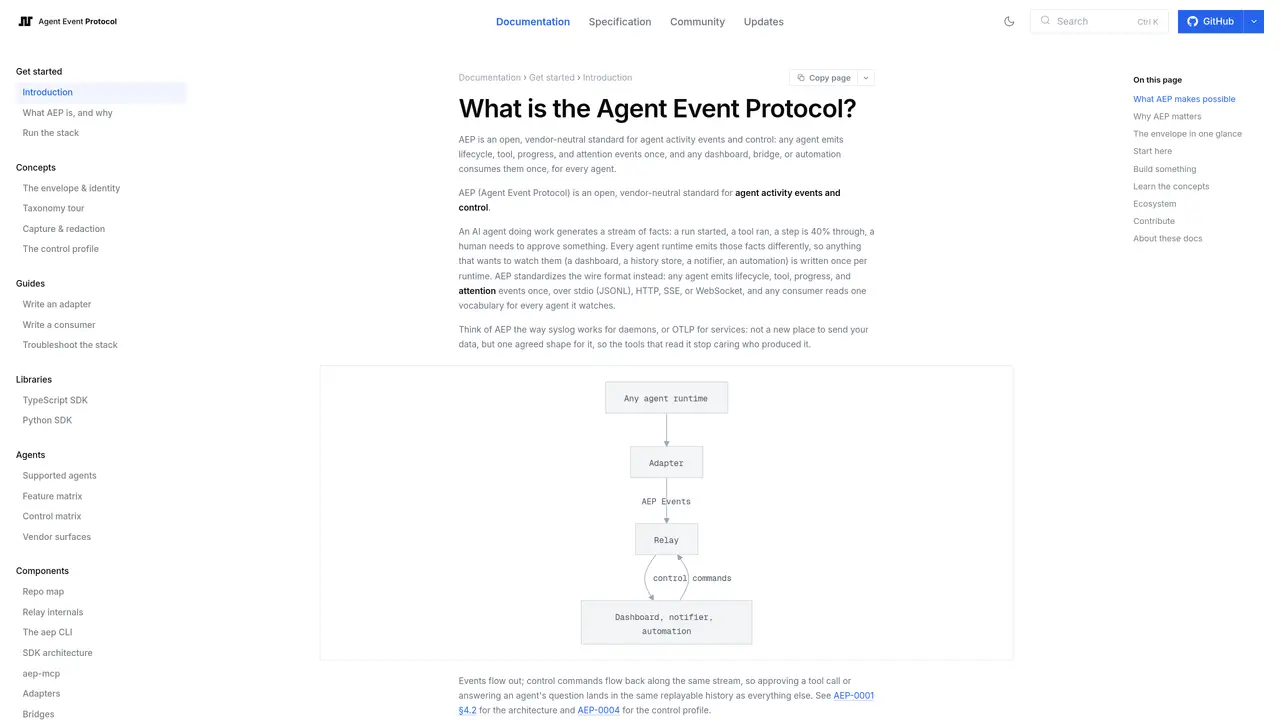
Agent Event Protocol (AEP) is an open, vendor-neutral standard designed to standardize how AI agent activity events and control commands are emitted and consumed. It provides a single vocabulary for lifecycle, tool, progress, and attention events, allowing any agent runtime to emit these events once while enabling dashboards, bridges, or automation tools to consume them uniformly. Events are transmitted via stdio (JSONL), HTTP, SSE, or WebSocket, and include structured metadata such as session, epoch, sequence numbers, and capture levels to support ordering, replay, and audit trails. Control commands flow back along the same stream, enabling actions like approvals or pauses to be logged within the same event history. AEP bridges existing telemetry standards like CloudEvents and OTLP, allowing adoption without requiring a second instrumentation pass. The protocol is intended for agent authors, consumer authors, fleet observers, and security teams who need consistent event handling across diverse agent runtimes.
Key features
- Lifecycle event emission (start, stop, progress)
- Tool execution event tracking with status and duration
- Progress and attention events for human-in-the-loop workflows
- Control command integration for approvals and cancellations
- Structured JSON envelope with 16 context attributes
- Session, epoch, and sequence-based replay capability
- Capture level control for event content filtering
- Reference stack with adapters, bridges, and CLI tools
Use cases
- Unifying event streams from multiple agent runtimes for centralized monitoring
- Enabling human approval workflows through attention.requested events
- Building audit trails for agent actions and control commands
Pros
- Standardizes agent event formats across different runtimes
- Supports multiple transport protocols (stdio, HTTP, SSE, WebSocket)
- Includes built-in control command flow for audit logging
- Provides structured metadata for ordering, replay, and capture levels
- Offers bridges to existing telemetry standards (CloudEvents, OTLP)
Cons
- Pre-release status with specifications at v0.1
- No published identifiers in public registries yet
- Requires implementation of adapters for new agent runtimes
Frequently asked questions about Agent Event Protocol
What is the Agent Event Protocol (AEP)?
The Agent Event Protocol is an open, vendor-neutral standard designed to standardize how AI agent activity events and control commands are emitted and consumed across different runtimes. It provides a single vocabulary for lifecycle, tool, progress, and attention events, enabling consistent event handling and control interactions.
Who should use AEP?
AEP is intended for agent authors, consumer authors, fleet observers, and security teams who need consistent event handling and control across diverse agent runtimes. It benefits anyone managing multiple agent systems or requiring unified telemetry and audit trails.
How does AEP work with existing telemetry standards?
AEP bridges existing telemetry standards like CloudEvents and OTLP through normative mappings, allowing adoption without requiring a second instrumentation pass. This means events can be consumed by existing pipelines without additional setup.
What transport protocols does AEP support?
AEP supports multiple transport protocols for event transmission, including stdio (JSONL), HTTP, Server-Sent Events (SSE), and WebSocket. Control commands flow back along the same stream, enabling bidirectional communication.
Can AEP handle control commands like approvals or pauses?
Yes, AEP includes a control profile that allows control commands such as approvals, pauses, or cancellations to be sent and logged within the same event stream. This ensures all actions are part of the audit trail.
How does AEP support replay and ordering of events?
AEP uses structured metadata such as session, epoch, sequence numbers, and capture levels to support ordering, replay, and audit trails. Events can be resumed from a specific point using epoch and sequence numbers, ensuring no data loss.