
OpenAI builds and deploys advanced AI models like GPT-4o for autonomous agents and workflows.

AI Rule Engine
$49Starting price
885Monthly visits
0Popularity
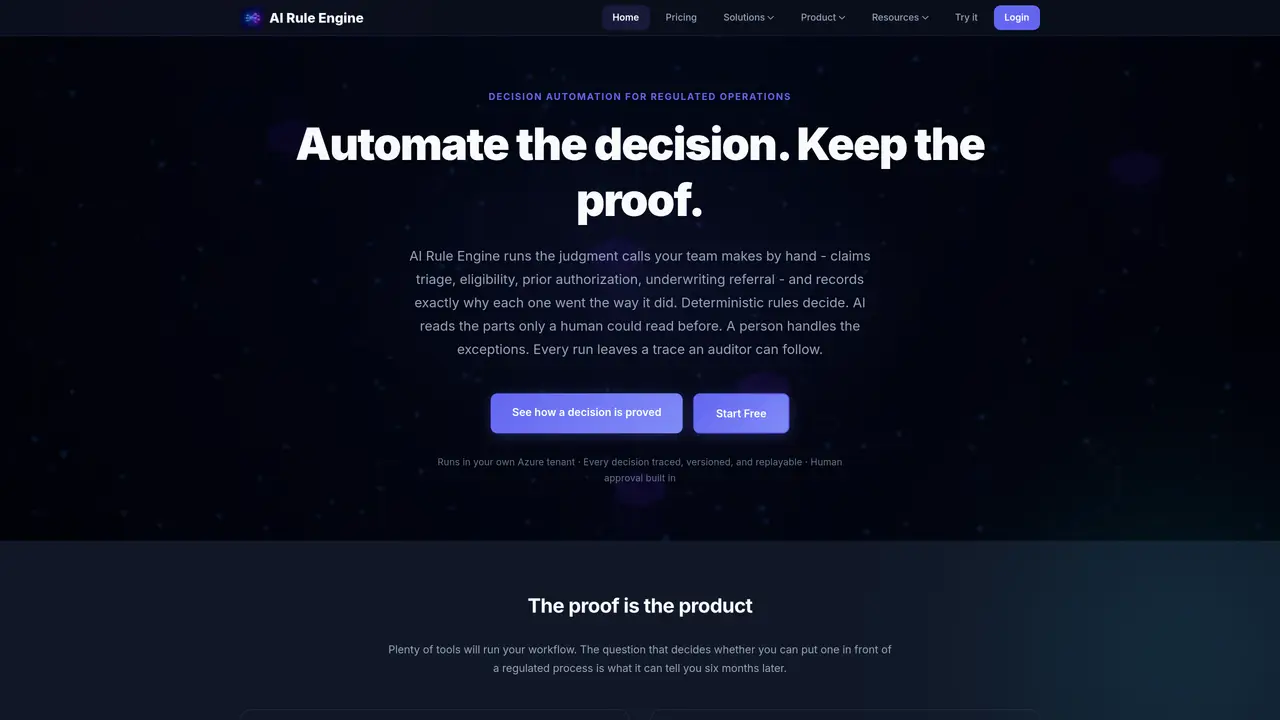
About AI Rule Engine
AI Rule Engine automates judgment-based decisions such as claims triage, eligibility, prior authorization, and underwriting referrals while preserving a detailed, replayable record of each decision’s reasoning. The system combines deterministic rules with AI for unstructured data processing, ensuring consistent outcomes without replacing human oversight for exceptions. Every decision is traced, versioned, and verifiable, with static checks preventing conflicts and stale conclusions. Rules are authored in human-readable formats like decision tables, enabling policy owners to maintain logic without coding. Deployments run within the user’s Azure tenant, keeping data, prompts, and execution history within the organization’s compliance boundary. The platform supports multiple AI models from providers such as Anthropic, OpenAI, Azure OpenAI, Google Gemini, and xAI, with integration options for SSO, SCIM provisioning, and SIEM streaming. Static verification flags issues like unreachable rules or conflicting conditions, while test cases run automatically on changes to ensure reliability.
Key features
- Automated decision execution with deterministic rules
- Unstructured data processing via AI models
- Static rule verification and conflict detection
- Human approval workflows for exceptions
- Versioned and replayable decision records
- SSO and SCIM provisioning for identity management
- SIEM-compatible audit trail export
- Signed records for verifiable proof
Use cases
- Claims triage and routing in insurance operations
- Eligibility and benefit determination for health plans
- Prior authorization review with clinician routing
Pros
- Maintains auditable, replayable decision trails for regulatory compliance
- Supports human-readable rule authoring without requiring code
- Deploys within user’s Azure tenant to keep data and prompts internal
- Static verification prevents conflicts and unreachable rules
- Supports multiple AI models from major providers
Cons
- No SOC 2 attestation or third-party penetration testing currently available
- Enterprise plan required for dedicated Azure hosts
- File storage not included in free tier
Frequently asked questions about AI Rule Engine
What does AI Rule Engine do?
AI Rule Engine automates judgment-based decisions such as claims triage, eligibility, prior authorization, and underwriting referrals while maintaining a detailed, replayable record of each decision’s reasoning.
Who is AI Rule Engine designed for?
The tool is designed for regulated industries, particularly insurance and healthcare operations, where consistent, auditable decision-making is required.
How does AI Rule Engine ensure compliance and security?
It runs within the user’s Azure tenant, keeping data, prompts, and execution history within the organization’s compliance boundary, with SSO, SCIM provisioning, and SIEM streaming support.
Can AI Rule Engine integrate with different AI models?
Yes, it supports multiple AI models from providers such as Anthropic, OpenAI, Azure OpenAI, Google Gemini, and xAI, with the ability to choose the model per step.
How are rules authored and maintained in AI Rule Engine?
Rules are authored in human-readable formats like decision tables, enabling policy owners to maintain logic without coding, with approval gating for publishing.
What happens if a fact behind a decision changes?
When a fact changes, the conclusion retracts rather than going stale, preventing indefensible automated decisions.
AI Rule Engine Website Engagement
Last Update: 9 days ago
Total Monthly Visits
0
Bounce Rate
0%
Visit Duration (avg)
—
Pages Per Visit
0
Country Rank
—
Unknown
Global Rank
0