
Frontier-grade Claude models with agentic workflows, strong coding, and enterprise guardrails delivered via developer console, web app, and cloud partners.

Guardrail Technologies
$11.40/mStarting price
0Popularity
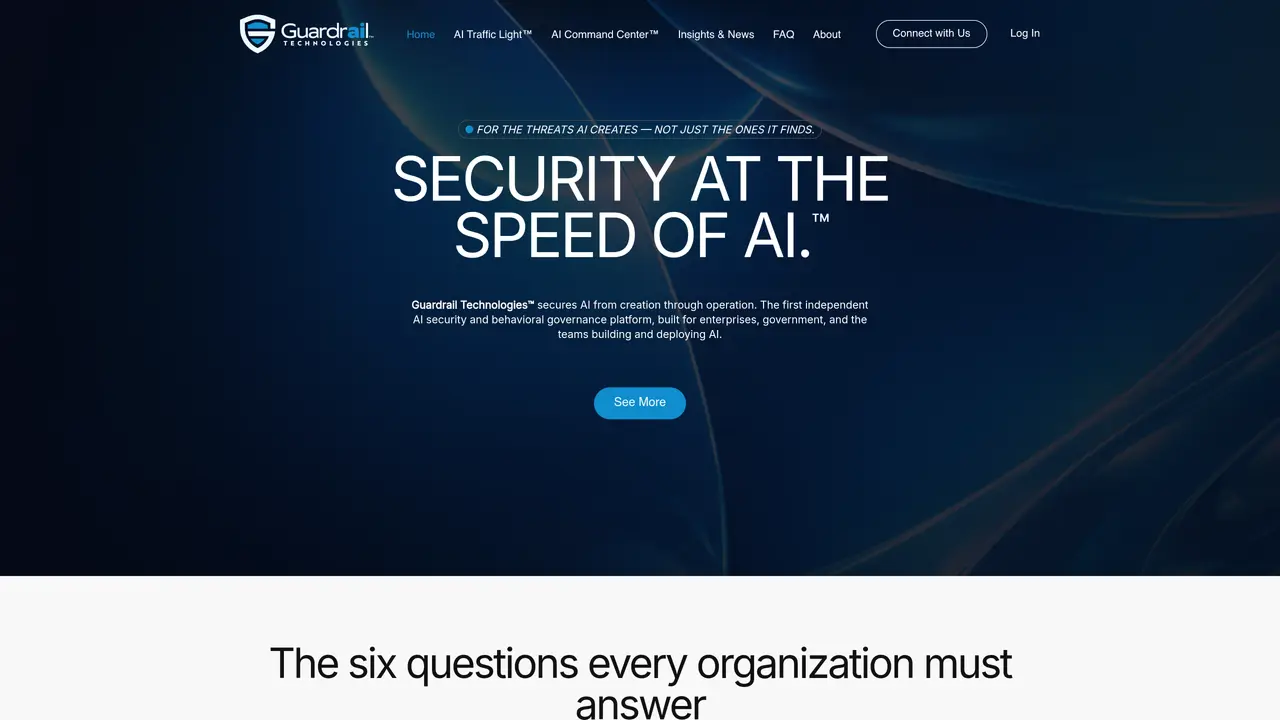
About Guardrail Technologies
Guardrail Technologies delivers an enterprise-grade control and security layer around generative and agentic AI. Rather than replacing models, it wraps AI-powered workflows in privacy, policy, and governance, deciding what data models can see, store, and reveal. Its modular engine and Trust Layer concept are built for organizations that want to lean into AI while keeping sensitive information protected, usage compliant, and technology choices fully under their own control. Key Features: AI Control Panel and Trust Layer: Centralizes configuration of models, prompts, data sources, and agents in one workspace, sitting between users and underlying LLMs so teams can enforce consistent policies across many tools. Context-preserving data masking: Replaces sensitive inputs with safe, context-aware aliases instead of blunt redaction, so models still get useful signal while actual identifiers, secrets, and IP stay in the customer’s domain. Authorized roles can later unmask values when permitted. Prompt Protect and policy rules: Scans prompts for confidential information, policy violations, or risky language, then blocks, rewrites, or routes them according to customizable rules while preserving enough context for the AI to remain effective. Granular role-based access control: Applies fine-grained permissions to who can view, send, or unmask sensitive data, aligning access with job functions and reducing both insider risk and accidental exposure. Audit trail and real-time risk intelligence: Logs every prompt, response, and user action, allowing security teams to review incidents, run investigations, and surface alerts when activity deviates from policy or appears fraudulent. Model and cloud agnostic integrations: Works alongside Microsoft, Google, OpenAI, Anthropic, Oracle Cloud Infrastructure, and more, so organizations can standardize protection across different vendors and workloads without giving up choice.
Key features
- AI Control Panel and Trust Layer
- Context-preserving data masking
- Prompt Protect and policy rules
- Granular role-based access control
- Audit trail and real-time risk intelligence
- Model and cloud agnostic integrations
Use cases
- Security, Risk, and Compliance Teams: govern how employees and internal tools interact with LLMs, enforce acceptable use policies, and retain a defensible audit trail.
- Highly Regulated Industries: experiment with AI on sensitive workloads without exposing personal or confidential data.
- Enterprise IT and Data Platform Groups: standardize AI access, routing, and model choice across business units.
Pros
- Enterprise-grade AI security and behavioral governance platform designed for large organizations and government entities
- Provides continuous monitoring and risk detection across the entire AI lifecycle, from development to deployment
- Offers context-preserving data masking to protect sensitive information while maintaining model utility
- Includes granular role-based access control and audit trails for compliance and accountability
- Model and cloud agnostic, integrating with major providers like Microsoft, Google, OpenAI, and Oracle Cloud Infrastructure
Cons
- May require significant setup and configuration to align with complex enterprise security policies
- Could introduce latency due to real-time monitoring and policy enforcement layers
- Limited visibility into risks introduced by third-party AI models or supply chain dependencies
Frequently asked questions about Guardrail Technologies
What is Guardrail Technologies and what does it do?
Guardrail Technologies provides an enterprise AI security and governance platform designed to secure AI workflows from creation through operation. It offers continuous monitoring through tools like AI Traffic Light™ and AI Command Center™ to detect and mitigate risks such as data leakage, compliance violations, and unmonitored agent behavior.
Who should use Guardrail Technologies?
The platform is built for enterprises, government agencies, and teams involved in building and deploying AI systems. It is particularly suited for organizations seeking to enable responsible AI innovation while maintaining control over sensitive data and compliance requirements.
How does Guardrail Technologies integrate with existing systems?
Guardrail Technologies connects to existing tech stacks without requiring rip-and-replace migrations. It offers no-code agentic AI capabilities to integrate apps, APIs, and model context protocols (MCPs) with built-in protection modules.
What risks does Guardrail Technologies address that traditional cybersecurity tools miss?
Traditional cybersecurity tools focus on external threats, but AI introduces internal risks such as data leakage, hallucinated outputs, compliance violations, IP exposure, and unmonitored agent behavior. Guardrail Technologies specifically targets these AI-specific threats.
Does Guardrail Technologies support agentic AI workflows?
Yes, Guardrail Technologies is designed to secure agentic AI workflows, including autonomous systems and AI-enabled hardware, by providing governance controls and real-time monitoring to prevent unauthorized or risky behavior.
How can organizations get started with Guardrail Technologies?
Organizations can schedule a consultation with Guardrail Technologies to assess their AI security needs and explore how the platform can be tailored to their specific requirements and existing infrastructure.