
OpenAI builds and deploys advanced AI models like GPT-4o for autonomous agents and workflows.

Aivory
$39Starting price
0Popularity
About Aivory
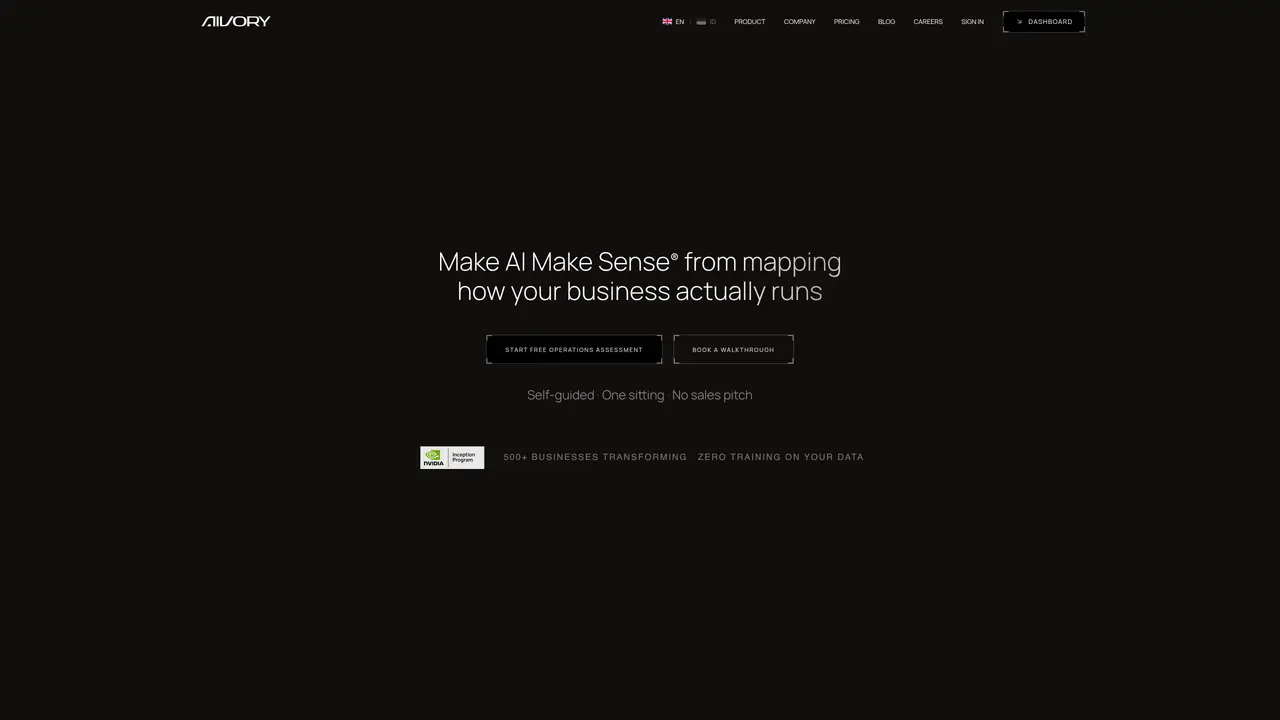
Aivory provides a structured path for organisations to transform operations through AI. It begins with a self-guided assessment that maps processes, bottlenecks, and costs in a single session, producing a deployment-ready automation blueprint. The platform then guides users through designing transformation strategies, planning implementation roadmaps, and deploying governed AI agents that integrate with existing systems. Workflows are built using plain language without code, and agents operate across communication tools, CRMs, and helpdesks to handle tasks such as ticket routing, lead qualification, and data entry. The platform supports multilingual operations by default and includes a template library for rapid deployment. Executive oversight is provided through a unified console that tracks transformation progress and agent performance. Integrations span major enterprise tools including Slack, Salesforce, HubSpot, and Zendesk.
Key features
- Self-guided business operations assessment
- Deployment-ready automation blueprint generation
- Plain-language workflow builder
- Governed AI agents for CRM and helpdesk integration
- Multilingual agent support
- Template library for workflow automation
- Unified executive operations console
- Multi-channel agent deployment
Use cases
- Mapping and automating customer support workflows
- Designing AI-driven lead qualification and routing systems
- Orchestrating cross-team operational processes
Pros
- Self-guided assessment completed in one sitting
- Governed AI agents integrate with existing enterprise tools
- Multilingual support without configuration
- Template library for rapid workflow deployment
- Executive workspace for monitoring transformation progress
Cons
- No free tier available
- Pricing requires contact for enterprise plans
- Limited to operational transformation use cases
Frequently asked questions about Aivory
What does Aivory do?
Aivory provides a structured path for organisations to transform operations through AI, starting with a self-guided assessment to map processes, bottlenecks, and costs. It then guides users through designing transformation strategies, planning implementation roadmaps, and deploying governed AI agents that integrate with existing systems.
Who is Aivory suitable for?
Aivory is designed for organisations looking to transform their operations through AI, particularly those seeking to automate repetitive tasks, improve workflow efficiency, and gain operational clarity without replacing existing systems.
How does Aivory's pricing model work?
Aivory offers a pricing model based on the transformation journey, starting with a self-guided assessment and progressing through strategy design, roadmapping, and deployment of AI agents. The model is structured to align with the organisation's transformation goals and scale of deployment.
What integrations does Aivory support?
Aivory integrates with major enterprise tools including Slack, Salesforce, HubSpot, Zendesk, Zoom, Letta, Glean, AWS, Tencent Cloud, GitHub, and supports connections to ERP systems, CRMs, and helpdesks without requiring rip-and-replace or new systems to learn.
What are the main limitations of Aivory?
Aivory requires organisations to first map their operations through a self-guided assessment, which may not suit those seeking immediate AI deployment without prior operational clarity. Additionally, while it supports multilingual operations by default, complex custom integrations may require additional configuration.
How do I get started with Aivory?
To get started, users can begin with a self-guided operations assessment to map their business processes, bottlenecks, and costs. This is followed by designing a transformation blueprint, planning a roadmap, and deploying governed AI agents using the platform's workflow builder and template library.