
OpenAI builds and deploys advanced AI models like GPT-4o for autonomous agents and workflows.

Alpha Hive
0Popularity
About Alpha Hive
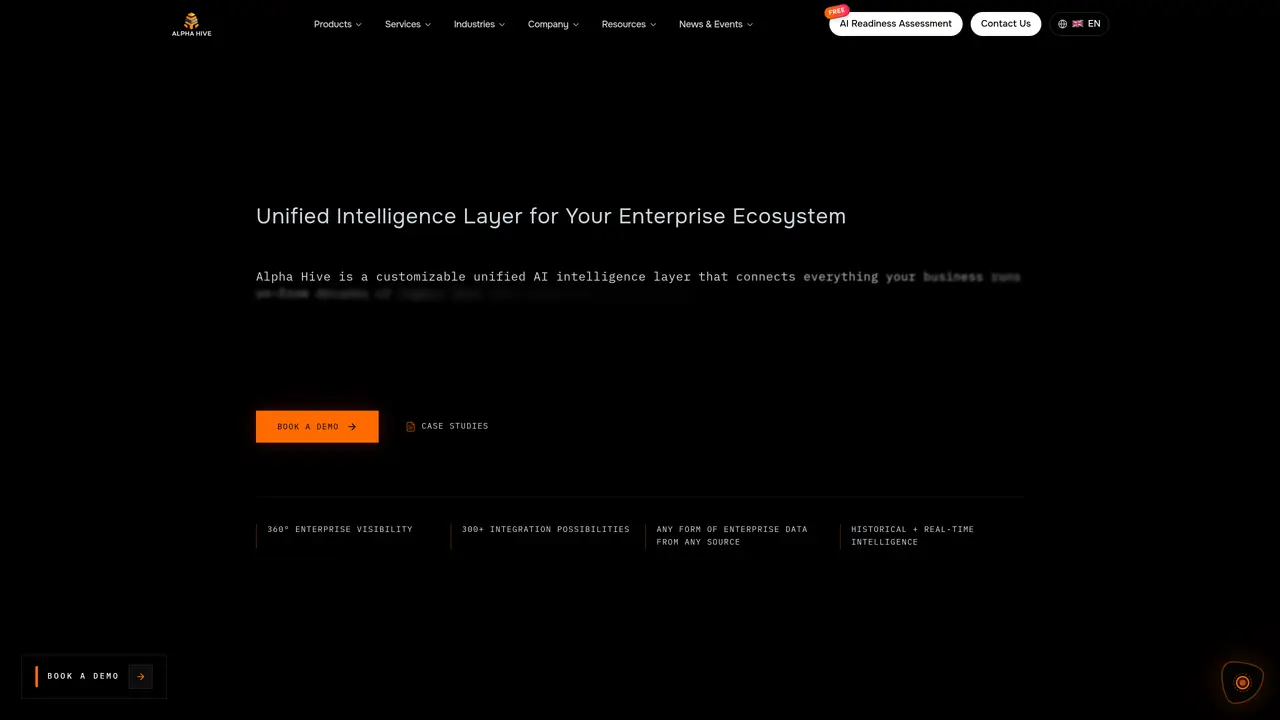
Alpha Hive provides a customizable unified AI intelligence layer designed to integrate fragmented enterprise data across legacy systems, applications, APIs, devices, and workflows. It transforms structured and unstructured data into a 360-degree view of the business, enabling contextual answers, faster decisions, and intelligent automation. The platform operates around existing technology and processes without requiring a full rebuild of the technology ecosystem. It supports secure, role-based access across teams and business functions while enabling natural language queries across connected data sources. Alpha Hive also offers cross-system question answering, workflow automation aligned with existing processes, and legacy plus real-time data fusion. The solution emphasizes enterprise security and compliance readiness with user-based access control, data isolation, permissions, auditability, and governance features.
Key features
- Enterprise SSO and secure role-based access
- Conversational enterprise intelligence via natural language queries
- Cross-system question answering from multiple platforms
- Beyond-the-dashboard reasoning for cause analysis
- Multi-source data connectivity (ERP, CRM, SQL, APIs, IoT sensors)
- Process-native workflow automation
- Legacy and real-time data fusion
- Enterprise security and compliance readiness
Use cases
- Unifying fragmented enterprise data for 360-degree visibility
- Automating workflows across ERP, CRM, and legacy systems
- Enabling AI-powered decision intelligence with traceable evidence
Pros
- Connects legacy data, enterprise apps, databases, APIs, documents, devices, and workflows into one layer
- Enables natural language queries across all connected enterprise data sources
- Supports both historical and real-time data integration
- Provides role-based access control and enterprise-grade security
- Automates workflows based on existing processes and roles
Cons
- No mention of a free tier or open API access
- No indication of mobile or cloud-native deployment options
- Limited to enterprise-scale organizations
- No explicit support for non-English languages
Frequently asked questions about Alpha Hive
What is Alpha Hive and what does it do?
Alpha Hive is a customizable unified AI intelligence layer that connects fragmented enterprise data across legacy systems, applications, APIs, devices, and workflows. It transforms structured and unstructured data into a 360-degree view, enabling contextual answers, faster decisions, and intelligent automation without requiring a full rebuild of the technology ecosystem.
Who is Alpha Hive designed for?
Alpha Hive is designed for organizations where critical data is spread across systems, departments, locations, and formats. It suits enterprises seeking to unlock more value from existing technology and processes through AI-driven insights and automation.
How does Alpha Hive integrate with existing systems?
Alpha Hive connects data from ERP, CRM, spreadsheets, emails, SQL databases, APIs, cameras, handheld devices, RF scanners, and IoT sensors into one intelligence layer. It operates around existing technology and processes, supporting secure, role-based access and natural language queries across connected data sources.
Does Alpha Hive support natural language queries?
Yes, Alpha Hive enables natural language queries across connected enterprise data, allowing users to ask questions and receive contextual answers without needing to search across systems individually.
What security and compliance features does Alpha Hive offer?
Alpha Hive emphasizes enterprise security and compliance readiness with features such as user-based access control, data isolation, permissions, auditability, and governance. It ensures secure, role-based access across teams and business functions.
How can I get started with Alpha Hive?
Prospective users can explore Alpha Hive by booking a demo or contacting the provider directly through their website. The platform is designed to integrate with existing systems, so implementation focuses on connecting and configuring data sources rather than rebuilding infrastructure.