OpenAI builds and deploys advanced AI models like GPT-4o for autonomous agents and workflows.

Cactal
FreeStarting price
1.6KMonthly visits
3Popularity
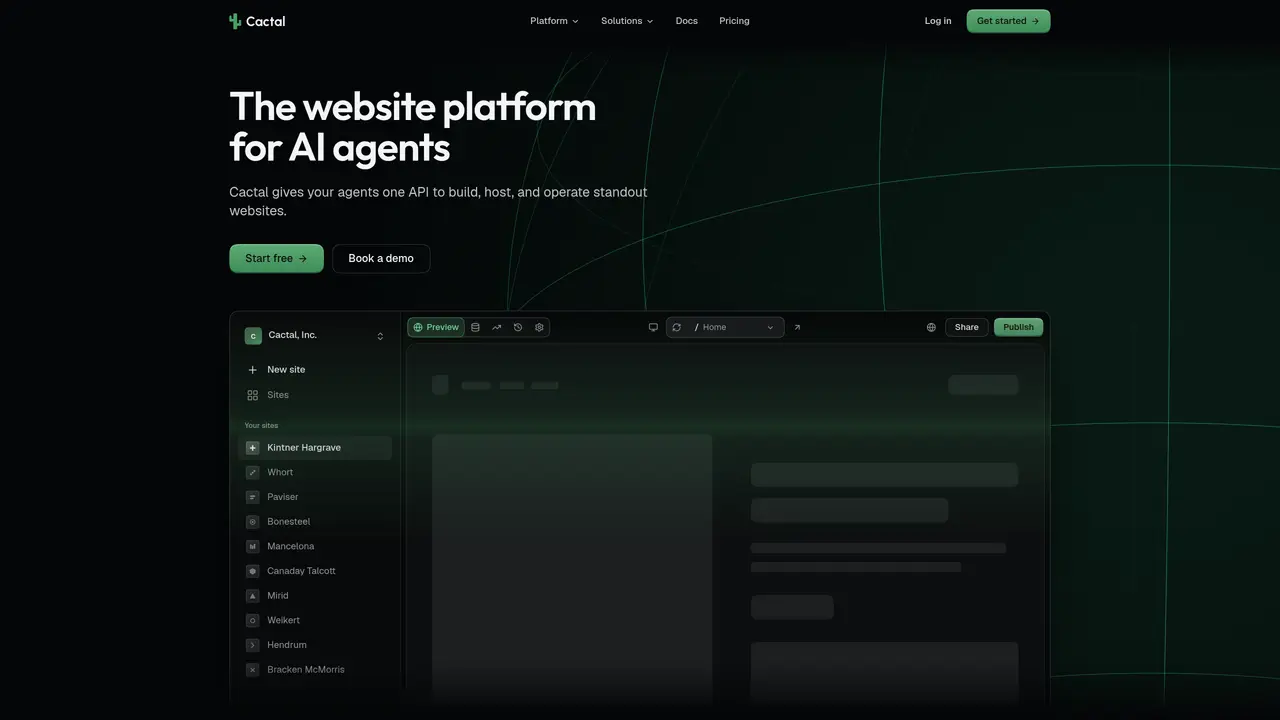
About Cactal
Cactal is a website platform designed specifically for AI agents, offering a single API to build, host, and operate websites efficiently. It integrates with popular AI coding agents like Claude Code, ChatGPT Codex, Cursor, and Gemini, as well as any MCP-compatible agent, granting them full control over pages, CMS, domains, analytics, and versioning. Websites are constructed in real React code and deployed on a global edge network, undergoing a nine-point quality control pipeline before going live. The platform supports a wide range of users, from solo developers to agencies managing thousands of client sites, with built-in tools for analytics, access controls, and SEO—all controllable via agent commands. Cactal emphasizes scalability and automation, allowing AI agents to handle repetitive tasks while maintaining high standards for performance and reliability. It streamlines the entire website lifecycle, from development to deployment and ongoing management, making it a practical solution for teams leveraging AI-driven workflows.
Key features
- Single API for building, hosting, and operating websites
- Integration with Claude Code, ChatGPT Codex, Cursor, Gemini, and MCP-compatible agents
- Real React code deployment on a global edge network
- Nine-point quality control pipeline before publishing
- Built-in analytics, access controls, and SEO tooling
- Versioning and CMS management via agent commands
- Scalable for solo developers and agencies
- Agent-driven site management and updates
Use cases
- Agencies managing multiple client websites with AI agents
- Solo developers automating website creation and updates
- Teams using AI coding tools to streamline web development workflows
Pros
- Enables AI agents like Claude Code and ChatGPT Codex to build, publish, and manage websites via a single API or MCP integration
- Deploys websites as real React code on a global edge network for fast, scalable performance
- Includes a nine-point quality control pipeline to prevent broken changes from going live
- Provides built-in tools for CMS, domains, analytics, SEO, and access controls without requiring additional plugins
- Supports collaboration by allowing clients to make edits through their existing AI assistants without new dashboards
Cons
- Requires reliance on external AI agents for core operations, which may introduce dependency on third-party tools
- Limited to users comfortable with AI-driven workflows and agent-based automation
- Quality control pipeline may slow down rapid iteration if frequent fixes are needed
Frequently asked questions about Cactal
What is Cactal and what does it do?
Cactal is an agent-native website platform that provides a single API for AI agents to build, host, and operate websites. It integrates with agents like Claude Code and ChatGPT Codex to handle tasks such as publishing, domain management, and content updates.
Who is Cactal designed for?
Cactal is designed for developers, agencies, and businesses that use AI agents to automate website creation and management. It suits teams looking to scale from one site to thousands while maintaining control and quality.
How does Cactal integrate with AI agents?
Cactal connects via MCP or API, allowing agents like Claude Code, ChatGPT Codex, or any MCP-compatible tool to directly build, edit, and deploy websites. Agents receive full access to pages, CMS, domains, analytics, and versioning.
Does Cactal require coding knowledge to use?
No, Cactal is designed to be used by AI agents, so users can operate it without writing code themselves. However, the websites are built in real React code, which agents generate and manage.
What kind of hosting and infrastructure does Cactal provide?
Cactal hosts websites on a global edge network with high-performance infrastructure. Pages are cached and served from the nearest city to visitors, with assets optimized and Brotli-compressed for speed.
How does Cactal handle security and access control?
Cactal provides scoped, audited, and isolated access keys. Clients can be granted access through their existing AI assistants without needing new tools or dashboards, reducing security risks.
Cactal Website Engagement
Last Update: 9 days ago
Total Monthly Visits
0
Bounce Rate
0%
Visit Duration (avg)
—
Pages Per Visit
0
Country Rank
0
India
Global Rank
0