
OpenAI builds and deploys advanced AI models like GPT-4o for autonomous agents and workflows.

DynoTable
FreeStarting price
1.3KMonthly visits
2Popularity
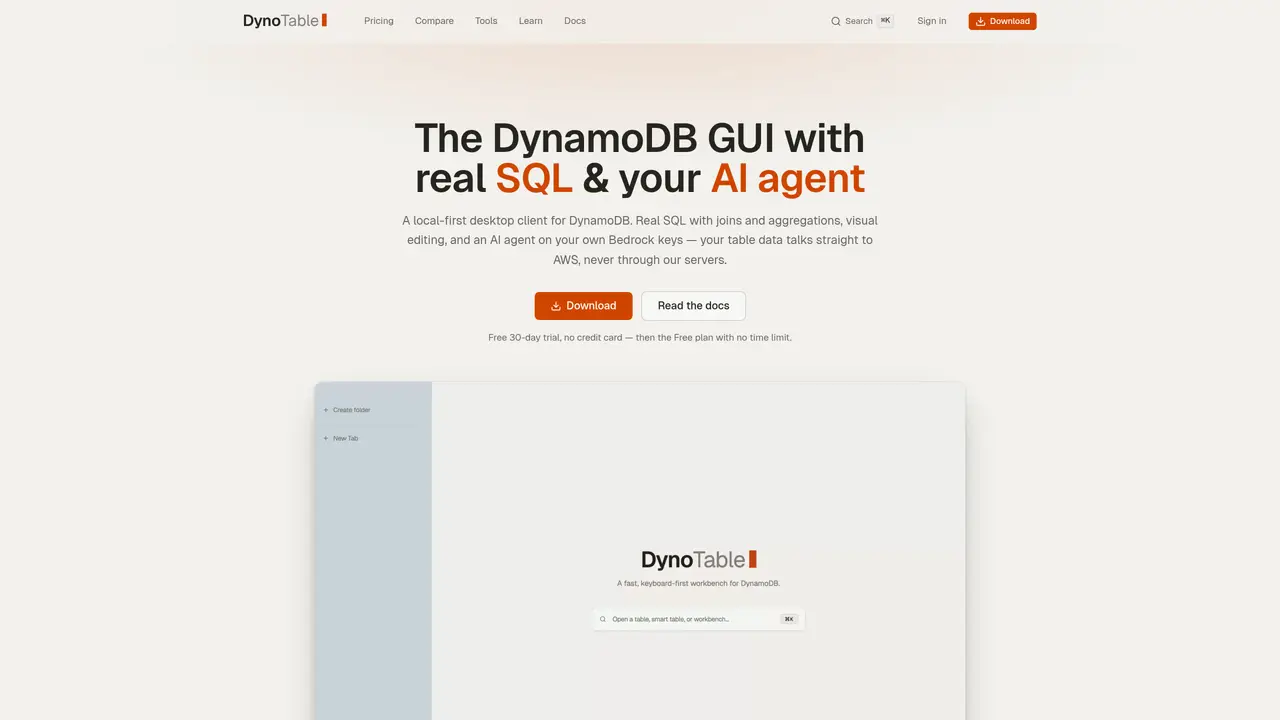
About DynoTable
DynoTable is a local-first desktop client for Amazon DynamoDB that provides real SQL with joins and aggregations, visual editing, and an AI agent running on the user’s own AWS Bedrock credentials. The application connects directly to AWS without routing data through its own servers, using the user’s AWS SSO, named profiles, or IAM-scoped access. It supports constant-memory exports of over one million rows and offers keyboard-first navigation with a command palette accessible via ⌘K. The tool includes a visual join canvas for creating and editing relationships between tables without schema migration or ETL, and a SQL Workbench that allows writing full SELECT statements with GROUP BY, COUNT, and other aggregations over live DynamoDB data. The AI agent reads schema, drafts queries and writes, and presents changes as reviewable diffs before committing to the database. External agents such as Claude Code or Cursor can be connected via an MCP server, with all changes staged for user approval.
Key features
- Real SQL with GROUP BY, COUNT, HAVING and multi-table joins
- Visual join canvas for live relationship editing between tables
- AI agent powered by user's AWS Bedrock with staged commits
- Constant-memory exports for large datasets (1M+ rows)
- Keyboard-first navigation with ⌘K command palette
- MCP server for integration with external agents like Claude Code
- Cost preview showing RCU estimates and access patterns
- Multi-format exports: JSON, NDJSON, CSV, schema and code
Use cases
- Querying and analyzing DynamoDB data with SQL for reporting
- Migrating or transforming DynamoDB data using visual joins and exports
- Automating schema exploration and query drafting with the AI agent
Pros
- Local-first design with no data routed through vendor servers
- Real SQL with joins and aggregations over DynamoDB data
- AI agent runs on user's own AWS Bedrock credentials with no third-party markup
- Visual join canvas for creating relationships between tables without ETL
- Keyboard-first navigation with ⌘K command palette
Cons
- No free tier after 30-day trial without credit card
- Requires AWS credentials and compatible IAM permissions
- Desktop application only, no web or mobile versions
- AI agent functionality depends on AWS Bedrock availability and costs
Frequently asked questions about DynoTable
How is DynoTable different from other DynamoDB GUI tools like Dynobase?
DynoTable offers a SQL Workbench with real joins, GROUP BY, and aggregations over live DynamoDB data, an AI agent that operates on the user's own AWS Bedrock credentials without routing data through third-party servers, and a local-first design where table data and credentials never leave the user's environment.
Does the AI agent send my data to a third party?
No. The AI agent runs entirely within the user's AWS account using their own Bedrock credentials, so prompts, schema, and table rows remain within the user's AWS boundary and never touch a DynoTable server.
Do I have to use the AI agent, and what does it cost?
No, the AI agent is optional. The table browser, SQL Workbench, and cost preview work without it. When used, the agent runs on the user's AWS Bedrock, so costs are billed directly by AWS at their standard rates with no markup or per-seat AI tax.
Is it safe to use DynoTable on production tables?
Yes. DynoTable uses the user's own AWS credentials, so its actions are limited by the user's IAM policies. Edits are staged for review before committing, ensuring no direct mutations occur without user approval.
Can I use external agents like Claude Code or Cursor with DynoTable?
Yes. DynoTable includes a local MCP server that allows external agents to connect and work with DynamoDB tables. Changes proposed by these agents are staged for user review and must be committed manually.
What AWS authentication methods does DynoTable support?
DynoTable supports AWS SSO, named profiles, and IAM-scoped access, allowing users to connect using their preferred AWS authentication method without exposing credentials to DynoTable's servers.
DynoTable Website Engagement
Last Update: 9 days ago
Total Monthly Visits
0
Bounce Rate
0%
Visit Duration (avg)
—
Pages Per Visit
0
Country Rank
0
Japan
Global Rank
0