
OpenAI builds and deploys advanced AI models like GPT-4o for autonomous agents and workflows.

HasMCP
FreeStarting price
6.6KMonthly visits
14Popularity
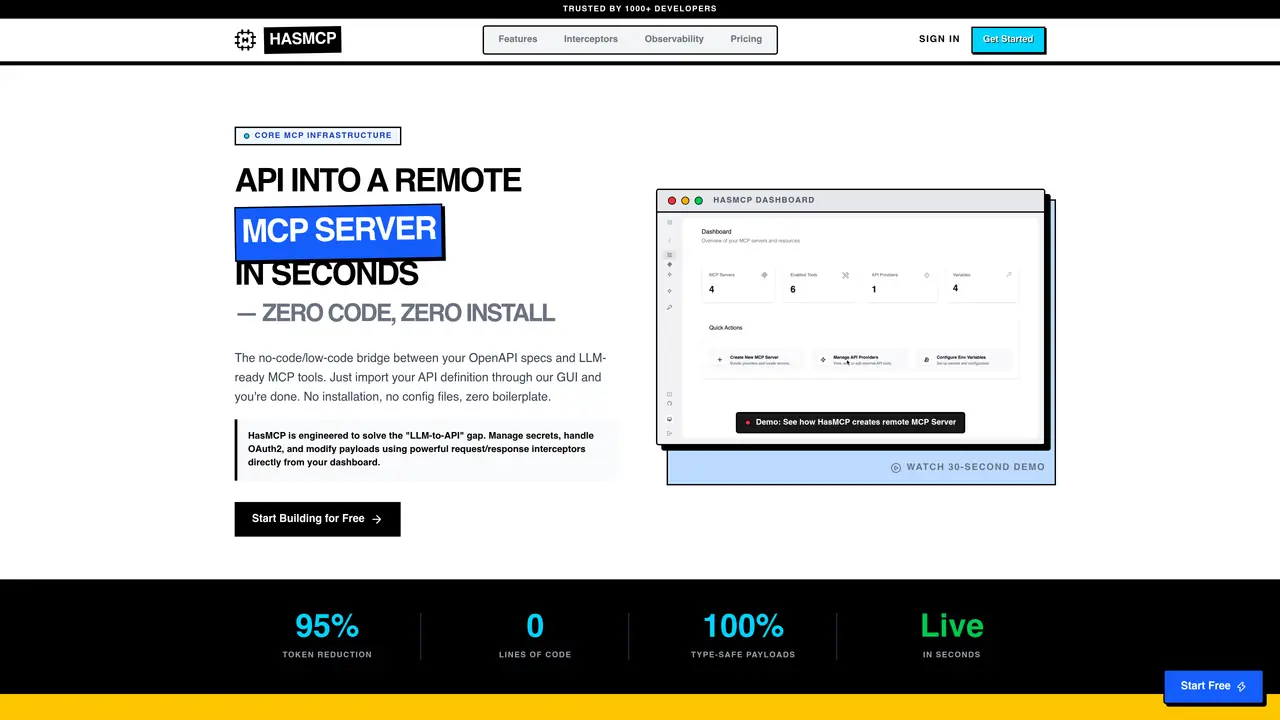
About HasMCP
HasMCP is a no-code/low-code MCP server framework and gateway designed to bridge the gap between APIs and LLM-ready tools. It transforms OpenAPI 3.0/3.1 and Swagger specifications into structured MCP tools automatically, eliminating manual setup and boilerplate code. The platform handles authentication, secrets management, and secure proxying while supporting OAuth2 elicitation for dynamic credential exchange. HasMCP includes powerful interceptors for optimizing token usage, such as JMESPath pruning for data projection and Goja JavaScript scrubbing for PII redaction, ensuring compliance and efficiency. It enables real-time dynamic tool discovery, composition of multiple MCP servers, and live telemetry for monitoring agentic workflows. Designed for developers and teams building agentic systems, HasMCP streamlines the integration of external APIs into AI-driven workflows with minimal overhead and maximum security. The tool is engineered to reduce inference costs and latency while providing governance and observability for safe, scalable deployments in production environments.
Key features
- Converts OpenAPI/Swagger specs into LLM-ready tools automatically
- Handles authentication, secrets, and secure proxying
- Supports Model Context Protocol (MCP)
- Dynamic tool discovery for agent interactions
- OAuth2 elicitation for just-in-time credentials
- Token-saving interceptors (JMESPath pruning and Goja JS scrubbing)
- Telemetry and governance for agentic workflows
- No-code/low-code MCP server framework
- Reduces inference costs and latency
- Production-grade integrations
Use cases
- Integrating third-party APIs into AI agents without manual coding
- Building secure, scalable agentic workflows with minimal setup
- Enabling dynamic credential handling for OAuth2-protected APIs
Pros
- Zero-code/low-code setup for transforming OpenAPI/Swagger specs into LLM-ready MCP tools
- Built-in OAuth2 elicitation for dynamic credential handling without exposing secrets to the model
- Token-saving interceptors like JMESPath pruning and Goja JavaScript scrubbing for efficiency
- Real-time dynamic tool discovery and schema updates without client-side reloads
- Enterprise-grade observability with telemetry, streaming debug console, and payload inspection
Cons
- Requires an existing OpenAPI/Swagger specification to function
- Dependency on Model Context Protocol (MCP) compatibility for client integration
- Potential learning curve for configuring advanced interceptors and security policies
Frequently asked questions about HasMCP
What is HasMCP and what problem does it solve?
HasMCP is a no-code/low-code framework that converts OpenAPI/Swagger specifications into LLM-ready MCP tools, enabling agents to call APIs directly without manual setup. It addresses the challenge of integrating external APIs into AI-driven workflows by automating tool generation, authentication, and secure proxying.
Who should use HasMCP?
HasMCP is designed for developers, teams, and organizations building agentic systems that require secure, efficient, and scalable integration of external APIs into LLM workflows. It suits those who want to minimize boilerplate code and leverage MCP for agentic interactions.
How does HasMCP handle authentication for APIs?
HasMCP implements OAuth2 elicitation to dynamically prompt users for credentials when needed, securely exchanging tokens just-in-time for API calls without exposing sensitive keys to the model context window. It also centralizes secret management via an encrypted vault.
Does HasMCP support real-time updates to tool schemas?
Yes, HasMCP monitors underlying API health and schema changes, notifying connected LLMs of new capabilities or structural updates instantly. This eliminates the need for server restarts or manual client re-indexing.
What kind of telemetry and observability does HasMCP provide?
HasMCP offers real-time telemetry, including streaming debug consoles, payload inspectors, and analytics for user governance and token economics. This provides deep insights into how LLMs interact with APIs, enabling optimization and compliance monitoring.
How do I get started with HasMCP?
To get started, import your OpenAPI/Swagger specification through the HasMCP dashboard. The platform automatically generates MCP tools, handles authentication, and provides interceptors for optimization. No installation or configuration files are required.
HasMCP Website Engagement
Last Update: 9 days ago
Total Monthly Visits
0
Bounce Rate
0%
Visit Duration (avg)
0.00s
Pages Per Visit
0
Country Rank
0
United States
Global Rank
0
Monthly Traffic
Traffic Sources
Traffic Share By Country
- United States65.5%
- India22.9%
- Brazil11.6%