
Generate captions, optimize content, and enhance with custom images for maximum engagement.
46M visits/mo-10%#3 Image & Design

Adds human oversight into automated AI workflows via API, ensuring safe, compliant, and high-quality decisions at critical points.
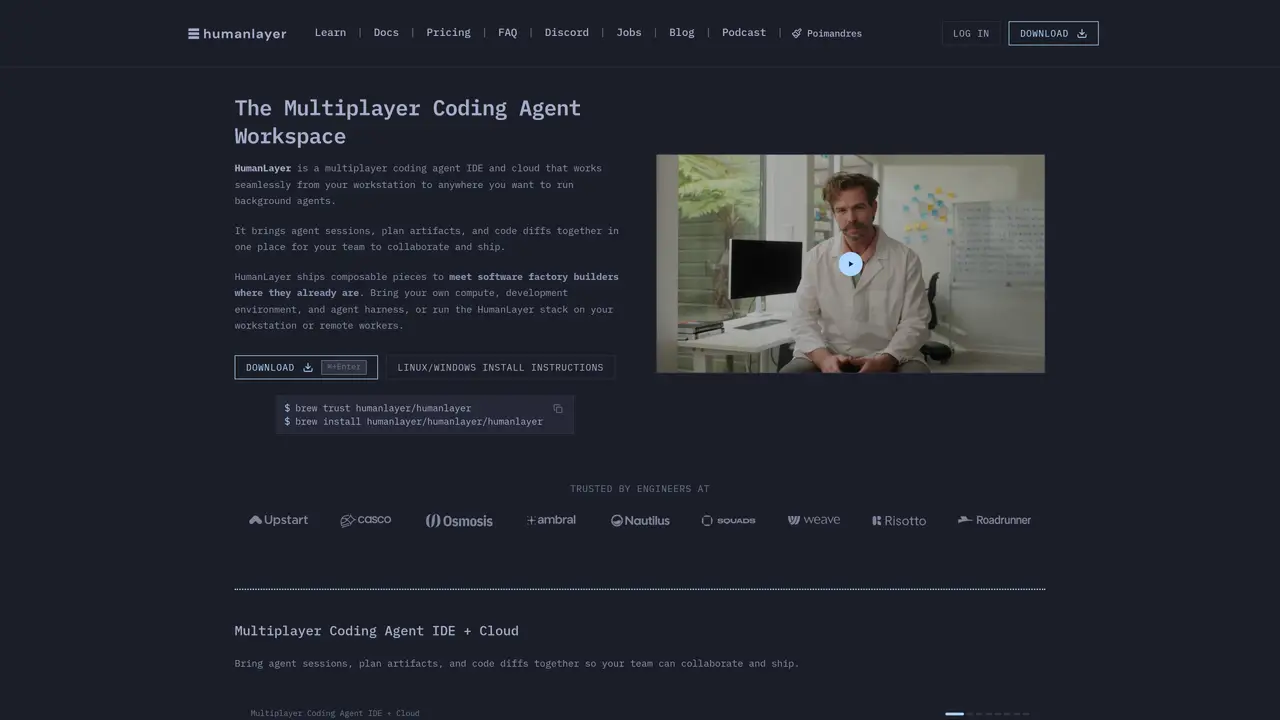
HumanLayer is a multiplayer coding agent IDE and cloud platform designed to enhance collaboration between human developers and AI agents throughout the software development lifecycle. The tool unifies agent sessions, plan artifacts, and code diffs into a single workspace, enabling teams to coordinate, review, and refine work in real time. Developers can bring their own compute and development environments or leverage HumanLayer’s stack for local or remote agent orchestration. The platform emphasizes structured workflows with phases for questioning, research, design, structuring, planning, and implementation, ensuring alignment and quality control at every step. Artifacts such as design documents, research summaries, and implementation plans are versioned and tied directly to tasks, fostering transparency and reducing the risk of large-scale errors. HumanLayer supports comment-driven refinement, allowing teams to catch mistakes early and maintain continuous feedback loops between humans and agents. The system is accessible via a consistent interface across web, desktop, and mobile devices, with agents continuing to operate even if a user’s local machine is offline.
HumanLayer is a multiplayer coding agent IDE and cloud platform designed for teams that want to collaborate with AI agents on software development tasks. It is particularly suited for engineering teams, product managers, and technical leads who need structured workflows, real-time collaboration, and integrated artifact management.
HumanLayer allows teams to bring their own compute, development environment, or agent harness, or run the platform's stack locally or in the cloud. It synchronizes state across devices and provides a unified interface for managing tasks, sessions, and artifacts.
The platform supports structured workflows with six phases: questioning, research, design, structuring, planning, and implementation. Each phase includes checkpoints for verification and collaboration, ensuring alignment and reducing the risk of large-scale errors.
While HumanLayer is primarily designed for software development workflows, its structured collaboration and artifact management features could potentially be adapted for other knowledge-intensive tasks that require team coordination and iterative refinement.
HumanLayer enables real-time collaboration through comment-driven refinement, where humans and agents can comment on design documents, research findings, and implementation plans. Decisions and feedback are directly integrated into the agents' workflows.
HumanLayer can run locally on a workstation or in the cloud, with a local daemon managing agent sessions in parallel. The platform supports Linux, Windows, and macOS, and provides installation instructions for each operating system.
humanlayer.dev · third-party estimates from Similarweb
Last 4 months · grows by one month every month
Share of visits by channel
No measurable traffic from Paid Referrals.
Share of visits · estimated visits
Other countries: 56.4%
How people reach this site from other AI tools
120 a month · 0.1% of all visits
Automation & Agents · Sep 2026
Traffic figures are third-party estimates, good for scale and trends; they can differ from a company's own numbers. Updated monthly.
We use essential cookies to run aitoolnavio™, and optional cookies to analyze traffic and measure our marketing. You choose what we use — optional cookies stay off unless you turn them on. See our Privacy Policy.
One short email a week: fresh tools worth trying, honest takes and the updates that actually matter. No spam, unsubscribe any time.
Generate captions, optimize content, and enhance with custom images for maximum engagement.
Build conversational forms, capture rich responses, and automate follow-ups with AI-powered surveys and workflows.
Automate code, research, and documents using agents.
AI-powered IDE for autonomous coding tasks and agentic development workflows
Source, match, and manage talent with predictive analytics for effortless recruiting.
Automate workflow, optimize operations, and detect potential issues with this efficient AI-driven solution.
Transforms thoughts into actions, enhancing productivity and efficiency.
AI Recruitment engine to hire top global talent
All-in-one team productivity platform combining chat, docs, video meetings, workflows, and AI tools in one place.
Personal assistant that coordinates tasks across apps and devices via text or call
AI automation and agent-building platform with 3,000+ app integrations
AI job search copilot that matches roles to skills, optimizes resumes for ATS, generates cover letters, and autofills applications with real-time insights.
Matched on what this tool does — grouped by the job you would be replacing.
matches AI agent pause and human approval requests · Multi-step approval workflows · Escalation paths for critical decisions
Mobile approval system for AI agents that pauses at decisions
Reliability layer preventing duplicate API calls and ensuring exactly-once execution for AI agents.
Monitors, audits and controls AI agents in real time with human oversight
Runtime governance layer that intercepts and approves AI agent actions before execution
matches Omnichannel notifications (Slack, email, Discord) · Integration with LangChain, CrewAI, LlamaIndex, and OpenAI
AI agents that join team channels and execute real work across existing tools
An AI teammate that works inside Slack, Teams, GitHub, and Linear, understands your org context, follows permissions, and executes tasks autonomously with auditable actions.