
OpenAI builds and deploys advanced AI models like GPT-4o for autonomous agents and workflows.

Phinq
0Popularity
About Phinq
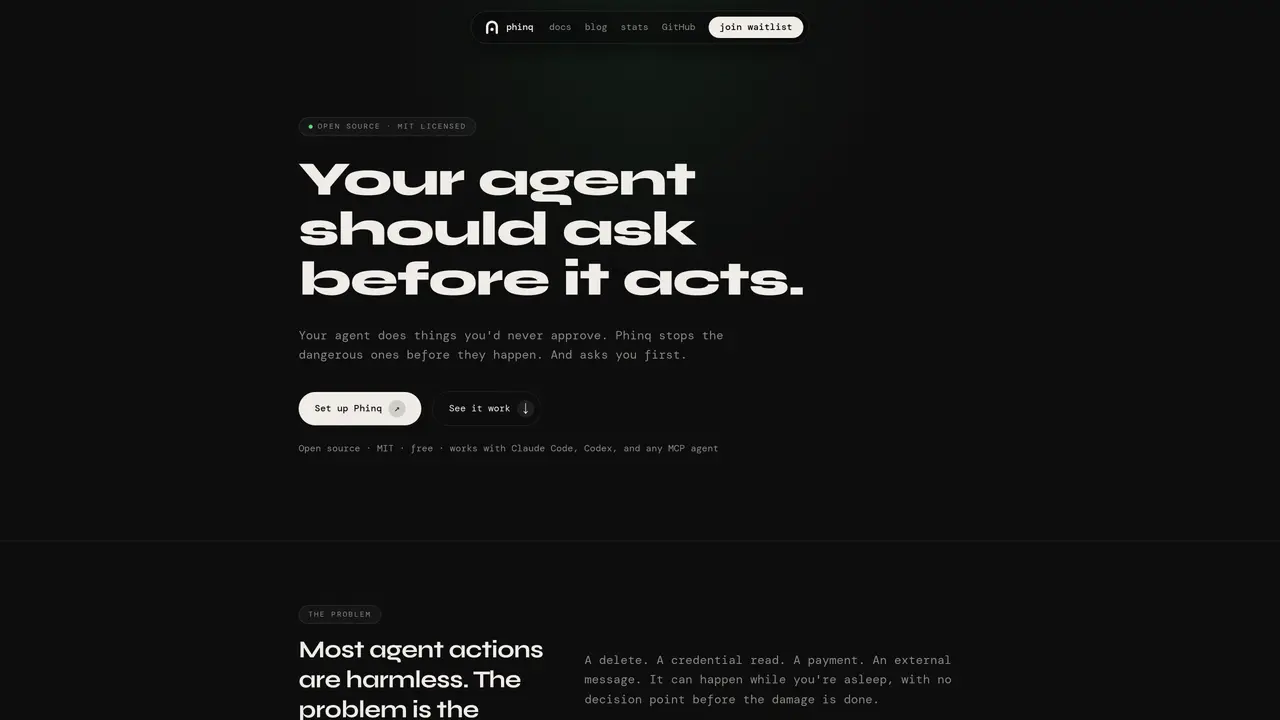
Phinq is an open-source runtime governance layer designed to intercept and evaluate every tool call made by an AI agent. It classifies actions by risk level, allowing safe operations to proceed automatically while holding irreversible actions such as deletions, credential reads, payments, or bulk sends for human approval. Each decision is recorded in a tamper-evident hash-chained audit log that can be verified after the fact. The system operates at the network boundary or as an in-process SDK, ensuring enforcement is structural rather than advisory. It supports multiple deployment boundaries including proxy, SDK, or HTTP gate, and is compatible with various agent frameworks and APIs. Phinq aims to prevent unintended or dangerous actions by requiring explicit approval before execution, providing a fail-closed mechanism for unanswered requests.
Key features
- Risk classification for agent tool calls
- Automatic approval for safe actions
- Human approval required for irreversible actions
- Tamper-evident hash-chained audit log
- Multiple deployment boundary options
- Compatibility with major AI agent frameworks
- Fail-closed mechanism for unanswered requests
- MIT licensed open-source software
Use cases
- Preventing accidental deletions or data loss by AI agents
- Blocking unauthorized credential access by automated tools
- Ensuring payment approvals before financial transactions
Pros
- Intercepts all agent tool calls for real-time risk assessment
- Provides tamper-evident audit logging with hash-chained verification
- Supports multiple deployment boundaries (proxy, SDK, HTTP gate)
- Compatible with OpenAI, Anthropic, Gemini, and MCP agents
- Fails closed on unanswered requests to prevent unintended actions
Cons
- Requires human approval for irreversible actions, which may introduce latency
- Open-source version requires self-hosting and setup
- Early access to Phinq Cloud is limited to first 200 members
Frequently asked questions about Phinq
What is Phinq?
Phinq is an open-source runtime governance layer for AI agents that intercepts every tool call, classifies actions by risk level, and holds irreversible actions like deletions or payments for human approval before execution.
How does Phinq stop an AI agent from causing damage?
Phinq sits between an agent and its tools, ensuring every action passes through it. Safe actions proceed automatically, while risky or irreversible actions are paused and require explicit approval before execution.
How is Phinq different from a prompt or skill-based governance?
Unlike prompts or skills, which are advisory and can be ignored, Phinq enforces governance structurally at the network or execution boundary, making it impossible for the agent to bypass.
Does Phinq slow down my AI agent?
Safe, reversible actions pass through with minimal latency. Only risky actions incur delay, and only when human oversight is required, so the impact is limited to oversight scenarios.
Is the Phinq audit log tamper-evident?
Yes. Every decision is recorded in a hash-chained, append-only log where each entry includes the hash of the previous one, ensuring any alteration breaks verification and proves integrity.
Does Phinq work with my agent framework?
Phinq supports deployment as a proxy, SDK, or HTTP gate and is compatible with frameworks and APIs such as OpenAI, Anthropic, Gemini, Claude Code, LangChain, CrewAI, and MCP.