GitHub hosts HunyuanVideo, Tencent's open-source framework for large-scale video generation models, enabling AI-driven video creation.

Wardin
FreeStarting price
0Popularity
About Wardin
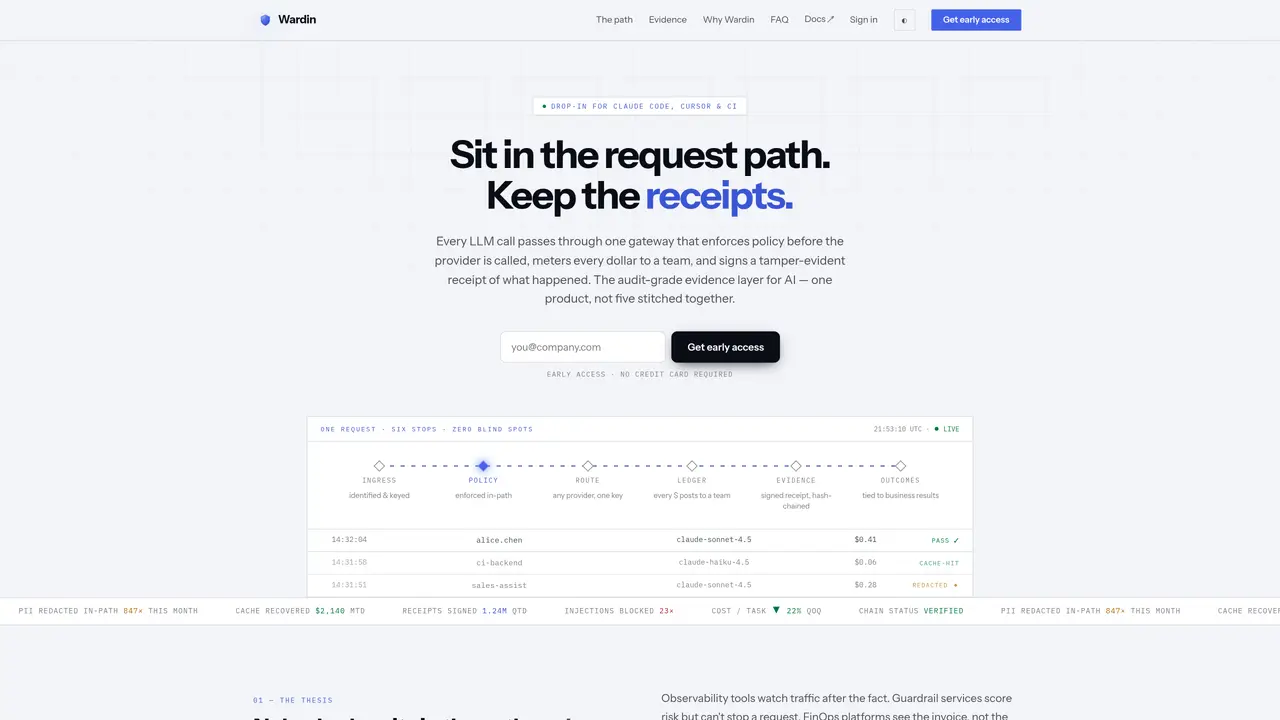
Wardin operates as a gateway in the request path of AI systems, intercepting every LLM call before it reaches the provider. It enforces policy controls such as PII redaction, injection shields, model allowlists, and budget caps, preventing violations from leaving the network. The tool meters costs in real time, assigning every dollar spent to a team or project, and generates signed, tamper-evident receipts for each call. These receipts include actor, model, policy checks, cost, and hash-chain links to prior records, enabling audit-grade verification without trust assumptions. Wardin replaces multiple separate tools—guardrail services, FinOps platforms, developer analytics, and observability tools—by consolidating governance, cost tracking, and evidence collection into a single control plane. The evidence layer is designed to meet regulatory requirements such as the EU AI Act’s logging and record-keeping duties, providing long-term retention via Object Lock WORM storage and offline verification for auditors.
Key features
- Real-time policy enforcement in the request path
- PII redaction and injection shielding
- Budget caps and model allowlists
- Finance-grade cost allocation per team
- Tamper-evident, hash-chained receipts
- EU AI Act and NIST AI RMF compliance mapping
- Long-term evidence retention with Object Lock WORM
- Offline verification for auditors
Use cases
- Compliance auditing for AI systems under regulatory frameworks
- Cost tracking and allocation for AI spend across teams
- Security enforcement for PII and injection risks in prompts
Pros
- Enforces policy in real time before requests reach providers
- Meters costs per team or project with signed receipts
- Generates tamper-evident, hash-chained evidence for audits
- Consolidates governance, cost tracking, and evidence into one tool
- Supports long-term retention with Object Lock WORM storage
Cons
- Waitlist-only access with no public availability
- Requires integration into the request path of AI systems
Frequently asked questions about Wardin
What does Wardin do?
Wardin operates as a gateway in the request path of AI systems, intercepting every LLM call before it reaches the provider to enforce policy controls, meter costs in real time, and generate tamper-evident receipts for audit-grade verification.
Who is Wardin designed for?
Wardin is designed for organizations that need to enforce AI governance, track costs accurately, and maintain audit-ready evidence for compliance, particularly those subject to regulatory requirements like the EU AI Act.
How does Wardin integrate with existing AI workflows?
Wardin sits in the request path of AI systems, acting as a drop-in gateway that enforces policies, meters costs, and signs receipts without requiring changes to existing AI tools or providers.
What types of policy controls does Wardin enforce?
Wardin enforces policy controls such as PII redaction, injection shields, model allowlists, and budget caps, preventing violations from leaving the network before they reach the provider.
Does Wardin provide cost tracking for AI usage?
Yes, Wardin meters costs in real time, assigning every dollar spent to a team or project, and provides finance-grade cost allocation that updates as spending occurs rather than waiting for invoices.
How does Wardin ensure the integrity of its evidence?
Wardin generates signed, tamper-evident receipts for each LLM call, including details like actor, model, policy checks, cost, and hash-chain links to prior records, making it impossible to alter past evidence without detection.