
OpenAI builds and deploys advanced AI models like GPT-4o for autonomous agents and workflows.
Mebot
613Monthly visits
0Popularity
About Mebot
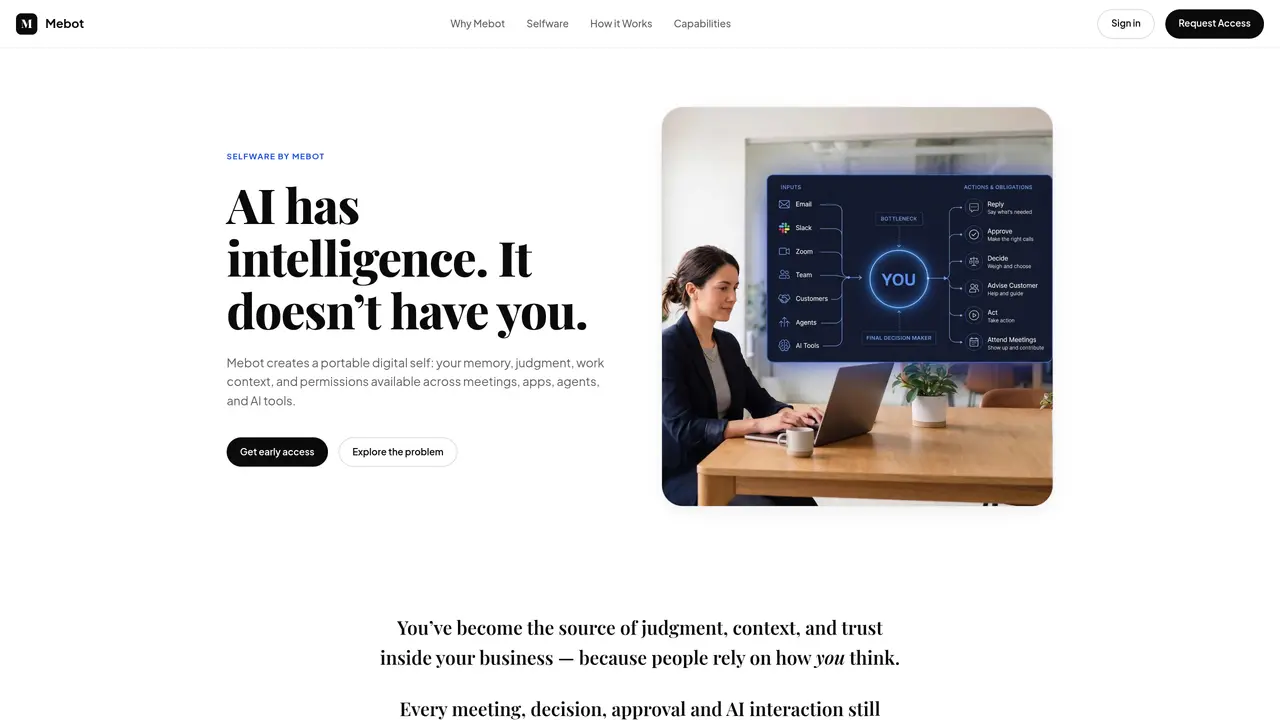
Mebot is a web-based voice and video AI agent designed for businesses and creators. It trains on a user’s existing knowledge to act as a digital clone, attending meetings, capturing context, and answering questions on behalf of the user. The tool allows for voice and video twin creation using a short recording, with an editable profile to shape responses. It supports two-way conversations via text, voice, or video call, enabling 24/7 availability across locations. Mebot offers bot training and integrations, including document uploads for retrieval, API access, CRM integration, automated workflows, analytics, and sentiment analysis. It is particularly useful for individuals and organizations seeking to automate client-facing interactions and maintain consistent engagement.
Key features
- Voice and video twin creation from a short recording
- Editable profile to shape responses and personality
- Meeting participation and context capture
- Two-way conversations via text, voice, or video call
- 24/7 availability across locations
- Bot training and integrations (document uploads, API access, CRM)
- Automated workflows and analytics
- Sentiment analysis capabilities
- Multi-channel and multilingual support
Use cases
- Attending and summarizing meetings for executives or consultants
- Providing always-on client-facing interactions for businesses
- Capturing and answering questions based on personal or organizational knowledge
Pros
- Creates a portable digital identity that captures user context, judgment, and preferences
- Continuously ingests and learns from user data across meetings, documents, and communications
- Enables consistent decision-making and responses by making user context available across platforms
- Designed for scalability, allowing user knowledge to extend beyond physical presence
- Provides a permissioned identity layer to control data sharing and privacy settings
Cons
- Requires initial setup and data ingestion to build an accurate digital self
- Dependent on user-provided context and data quality for effectiveness
- May raise privacy concerns due to the aggregation of personal and professional information
- Early-stage product with limited public availability and user base
Frequently asked questions about Mebot
What is Mebot Selfware?
Mebot Selfware is a permissioned identity layer that creates a portable digital self by learning from a user’s existing knowledge, context, and judgment. It acts as a centralized memory and decision-making layer that can be used across meetings, apps, agents, and AI tools.
Who should use Mebot?
Mebot is designed for individuals and organizations that rely on their knowledge, judgment, and context to make decisions and interact with clients or teams. It is particularly useful for professionals who need to scale their presence and availability beyond their physical presence.
How does Mebot work?
Mebot continuously ingests a user’s scattered data, such as meetings, notes, and documents, to learn their context and preferences. It then delivers a personalized digital presence that can be used across various platforms and tools, enabling consistent and context-aware interactions.
Can Mebot integrate with other tools or platforms?
Yes, Mebot is designed to be portable and works across meetings, apps, agents, and AI tools. It acts as a context layer that can be integrated into existing workflows to provide consistent and personalized interactions.
What kind of data does Mebot use to learn my context?
Mebot learns from a user’s existing data, including meetings, notes, documents, and other scattered information. It captures not just what happened but also how the user makes decisions and communicates, creating a more holistic digital presence.
How do I get started with Mebot?
Users can request early access to Mebot Selfware by joining the waitlist on the official website. Once onboarded, users can begin integrating their data and setting up their portable digital self.
Mebot Website Engagement
Last Update: 9 days ago
Total Monthly Visits
0
Bounce Rate
0%
Visit Duration (avg)
—
Pages Per Visit
0
Country Rank
—
Unknown
Global Rank
0