
OpenAI builds and deploys advanced AI models like GPT-4o for autonomous agents and workflows.

Mem U
FreeStarting price
10KMonthly visits
17Popularity
About Mem U
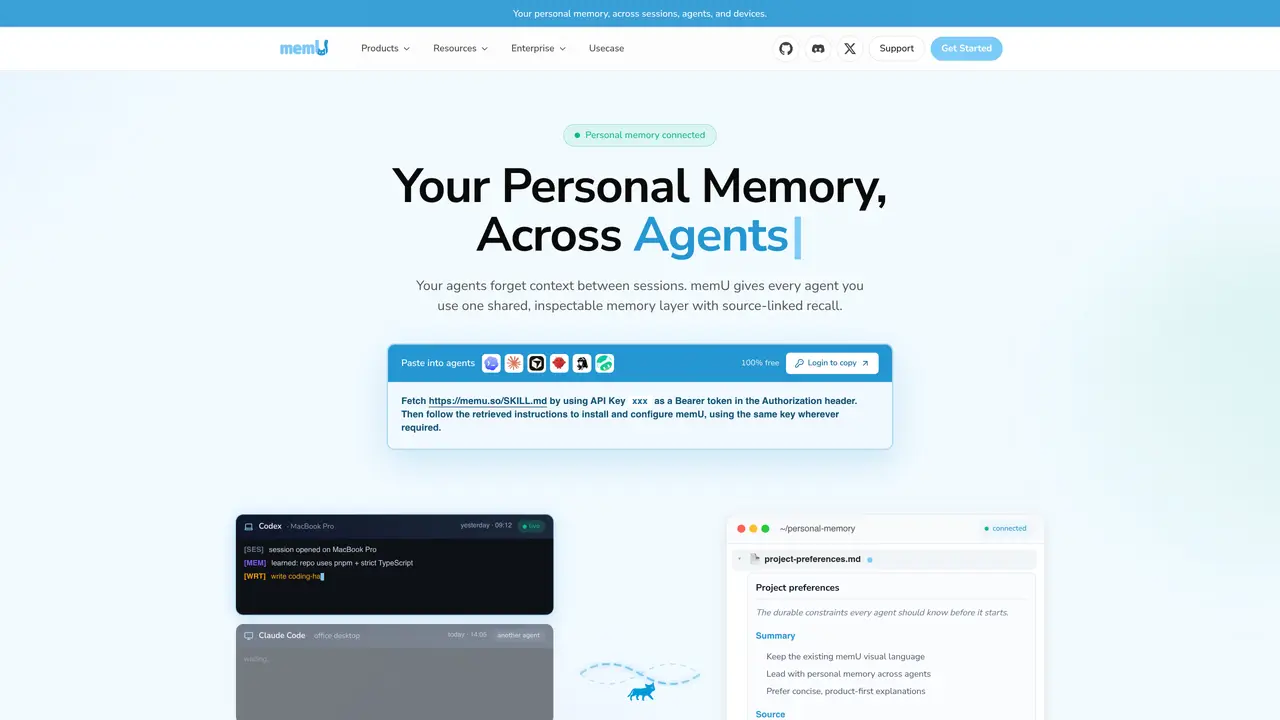
MemU is an AI memory framework designed for intelligent agents, allowing them to remember past interactions and understand user requirements. It supports continuous operation, enabling agents to work actively 24/7 while adapting to individual communication styles. The tool is particularly useful for developers building content tools, financial AIs, or any system requiring persistent memory and context retention. By optimizing retrieval speed and accuracy, MemU helps agents deliver quicker and more precise responses, making it ideal for applications where consistency and adaptability are critical. Its proactive operation ensures agents can anticipate needs rather than merely respond to queries, which is valuable for customer support, virtual assistants, and multi-agent workflows. While the initial setup may require technical effort, the framework’s benefits in memory management and agent performance can significantly enhance automation and personalization in AI-driven systems.
Key features
- Persistent memory for agents to recall past interactions
- Proactive 24/7 agent operation without manual intervention
- Optimized retrieval speed and higher memory accuracy
- Adaptation to user communication styles and preferences
- Support for multi-agent workflows and self-evolving AI companions
- Open-source availability for customization and integration
- Context retention for consistent and accurate responses
- Ideal for developers building content tools or financial AIs
Use cases
- Track and manage content creation drafts with contextual memory
- Build 24/7 proactive agents for customer support or virtual assistance
- Enable self-evolving AI companions that adapt to user preferences
Pros
- Enables shared, inspectable memory layer across multiple agents and devices
- Supports cross-agent and cross-session memory continuity
- Provides automatic skill extraction and source-linked recall for traceability
- Offers readable Markdown-based memory storage for easy inspection and reuse
- Facilitates durable constraints and preferences retention across workflows
Cons
- Initial setup may require technical configuration and API key integration
- Limited to agents and workflows that explicitly support MemU integration
- Memory retrieval behavior requires careful configuration to avoid stale or irrelevant context
Frequently asked questions about Mem U
What is MemU and how does it work?
MemU provides a shared, inspectable memory layer that connects multiple AI agents across sessions, devices, and workflows. It allows agents to retrieve and store personal memory, preferences, decisions, and learned skills in a readable Markdown format with source-linked recall.
Who should use MemU?
MemU is designed for developers, teams, and enterprises building AI-driven systems that require persistent memory and context retention, such as coding assistants, personal assistants, knowledge workers, and support systems.
How do I get started with MemU?
To start using MemU, fetch the installation instructions from https://memu.so/SKILL.md using an API key as a Bearer token in the Authorization header. Follow the retrieved instructions to install and configure MemU across your agents.
Can MemU be used with multiple agents and devices?
Yes, MemU supports cross-agent and cross-device memory, allowing agents like Codex, Claude, Cursor, OpenClaw, Hermes, and WorkBuddy to share a unified memory layer, ensuring continuity across workflows.
Does MemU offer enterprise solutions?
MemU provides enterprise options, including custom memory systems, retrieval and storage configuration, private deployment (cloud or self-hosted), and agent memory integration tailored to organizational needs.
Is MemU open source?
MemU offers open-source resources and community support, with additional enterprise features and partnerships available for custom deployments and integrations.
Mem U Website Engagement
Last Update: 9 days ago
Total Monthly Visits
0
Bounce Rate
0%
Visit Duration (avg)
0.00s
Pages Per Visit
0
Country Rank
0
United States
Global Rank
0
Monthly Traffic
Traffic Sources
Traffic Share By Country
- United States51.2%
- India14.9%
- Indonesia10.8%
- Hong Kong8.9%
- Canada8.3%