GitHub hosts HunyuanVideo, Tencent's open-source framework for large-scale video generation models, enabling AI-driven video creation.

EverMind
0Popularity
About EverMind
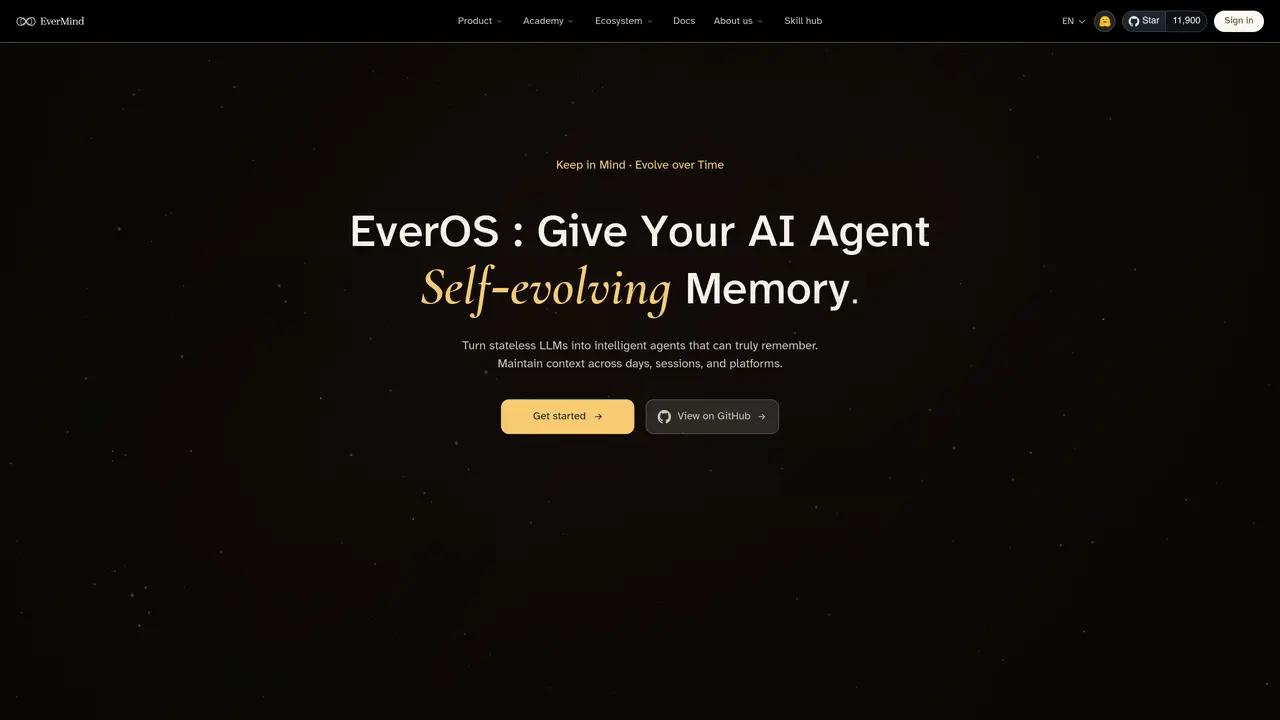
EverMind is an open-source AI memory platform that addresses the critical limitation of short-term memory in large language models by providing near-infinite, persistent long-term memory and a self-evolving identity. The platform transforms stateless LLMs into intelligent agents capable of maintaining context across days, sessions, and even different platforms, enabling coherent and contextually aware interactions over time. EverMind operates through EverOS, a memory operating system that supports non-parametric, self-evolving skill memory and offers a flexible framework for diverse agent architectures. It introduces multimodal retrieval and ingestion capabilities, allowing agents to parse and store a wide range of data types—including PDFs, images, spreadsheets, emails, and URLs—through a single API. By recording agent trajectories as cases and distilling repeated patterns into reusable skills, EverMind enables agents to learn from experience and evolve over time. The platform is designed for building personalized assistants, long-running conversational agents, and enterprise applications requiring improved continuity and memory evaluation. EverMind also provides open-source benchmarks to verify performance claims, ensuring transparency and reproducibility in its results. EverMind is particularly suited for developers and organizations seeking to build AI agents that can remember, reason with extended context, and adapt across interactions. It bridges the memory gap in modern AI by enabling agents to track temporal changes, maintain team context in multi-agent systems, and distinguish current facts from outdated information. The platform emphasizes consistency, learning from experience, and evolving capabilities, positioning memory as the defining factor between a tool and a true agent.
Key features
- Long-term memory storage for LLMs
- Persistent identity for AI agents
- KV-cache based memory storage
- End-to-end training for memory integration
- Memory-aware retrieval mechanisms
- Open-source platform (EverMemOS, EverMemModel, EverMemBench)
- Enables reasoning with extended context
- Supports personalized AI assistants
- Improves continuity in AI interactions
- Memory evaluation benchmarks included
Use cases
- Building personalized AI assistants
- Creating long-running conversational agents
- Applications requiring improved continuity and reasoning
Pros
- Enables stateless LLMs to retain persistent, long-term memory across sessions and platforms
- Supports multimodal memory retrieval and storage (text, PDFs, images, spreadsheets, emails, etc.)
- Provides open-source benchmarks (e.g., LoCoMo, LongMemEval, HaluMem) for verifiable performance
- Facilitates self-evolving agent memory through distilled reusable skills and recorded trajectories
- Designed for multi-agent coordination and enterprise-scale applications
Cons
- Requires integration with existing AI models and systems, adding complexity to deployment
- Memory management and retrieval strategies may introduce latency in real-time interactions
- Open-source nature may demand technical expertise for optimal customization and maintenance
Frequently asked questions about EverMind
What does EverMind do?
EverMind provides an open-source memory platform that gives AI agents persistent, long-term memory and a self-evolving identity, enabling them to remember context across sessions and platforms.
Who is EverMind designed for?
EverMind is designed for developers, enterprises, and organizations building personalized assistants, long-running conversational agents, or multi-agent systems that require improved continuity and memory evaluation.
How does EverMind handle different types of data?
EverMind supports multimodal memory retrieval and ingestion, allowing agents to parse and store a wide range of data types, including text, PDFs, images, spreadsheets, emails, and URLs, through a single API.
Does EverMind provide performance benchmarks?
Yes, EverMind offers open-source benchmarks such as LoCoMo, LongMemEval, and HaluMem, which users can reproduce to verify the platform's performance claims.
How does EverMind enable agents to evolve over time?
EverMind records agent trajectories as cases and distills repeated patterns into reusable skills, allowing agents to learn from experience and adapt their behavior across interactions.
What is the difference between EverOS and EverMe?
EverOS is the memory operating system for AI agents, providing persistent and self-evolving memory, while EverMe is a personal memory hub that creates a visual digital twin based on past interactions.