Generate captions, optimize content, and enhance with custom images for maximum engagement.
46M visits/mo-10%#3 Image & Design

Ultra-lightweight open-source runtime for reliable, long-horizon AI agents with predictable token budgets and minimal overhead.
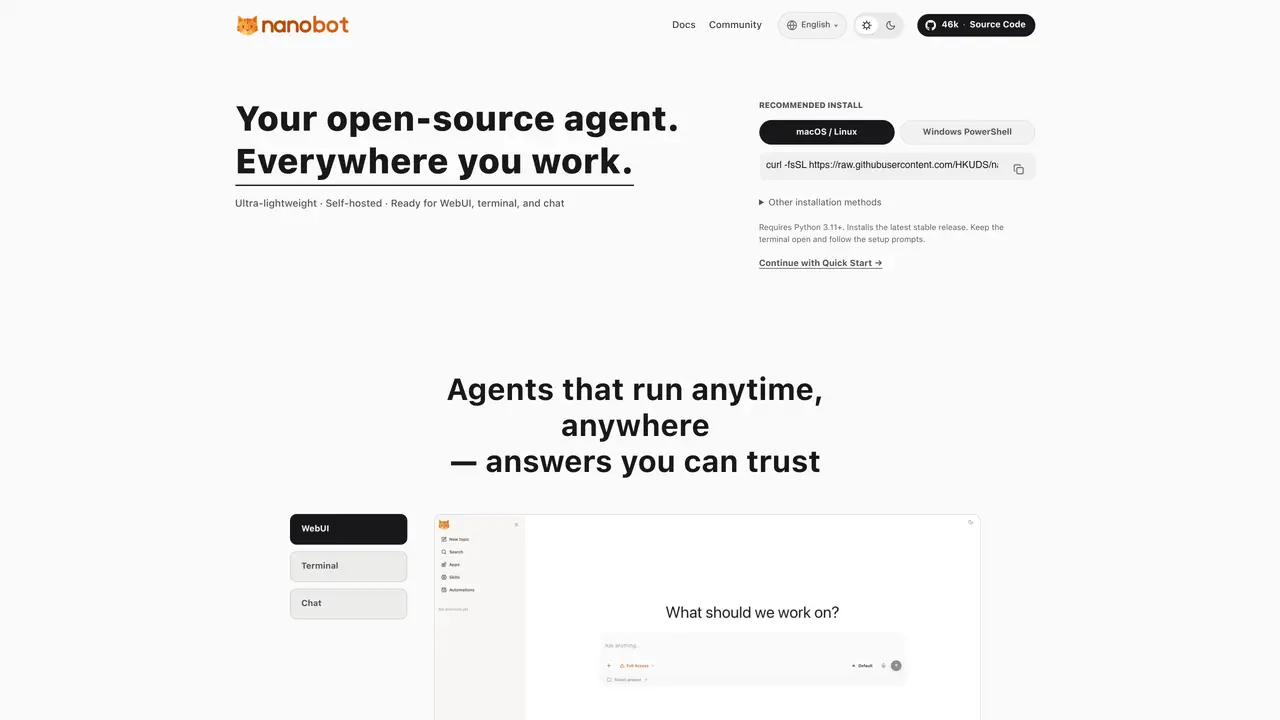
NanoBot is an ultra-lightweight, open-source personal AI agent runtime for Python designed for steady, long-horizon automation. It prioritizes compact code, predictable token budgets, and reliable execution to embed agents in terminals, scripts, and services with minimal overhead. The tool cleanly separates planning, tool invocation, and context handling, enabling straightforward embedding in Python applications, services, and command-line workflows. It supports long-horizon sequences—tens to hundreds of steps—while maintaining coherent context and execution state, allowing reliable multi-step automation without derailing midway through complex workflows. NanoBot provides predictable token budgeting and compact prompts, helping teams control spend from day one while preserving response quality across extended sessions and iterative task refinement. It ships with a terminal-first chat experience and a minimal online interface, making it easy to test, operate, and monitor agents locally or remotely with very low overhead. Released under the MIT License and distributed on PyPI, NanoBot simplifies installation, versioning, and integration into existing CI pipelines, deployment scripts, and Python-based infrastructure.
NanoBot is an open-source, ultra-lightweight AI agent runtime for Python designed for steady, long-horizon automation with predictable token budgets and reliable execution.
NanoBot suits developers, teams, and organizations looking to embed AI agents in Python-based workflows, services, or command-line tools with minimal overhead and maximum control.
NanoBot emphasizes compact code and sensible context management to provide predictable token budgets, helping users control spending while maintaining response quality across extended sessions.
NanoBot is designed for self-hosted environments and supports installation on macOS, Linux, and Windows via PowerShell, with integration options for terminal, chat, and web interfaces.
Users can install NanoBot via PyPI, uv, or direct cloning from GitHub, then follow setup prompts to deploy agents in terminal, chat, or web UI environments.
Yes, NanoBot requires Python 3.11 or higher for installation and operation.
nanobot.wiki · third-party estimates from Similarweb
Last 4 months · grows by one month every month
Share of visits by channel
No measurable traffic from Paid Referrals.
Share of visits · estimated visits
Other countries: 13.2%
Automation & Agents · Sep 2026
Traffic figures are third-party estimates, good for scale and trends; they can differ from a company's own numbers. Updated monthly.
We use essential cookies to run aitoolnavio™, and optional cookies to analyze traffic and measure our marketing. You choose what we use — optional cookies stay off unless you turn them on. See our Privacy Policy.
One short email a week: fresh tools worth trying, honest takes and the updates that actually matter. No spam, unsubscribe any time.
Generate captions, optimize content, and enhance with custom images for maximum engagement.
Build conversational forms, capture rich responses, and automate follow-ups with AI-powered surveys and workflows.
Automate code, research, and documents using agents.
AI-powered IDE for autonomous coding tasks and agentic development workflows
Source, match, and manage talent with predictive analytics for effortless recruiting.
Automate workflow, optimize operations, and detect potential issues with this efficient AI-driven solution.
Transforms thoughts into actions, enhancing productivity and efficiency.
AI Recruitment engine to hire top global talent
All-in-one team productivity platform combining chat, docs, video meetings, workflows, and AI tools in one place.
Personal assistant that coordinates tasks across apps and devices via text or call
AI automation and agent-building platform with 3,000+ app integrations
AI job search copilot that matches roles to skills, optimizes resumes for ATS, generates cover letters, and autofills applications with real-time insights.
Matched on what this tool does — grouped by the job you would be replacing.
matches Ultra-lightweight open-source runtime for Python · Predictable token budgeting and compact prompts · Steady long-horizon execution with coherent context
Open-source framework for running controllable, auditable AI agents in Docker sandboxes on your local hardware with a desktop launcher and plugin hub.
Durable runtime for building resilient agents and backend services
A lightweight TypeScript framework for building and deploying AI agents in JavaScript with zero dependencies and unified tooling.
matches Terminal-first chat experience with minimal overhead · Minimal web interface for remote monitoring and operation
Open-source AI workforce OS for autonomous agents performing business functions
A terminal-based agent swarm for managing AI-powered tasks and projects