
Build teams of AI agents that collaborate, automate workflows, and complete complex tasks together.

Ankole
0Popularity
About Ankole
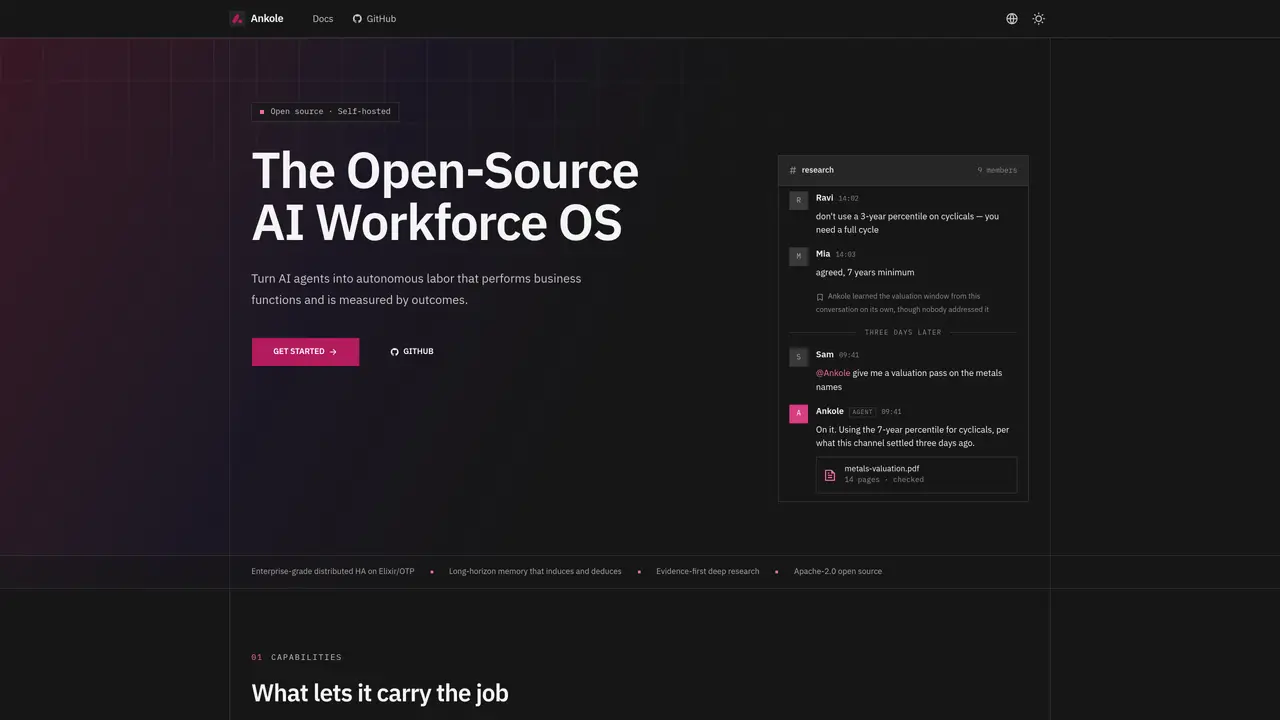
Ankole is an open-source, self-hosted platform designed to turn AI agents into autonomous labor that executes business functions and is measured by outcomes. It operates as an enterprise-grade distributed system built on Elixir/OTP, supporting high availability and long-horizon memory that both induces and deduces from ongoing operations. The platform integrates with existing communication tools such as Lark, Slack, DingTalk, Teams, WeCom, and Google Workspace, using an organization’s identity provider for permissions and audit trails. Agents in Ankole maintain durable execution loops, handling background jobs, schedules, and retries while preserving operating context across sessions. Memory in Ankole functions as a world model, predicting outcomes and adapting based on real-world corrections, enabling agents to learn and improve over time. The system supports deep research workflows with fan-out retrieval, layered checks, and competing-hypothesis analysis, producing cited reports rather than confident summaries. It also includes a Chromium-based browser runtime for interacting with web pages, executing Playwright scripts, and maintaining persistent sessions.
Key features
- Distributed HA on Elixir/OTP
- Long-horizon memory and world modeling
- Enterprise-grade deployment options
- Multi-agent execution with shared context
- Chromium-based browser runtime for web interaction
- Playwright script execution and persistent sessions
- Deep research with fan-out retrieval and layered checks
- Self-improving skills with human approval workflows
Use cases
- Performance marketing campaign management with incremental ROAS tracking
- Industry research and trading with Sharpe ratio and drawdown metrics
- Regulatory submissions with first-pass approval rate measurement
Pros
- Open-source and self-hosted with Apache-2.0 license
- Enterprise-grade distributed architecture with high availability
- Long-horizon memory that learns and adapts from real-world corrections
- Integrates with multiple IM platforms and identity providers
- Supports durable execution loops for background jobs and retries
Cons
- Requires Docker or Kubernetes for deployment
- No mention of a free tier or hosted version
- Limited to specific business functions with measurable outcomes
- Installation requires technical setup from source or Docker Compose
Frequently asked questions about Ankole
What is Ankole and what does it do?
Ankole is an open-source, self-hosted platform that turns AI agents into autonomous labor for performing business functions measured by outcomes. It operates as an enterprise-grade distributed system built on Elixir/OTP, supporting durable execution loops, long-horizon memory, and deep research workflows.
Who is Ankole designed for?
Ankole is designed for enterprises and teams that need autonomous AI agents to handle business functions such as performance marketing, industry research, SEO, regulatory submissions, patent prosecution, and smart contract audits. It suits organizations that require measurable outcomes and audit trails.
How does Ankole integrate with existing tools?
Ankole integrates with communication tools like Lark, Slack, DingTalk, Teams, WeCom, and Google Workspace. It uses an organization’s identity provider for permissions, audit trails, and outbound identity, ensuring seamless alignment with existing workflows.
What kind of memory does Ankole use?
Ankole uses a world model for memory that predicts outcomes, adapts based on real-world corrections, and learns from ongoing operations. This enables agents to improve over time and maintain operating context across sessions.
Can Ankole handle long-running tasks and retries?
Yes, Ankole supports long-running background jobs, schedules, and retries while preserving operating context. If a step fails, the agent identifies the failure and retries, ensuring durable execution loops.
How do I get started with Ankole?
Ankole can be installed via Docker Compose for single-host setups, Kubernetes for enterprise deployments, or from source. The platform includes PostgreSQL, a Worker, and Caddy HTTPS in the Docker Compose stack, with setup instructions available in the documentation.