
OpenAI builds and deploys advanced AI models like GPT-4o for autonomous agents and workflows.

Engram
17KMonthly visits
20Popularity
About Engram
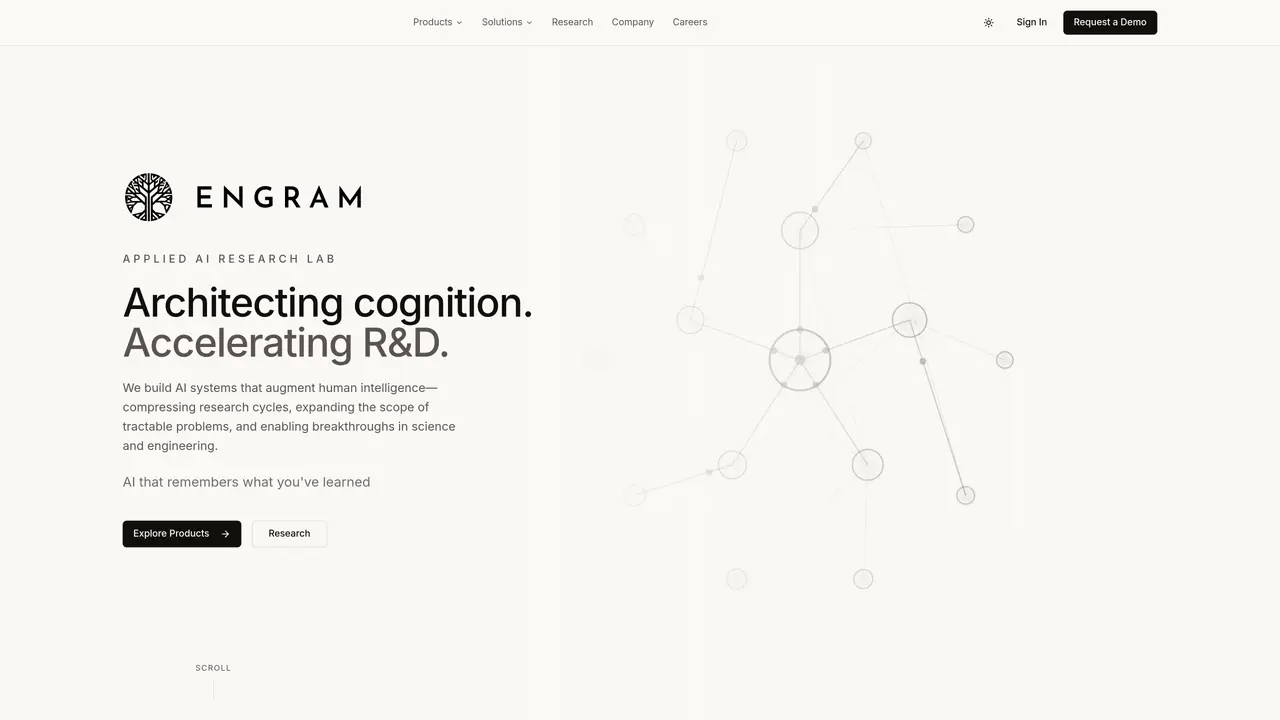
Engram builds agentic R&D systems designed to augment human intelligence and accelerate research cycles across scientific, engineering, and enterprise domains. The platform addresses systemic failures in AI workflows—such as loss of state, brittle tool use, and lack of verification—by embedding models within an operating loop that includes persistent memory, tool-native execution, autonomous agents, and verifiable decisions. Each interaction strengthens the system, enabling continuous improvement without retraining. Engram’s architecture spans hardware-aware compute, specialized models like Engram-VQ for reasoning, and memory systems such as Engram-Locus for long-horizon state management. The platform supports regulated environments through provenance infrastructure, decision lineage tracking, and audit-ready outputs. Teams can deploy via APIs, SDKs, headless runtimes, cloud, or self-hosted infrastructure, depending on their compliance and technical requirements. Typical use cases include clinical research, cybersecurity, hardware engineering, and scientific computing, where reproducible and verifiable workflows are critical. By integrating autonomous agents, compute orchestration, and governance records, Engram enables research teams to focus on high-value work while automating routine cognitive overhead and experiment management. Engram’s products, such as Monad for R&D workbenches and Engelbart for research assistants, provide natural interfaces—voice, text, or API—adapting to user tasks. The system supports parallel compute, virtual environments, and deep research with relevance scoring, while background agents maintain knowledge graphs and monitor experiments. Governance tools like Decision Engine Provenance and Evidence Inspector ensure traceability and conflict detection in regulated settings. The platform’s modular design allows specialized systems to work together, solving problems that no single model could address independently.
Key features
- Agentic R&D workbench for ideation, literature review, and experiment management
- Persistent AI memory with episodic and semantic graphs, memory consolidation, and surprise-gated writing
- Provenance infrastructure for audit-ready decision records, evidence extraction, and conflict detection
- Specialized models for reasoning, retrieval, embeddings, document synthesis, code generation, SQL, clinical research, and cybersecurity
- Compute orchestration and GPU workflows for reproducible scientific experiments
- API, SDK, and self-hosted deployment options with enterprise-grade governance
- Knowledge graph construction and maintenance for domain-specific AI systems
- Background research agents for literature monitoring and automated knowledge updates
- Lineage graphs and governance logs for compliance and regulatory workflows
- Tool-native execution environments for integrating external systems and APIs
Use cases
- Accelerate research with autonomous agents, literature monitoring, and knowledge graph updates
- Orchestrate experiments, virtual environments, and reproducible scientific workflows
- Build stateful AI agents with persistent memory, tool runtimes, and verifiable decision loops
Pros
- Persistent memory and state management across sessions and tasks
- Tool-native execution with verifiable, replayable decision-making
- Domain-specific AI systems tailored for specialized workflows
- Full-stack architecture integrating hardware, models, and governance
- Background autonomous agents for continuous research and knowledge updates
Cons
- Complexity in setup and integration due to full-stack nature
- Potential learning curve for teams unfamiliar with agentic R&D systems
- Requires compliance and technical alignment for deployment options
Frequently asked questions about Engram
What does Engram do?
Engram builds agentic R&D systems that augment human intelligence by accelerating research cycles and enabling breakthroughs in science and engineering. It combines persistent AI memory, autonomous agents, verifiable decisions, and governance infrastructure to support complex workflows in domains like clinical research, cybersecurity, and hardware engineering.
Who is Engram for?
Engram is designed for research teams, engineers, and enterprises that require reproducible, verifiable, and auditable workflows. It suits organizations in life sciences, clinical research, hardware engineering, robotics, neurotechnology, and cybersecurity where state preservation and decision provenance are critical.
How does Engram ensure verifiable and reproducible workflows?
Engram uses provenance infrastructure, decision lineage tracking, and replayable runs to ensure verifiable decisions. Its operating loop includes persistent memory, tool-native execution, and autonomous agents, while governance tools like Evidence Inspector reconcile multi-source conflicts and monitor exceptions.
What deployment options does Engram offer?
Engram can be deployed through APIs, SDKs, headless runtimes, cloud, or self-hosted infrastructure, depending on compliance and technical requirements. This flexibility allows teams to integrate the system into existing stacks or operate it independently.
How does Engram handle background processes and autonomous agents?
Engram supports background agents for continuous research, knowledge updates, and experiment monitoring. These agents operate asynchronously, enabling parallel compute, virtual environments, and real-time knowledge graph updates without interrupting user workflows.
Can Engram integrate with existing tools or products?
Yes, Engram offers APIs and SDKs for integration with existing products and stacks. The headless runtime allows teams to embed Monad or other Engram systems into their workflows without requiring the full user interface.
Engram Website Engagement
Last Update: 9 days ago
Total Monthly Visits
0
Bounce Rate
0%
Visit Duration (avg)
0.00s
Pages Per Visit
0
Country Rank
0
United States
Global Rank
0
Monthly Traffic
Traffic Sources
Traffic Share By Country
- United States54.6%
- Mexico14.8%
- Colombia14%
- Spain9.5%
- India2.5%