Generate captions, optimize content, and enhance with custom images for maximum engagement.
46M visits/mo-10%#3 Image & Design

Enterprise AI operating system for governed agentic workflows and institutional memory
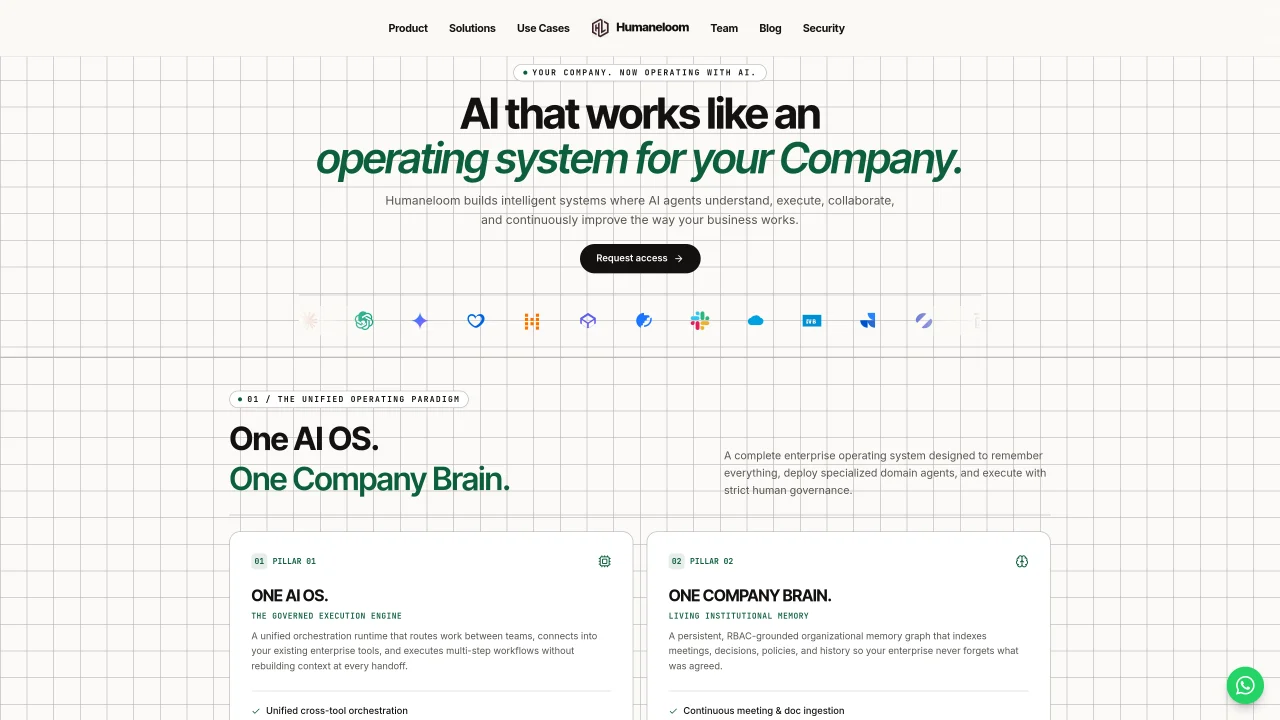
LoomOS functions as an AI-native operating system for enterprises, coordinating specialized AI agents across departments while preserving institutional knowledge. It ingests meetings, documents, and communications in real time to build a persistent organizational memory graph that indexes decisions, policies, and precedents. The system orchestrates multi-step workflows across existing enterprise tools such as SAP, Jira, Slack, and Linear without rebuilding context at each handoff. Purpose-built AI employees handle roles in HR, IT, finance, operations, and executive functions, executing tasks with human approval gates and cryptographic audit trails. The platform enforces strict governance through immutable logs and deterministic ownership chains, ensuring accountability and traceability for every action. Continuous execution loops transform conversations into reasoning, planning, and governed action, with outcomes automatically recorded back into the institutional memory.
LoomOS is an AI-native operating system for enterprises that coordinates specialized AI agents across departments while preserving institutional knowledge. It ingests meetings, documents, and communications in real time to build a persistent organizational memory graph that indexes decisions, policies, and precedents.
LoomOS is designed for enterprises seeking to automate multi-step workflows across existing tools like SAP, Jira, Slack, and Linear while maintaining human governance and accountability. It suits organizations that need to preserve institutional knowledge and ensure traceability in their operations.
LoomOS connects into existing enterprise tools such as SAP, Jira, Slack, and Linear through APIs, enabling unified cross-tool orchestration without rebuilding context at each handoff. This ensures seamless workflow execution across departments and systems.
No, LoomOS retains human authority by design, incorporating approval gates at critical thresholds and providing immutable cryptographic audit logs for complete operational traceability. Human oversight remains central to the execution process.
LoomOS deploys purpose-built AI employees tuned for specific domains such as HR recruitment, IT service desk, finance reconciliation, factory operations, sales intelligence, and executive briefings. These agents collaborate across departments to automate enterprise operations.
LoomOS builds a persistent organizational memory graph that indexes meetings, decisions, policies, and precedents, ensuring the company never loses context. It captures verbatim discussions, reasoning, constraints, and ownership chains for future reference.
We use essential cookies to run aitoolnavio™, and optional cookies to analyze traffic and measure our marketing. You choose what we use — optional cookies stay off unless you turn them on. See our Privacy Policy.
One short email a week: fresh tools worth trying, honest takes and the updates that actually matter. No spam, unsubscribe any time.
Generate captions, optimize content, and enhance with custom images for maximum engagement.
Build conversational forms, capture rich responses, and automate follow-ups with AI-powered surveys and workflows.
Automate code, research, and documents using agents.
AI-powered IDE for autonomous coding tasks and agentic development workflows
Source, match, and manage talent with predictive analytics for effortless recruiting.
Automate workflow, optimize operations, and detect potential issues with this efficient AI-driven solution.
Transforms thoughts into actions, enhancing productivity and efficiency.
AI Recruitment engine to hire top global talent
All-in-one team productivity platform combining chat, docs, video meetings, workflows, and AI tools in one place.
Personal assistant that coordinates tasks across apps and devices via text or call
AI automation and agent-building platform with 3,000+ app integrations
AI job search copilot that matches roles to skills, optimizes resumes for ATS, generates cover letters, and autofills applications with real-time insights.
Matched on what this tool does — grouped by the job you would be replacing.
matches Cross-tool workflow orchestration · Multi-agent collaborative loops · Domain-tuned AI employees
Unified AI operating system that connects agents, workflows, and business systems into one intelligent execution platform.
Enterprise AI orchestration platform that connects autonomous agents to business apps via a single governed endpoint.
Enterprise agentic automation platform unifying data and executing workflows across systems
Enterprise AI operating system for building, running and governing AI agents and workflows
matches Real-time meeting and document ingestion · Role-based access control (RBAC) grounded memory · Cryptographic audit logging
Collaborative workspace where teams and AI agents work together in shared rooms
AI agent runtimes, persistent memory, and provenance infrastructure for R&D teams and enterprises.
Turn screen recordings into governed agent workflows that operate across real software
Enterprise AI knowledge platform connecting documents and tools into a governed shared brain