
OpenAI builds and deploys advanced AI models like GPT-4o for autonomous agents and workflows.

Meterless
0Popularity
About Meterless
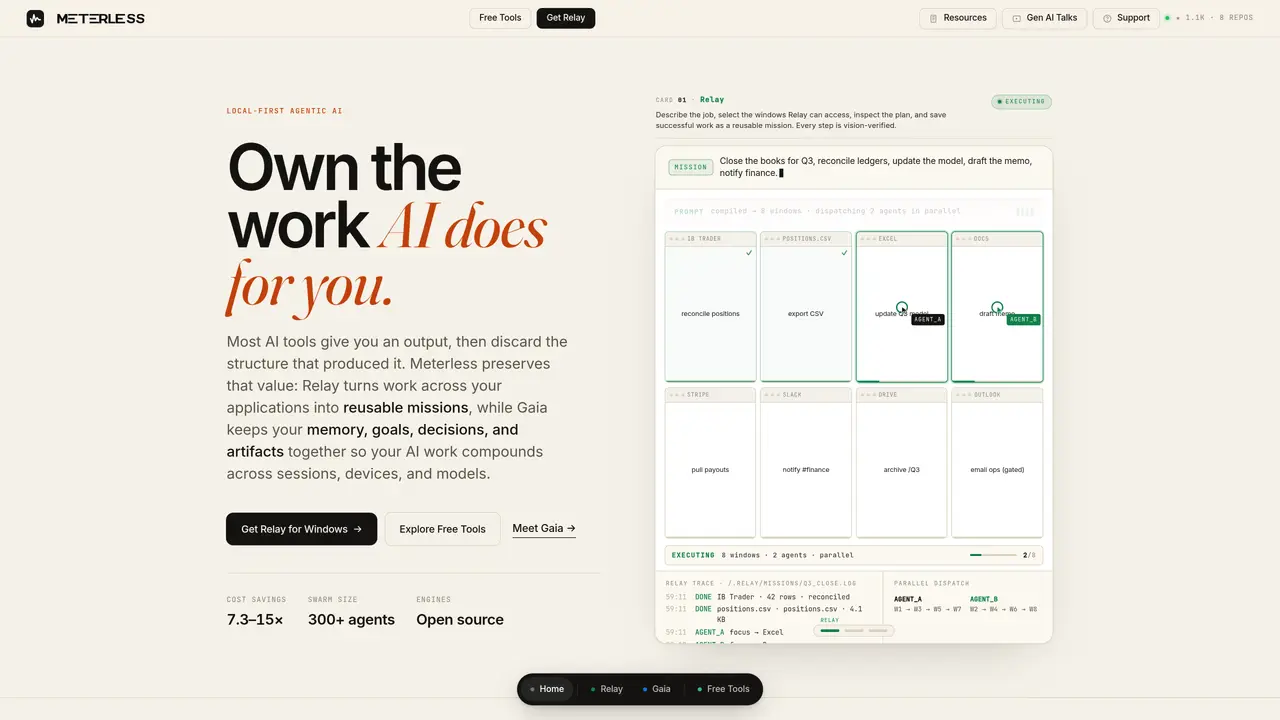
Meterless provides a local-first environment for creating, storing, and reusing AI-driven workflows. The platform consists of three main components: Relay, Gaia, and Swarms. Relay allows users to describe tasks, select accessible applications, and save successful workflows as reusable missions with vision-verified steps. Gaia maintains memory, goals, decisions, and artifacts across sessions, enabling continuous learning and context retention independent of AI models. Swarms enables the creation of coordinated agent teams that run locally in the browser, with editable graphs and preserved artifacts. The Meterless Runtime underpins these tools, offering model-agnostic orchestration, persistent context, and local execution. The system emphasizes privacy by processing files on-device and supports open-source components. It is designed for users who need to automate repetitive tasks, maintain workflow continuity, and reduce dependency on specific AI providers.
Key features
- Mission creation with vision-verified steps
- Persistent memory across sessions
- Swarm agent coordination in browser
- PDF and image batch processing
- Model-agnostic workflow execution
- On-device file processing
- Approval gates and replay functionality
- Open-source runtime and primitives
Use cases
- Automating repetitive desktop workflows
- Maintaining project continuity across AI model changes
- Coordinating parallel AI agents for complex tasks
Pros
- Preserves workflow structures for reuse across sessions
- Local-first processing with privacy controls
- Supports vision-verified steps and approval gates
- Open-source components with Apache 2.0 license
- Model-agnostic orchestration
Cons
- Windows-only for Relay
- Waitlist required for some features
- Limited to local execution for free tools
Frequently asked questions about Meterless
What does Meterless do?
Meterless provides a local-first environment for creating, storing, and reusing AI-driven workflows. It preserves the structure of AI work, including missions, memory, decisions, and artifacts, so users can automate tasks, maintain continuity, and reduce dependency on specific AI providers.
Who is Meterless designed for?
Meterless is designed for users who need to automate repetitive tasks, maintain workflow continuity, and reduce dependency on specific AI providers. It suits individuals or teams looking to preserve and reuse AI work across sessions and devices.
How does Meterless handle pricing?
Meterless offers free tools, including Relay, Gaia, and Swarms, which process files on-device without requiring an account. The platform emphasizes privacy and open-source components, with pricing models potentially varying for advanced or enterprise use cases.
What integrations does Meterless support?
Meterless supports integrations with local applications through Relay, enabling users to describe tasks and select accessible windows for automation. It also supports open-source components and can be integrated into other platforms via the Meterless Runtime.
What are the limitations of Meterless?
Meterless processes files locally, which may limit performance for very large or complex tasks. Additionally, while it supports open-source components, advanced features or enterprise use cases may require specific configurations or waitlist access.
How do I get started with Meterless?
Users can start with Meterless by downloading Relay for Windows, exploring Gaia for memory and continuity, or launching Swarms for agent coordination. The platform offers free tools that require no account and process files on-device for privacy.