
OpenAI builds and deploys advanced AI models like GPT-4o for autonomous agents and workflows.

Odysseus
$0.07Starting price
0Popularity
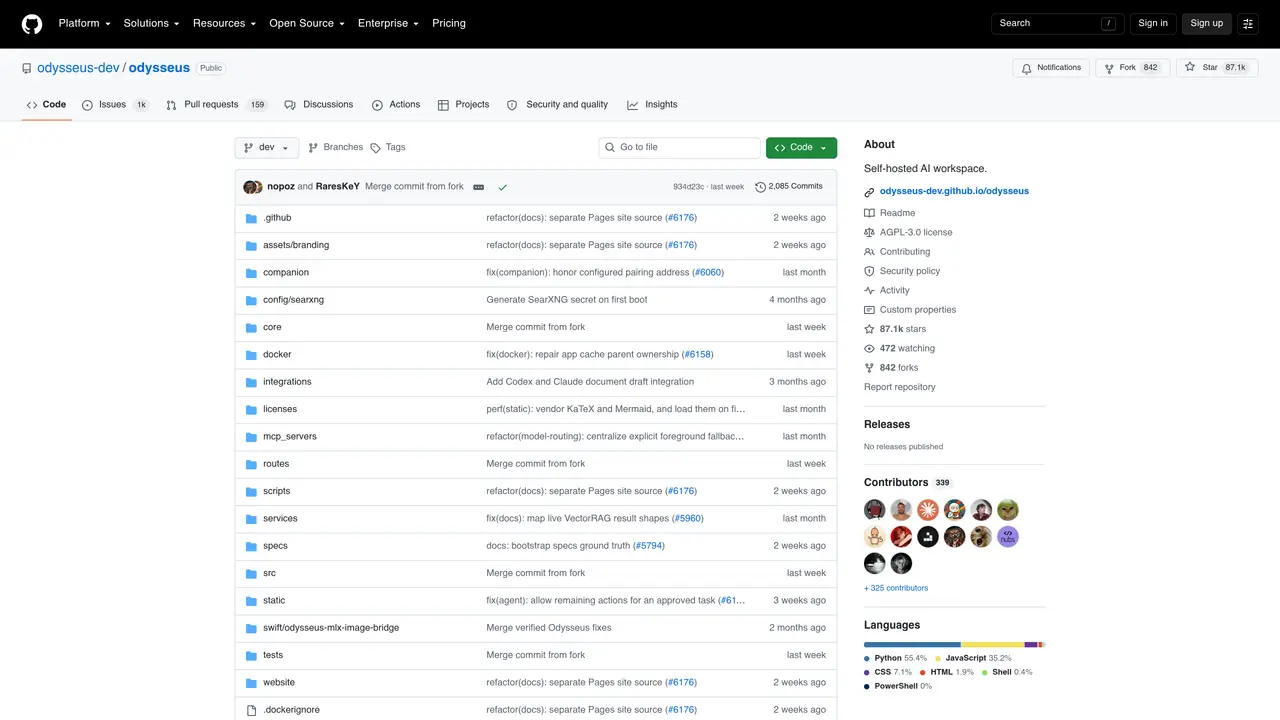
About Odysseus
Odysseus is a self-hosted AI workspace designed to run on your own hardware, offering a unified environment for local-first chat, autonomous agents, tool execution, model serving, email integration, and research workflows. It combines the conversational experience of ChatGPT with the workspace UX of Claude, enabling users to manage AI interactions entirely within their own infrastructure. The platform is built for developers, AI builders, privacy-focused users, and teams seeking full control over their AI tools, data, and model choices without relying on cloud services. Odysseus supports both local LLMs and API-based models, allowing experimentation with self-hosted infrastructure and open-source workflows. It functions as a personal AI command center for tasks like research, note-taking, task management, and agent-driven automation, all while prioritizing data privacy and avoiding built-in telemetry. The interface integrates model routing, workspace behavior customization, and private AI productivity flows, making it suitable for homelab users, researchers, students, and technical founders who value autonomy and security in their AI workflows.
GitHub, Inc.
San Francisco, California, US · Founded 2008
- Founders
- Tom Preston-Werner, Chris Wanstrath, PJ Hyett, Scott Chacon
- Founded
- 2008
- Headquarters
- San Francisco, California, US
- Legal status
- Subsidiary of Microsoft (NASDAQ: MSFT)
Key features
- Self-hosted AI workspace on personal hardware
- Local-first chat with ChatGPT-style and Claude-style UX
- Autonomous agents and tool execution
- Model serving for local and API-based LLMs
- Email integration within the workspace
- Research workflows and private data control
- No built-in telemetry for privacy-first operation
- Customizable model routing and workspace behavior
- Support for local LLMs and open-source AI infrastructure
- Personal AI command center for research, notes, and tasks
Use cases
- Run a private self-hosted AI workspace on personal hardware
- Experiment with autonomous agents, tools, and model serving in a local-first environment
- Manage research workflows, notes, and tasks with privacy-focused AI control
Pros
- Self-hosted deployment ensures full control over data, models, and infrastructure
- Supports both local LLMs and API-based models for flexible experimentation
- Integrates multiple productivity tools (email, notes, tasks, calendar) in a unified workspace
- Prioritizes privacy with no built-in telemetry and local-first architecture
- Hardware-aware model recommendations and serving via the Cookbook feature
Cons
- Requires technical setup for self-hosting, including Docker and configuration
- Local model performance depends on available hardware resources
- Exposing the workspace to networks requires careful security configuration
Frequently asked questions about Odysseus
What is Odysseus and what does it do?
Odysseus is a self-hosted AI workspace that combines chat, autonomous agents, research workflows, document editing, email integration, and productivity tools into a unified local environment.
Who is Odysseus designed for?
It is designed for developers, AI builders, privacy-focused users, researchers, students, and technical teams who want full control over their AI tools and data without relying on cloud services.
How does Odysseus handle pricing and licensing?
Odysseus is open-source software released under the AGPL-3.0 license, meaning it is free to use, modify, and distribute, though self-hosting may incur hardware and operational costs.
What integrations does Odysseus support?
It supports integrations with local and API-based models, MCP servers for external tools, IMAP/SMTP for email, and CalDAV for calendar sync, among others.
What are the main limitations of Odysseus?
The primary limitations include the need for technical expertise to set up and maintain a self-hosted environment, dependency on local hardware for model performance, and security considerations when exposing the workspace to networks.
How do I get started with Odysseus?
To get started, clone the repository, configure the environment using the provided example files, and run the Docker containers. Detailed setup instructions are available in the project's documentation.