GitHub hosts HunyuanVideo, Tencent's open-source framework for large-scale video generation models, enabling AI-driven video creation.

Open WebUI
$0.07Starting price
0Popularity
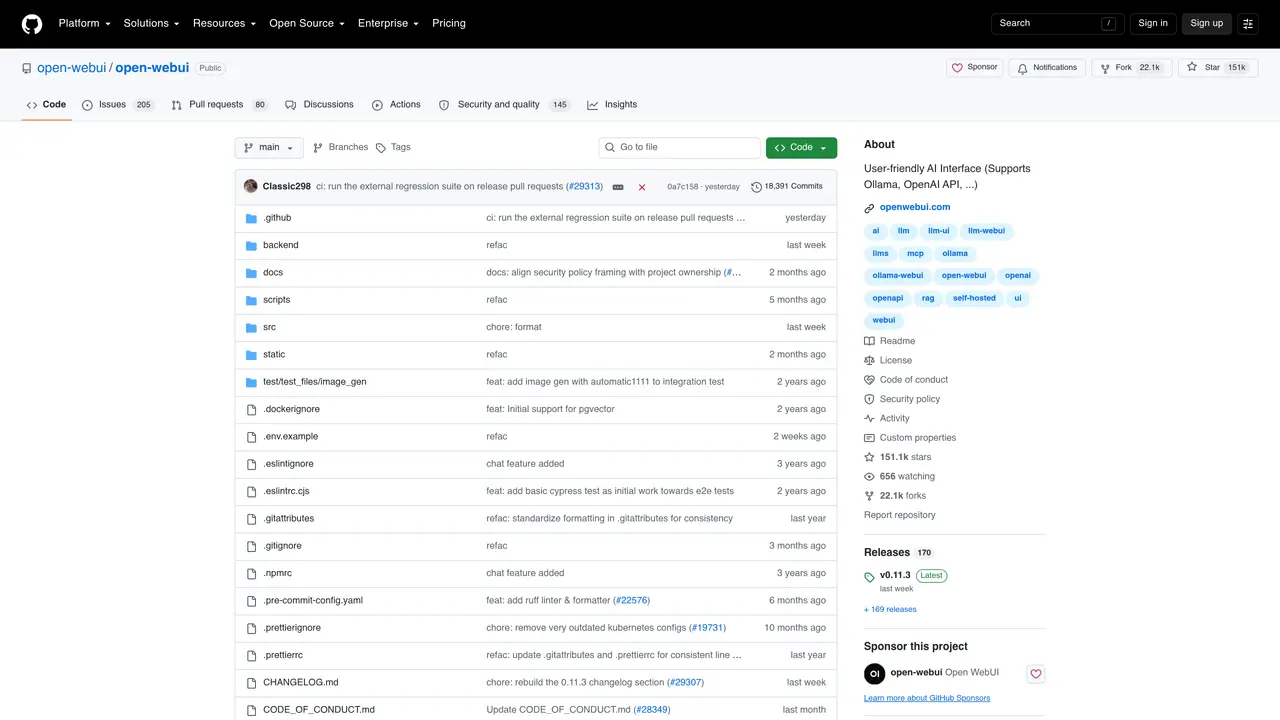
About Open WebUI
Open WebUI is a self-hosted platform designed for running AI language models locally, ensuring complete data privacy and avoiding vendor lock-in. It supports a variety of language models and provides tools for managing users, customizing interactions, and integrating retrieval-augmented generation (RAG) capabilities. The platform is built for individuals and organizations that prioritize control over their AI infrastructure, cost efficiency, and the ability to tailor the system to specific needs. By hosting models on-premise, users eliminate dependency on external APIs and maintain full ownership of their data and model interactions. Open WebUI is particularly suited for environments where data security is critical, such as research labs, enterprises, or privacy-focused teams. Its active community and open-source nature further enhance its flexibility and long-term viability as an AI solution.
GitHub, Inc.
San Francisco, California, US · Founded 2008
- Founders
- Tom Preston-Werner, Chris Wanstrath, PJ Hyett, Scott Chacon
- Founded
- 2008
- Headquarters
- San Francisco, California, US
- Legal status
- Subsidiary of Microsoft (NASDAQ: MSFT)
Key features
- Self-host AI language models locally
- User management and role-based access control
- Customizable AI interactions and interfaces
- Retrieval-augmented generation (RAG) support
- Offline operation with no external API dependencies
- Open-source and community-driven development
- Model selection flexibility across supported LLMs
- Data privacy and security through local hosting
Use cases
- Running AI models in secure, air-gapped environments
- Customizing AI workflows for specific organizational needs
- Avoiding vendor lock-in while maintaining full data control
Pros
- Supports both local and cloud-based AI models through OpenAI-compatible APIs and Ollama
- Offers granular role-based access control (RBAC) and user group management for secure multi-user environments
- Extensible via plugins, tools, and MCP/MCPO/OpenAPI integrations for custom workflows
- Available as self-hosted installation via pip, Docker, or Kubernetes with optimized images
- Designed for offline operation and complete data privacy
Cons
- Requires technical expertise for self-hosting and configuration
- Performance depends on local hardware capabilities for running models
- Limited official support compared to managed AI platforms
Frequently asked questions about Open WebUI
What is Open WebUI?
Open WebUI is a self-hosted, open-source AI platform designed to run language models locally or connect to cloud-based providers via OpenAI-compatible APIs. It provides a user-friendly interface for managing models, users, and integrations while prioritizing data privacy and offline operation.
Who should use Open WebUI?
Open WebUI suits individuals, researchers, and organizations that require full control over their AI infrastructure, such as privacy-focused teams, enterprises, or labs handling sensitive data. It is ideal for those who prefer self-hosting over relying on external APIs.
How do I get started with Open WebUI?
Open WebUI can be installed via pip, Docker, or Kubernetes using provided images and configurations. The platform supports Ollama for local models and OpenAI-compatible APIs for cloud-based models, with detailed documentation available for setup and customization.
Does Open WebUI support integrations with other tools?
Yes, Open WebUI supports integrations through plugins, tools, and MCP/MCPO/OpenAPI tool servers, allowing users to connect external services, build custom workflows, and extend functionality as needed.
Can Open WebUI run offline?
Yes, Open WebUI is designed to operate entirely offline when using local models, ensuring data privacy and eliminating dependency on external APIs.
What model providers does Open WebUI support?
Open WebUI supports local models via Ollama and any OpenAI-compatible API, including providers like LMStudio, GroqCloud, Mistral, OpenRouter, and vLLM, allowing users to mix and match providers freely.