GitHub hosts HunyuanVideo, Tencent's open-source framework for large-scale video generation models, enabling AI-driven video creation.

SovereignAI
FreeStarting price
0Popularity
About SovereignAI
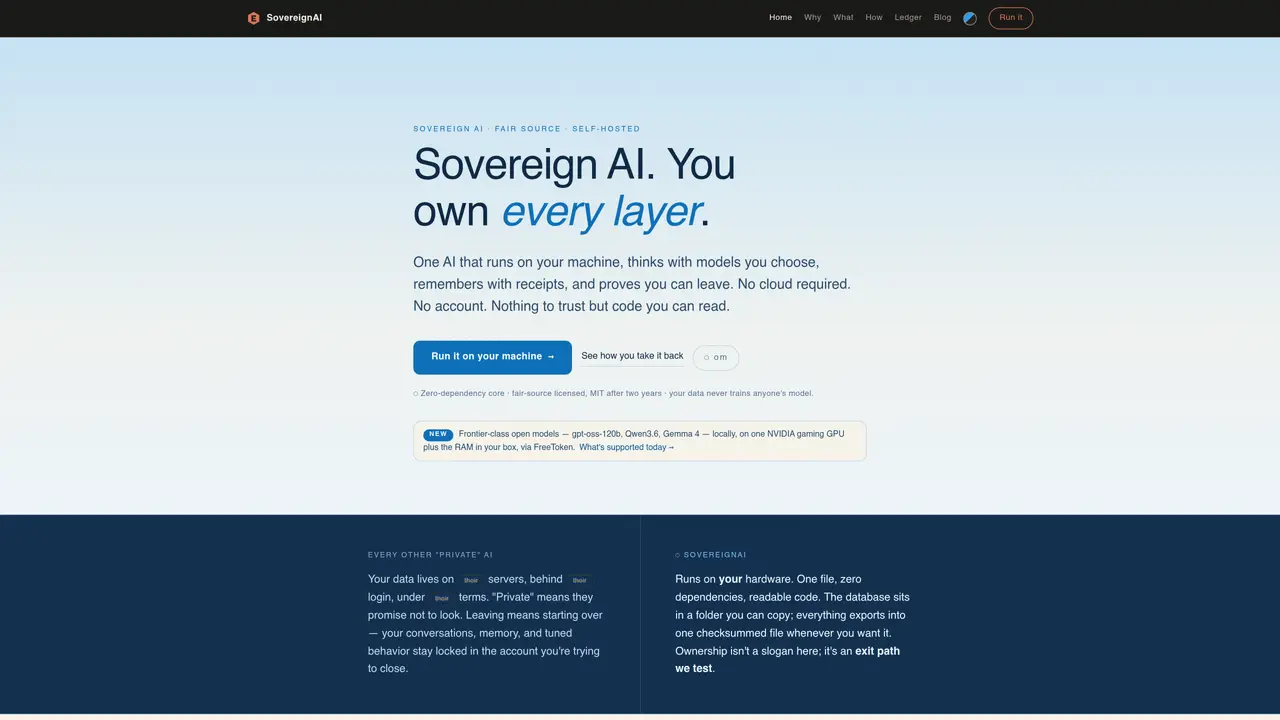
SovereignAI is a self-hosted AI platform designed to run entirely on local hardware without cloud dependency. It allows users to select and run open models locally, including frontier-class options like gpt-oss-120b and Qwen3.6, using minimal hardware such as a single NVIDIA gaming GPU and host RAM. The system emphasizes data ownership by storing all information locally in a portable folder and enabling exports with cryptographic verification. It supports importing conversations, emails, and documents in various formats, parsing them locally without uploading data. The platform integrates with multiple local engines like Ollama, FreeToken, and llama.cpp, and offers compatibility with popular development tools through an OpenAI-compatible API. Memory management includes distilling conversations into retrievable facts with citations, while provenance tracking ensures every output can be verified. The interface is delivered as a single binary with zero runtime dependencies, available for Windows, macOS, and Linux.
Key features
- Local model execution with user-selected open models
- Portable database stored in a single folder
- Cryptographic verification of exports and receipts
- Local parsing of documents and emails without upload
- OpenAI-compatible API for tool integration
- Memory distillation with citation tracking
- Multi-platform support (Windows, macOS, Linux)
- Zero runtime dependencies in single binary
Use cases
- Migrating prior AI conversations from cloud services to local storage
- Auditing personal subscriptions and expenses from email exports
- Running private AI models on local hardware for sensitive tasks
Pros
- Runs entirely on local hardware without cloud dependency
- Supports importing and distilling prior AI conversations and emails locally
- Portable data storage with cryptographic verification and export options
- Open-source core with fair-source licensing model
- Integrates with multiple local AI engines and development tools
Cons
- Requires compatible local hardware for model execution
- No cloud backup or synchronization options
- Limited to models and features available at the time of download
Frequently asked questions about SovereignAI
What is SovereignAI and how does it differ from other AI tools?
SovereignAI is a self-hosted, fair-source AI platform that runs entirely on local hardware without cloud dependency or accounts. Unlike other tools, it emphasizes data ownership by storing all information locally in a portable folder and enabling exports with cryptographic verification.
Who should use SovereignAI?
SovereignAI suits users who prioritize data privacy, control, and ownership, such as individuals, researchers, or organizations that want to run frontier-class AI models locally without relying on cloud services or third-party servers.
How does SovereignAI handle data privacy and ownership?
All data is stored locally in a portable folder and can be exported with cryptographic verification. The platform parses imported files like emails or documents locally without uploading data, ensuring nothing leaves the user's machine unless explicitly chosen.
What models and engines does SovereignAI support?
SovereignAI supports frontier-class open models like gpt-oss-120b and Qwen3.6, as well as smaller models, via local engines such as Ollama, FreeToken, and llama.cpp. It also offers an OpenAI-compatible API for integration with popular development tools.
How do I get started with SovereignAI?
Users can download a single binary with zero runtime dependencies for Windows, macOS, or Linux. The platform requires no account and works offline, with options to run via Docker, Docker Compose, or directly from source.
Does SovereignAI support remote models or cloud services?
Local models are the default, but SovereignAI allows remote model usage if explicitly chosen. Any remote call is disclosed on screen at the moment it is used, and the platform provides a receipt for verification.