OpenAI builds and deploys advanced AI models like GPT-4o for autonomous agents and workflows.

Ollagraph
$5Starting price
0Popularity
About Ollagraph
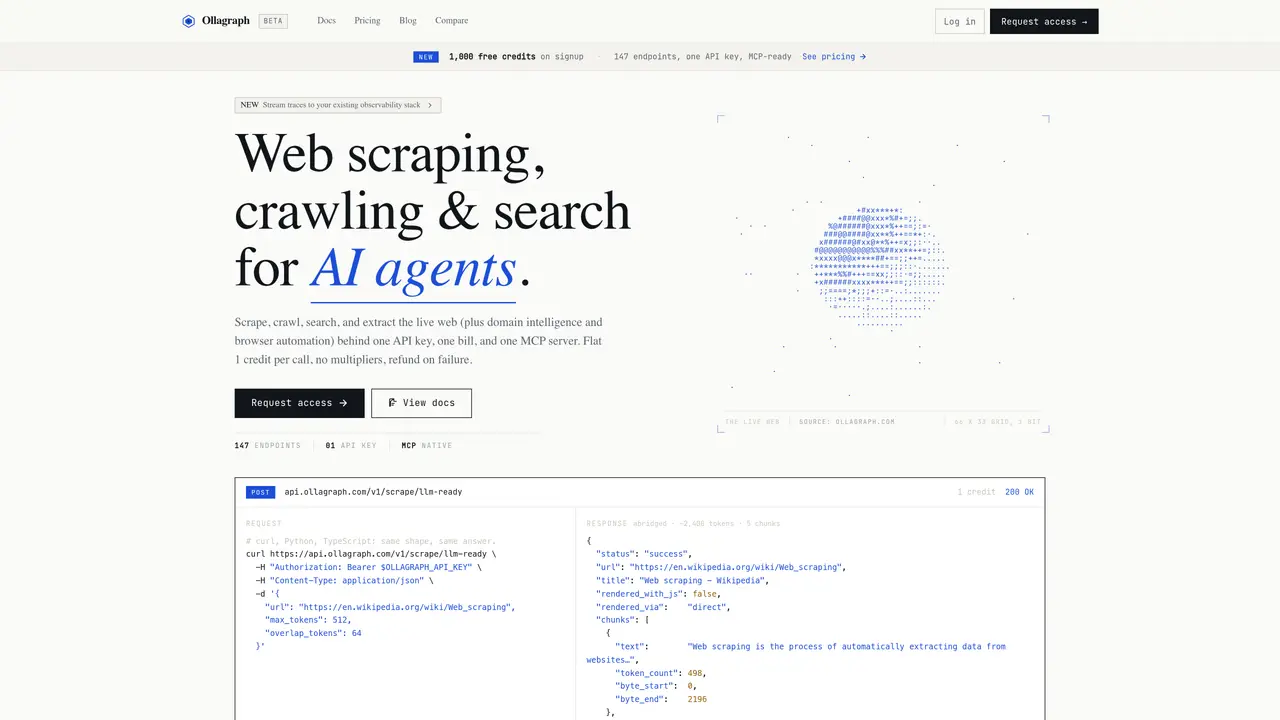
Ollagraph provides a unified API for web scraping, crawling, search, and structured extraction, designed specifically for AI agents. It offers 147 endpoints under one API key, billing model, and MCP server, covering core primitives like scrape, crawl, search, and extract. The service handles JavaScript rendering when needed, follows robots.txt rules, and includes browser automation via stealth Chromium pools. It supports structured extraction with JSON schemas, async jobs with webhooks, and agent observability with trace replay and diff tools. Additional features include domain intelligence (DNS, SSL, threat signals), markdown conversion, and AEO audits for AI crawler visibility. The platform emphasizes flat pricing with 1 credit per call and automatic refunds on failures, targeting production AI workflows.
Key features
- 147 endpoints under one API key
- JavaScript rendering with stealth Chromium pools
- Structured extraction with JSON schemas
- Smart crawling respecting robots.txt
- Web search across engines with merged results
- Async jobs with webhooks and idempotency keys
- Agent observability with trace replay
- Domain intelligence including DNS and SSL checks
Use cases
- RAG and LLM pipeline ingestion from live web content
- Sales lead enrichment with firmographics and tech stack data
- Price and review monitoring across marketplaces
Pros
- Unified API covering scraping, crawling, search and extraction
- MCP-native integration for AI agent tooling
- Automatic JavaScript rendering with residential proxy pool
- Structured extraction with JSON schema validation
- Agent observability with trace replay and diff tools
Cons
- No free tier beyond initial 1,000 credits
- Requires API key and credits for usage
- Limited to 30–120 requests per minute depending on plan
Frequently asked questions about Ollagraph
What does Ollagraph do?
Ollagraph provides a unified API for web scraping, crawling, search, and structured extraction designed specifically for AI agents. It consolidates core primitives like scrape, crawl, search, and extract into a single platform with 147 endpoints, one API key, and one billing model.
Who is Ollagraph for?
Ollagraph is built for AI agents, developers, and teams working with production AI workflows that require reliable web data access. It suits use cases like RAG pipelines, sales intelligence, price monitoring, and AI-search audits.
How does Ollagraph handle pricing?
Ollagraph uses a flat pricing model where most endpoints cost 1 credit per call, with orchestrators costing 3 credits. It offers automatic refunds on failures, ensuring users only pay for successful calls.
Does Ollagraph support integrations with other tools?
Yes, Ollagraph is MCP-native, providing all 147 endpoints as MCP tools. It also offers typed SDKs in TypeScript and Python, a REST API, and supports webhooks for async jobs, making it compatible with existing workflows.
What are the limitations of Ollagraph?
Ollagraph does not store scraped content and emphasizes compliance with robots.txt rules. However, it may face challenges with highly anti-bot-protected sites, though it uses stealth Chromium pools and SPA detection to mitigate this.
How do I get started with Ollagraph?
Users can sign up to receive 1,000 free credits and access the platform via the API key. Documentation and SDKs are available for TypeScript, Python, and cURL, with MCP support for seamless integration into AI workflows.