
OpenAI builds and deploys advanced AI models like GPT-4o for autonomous agents and workflows.

Polimorf
0Popularity
About Polimorf
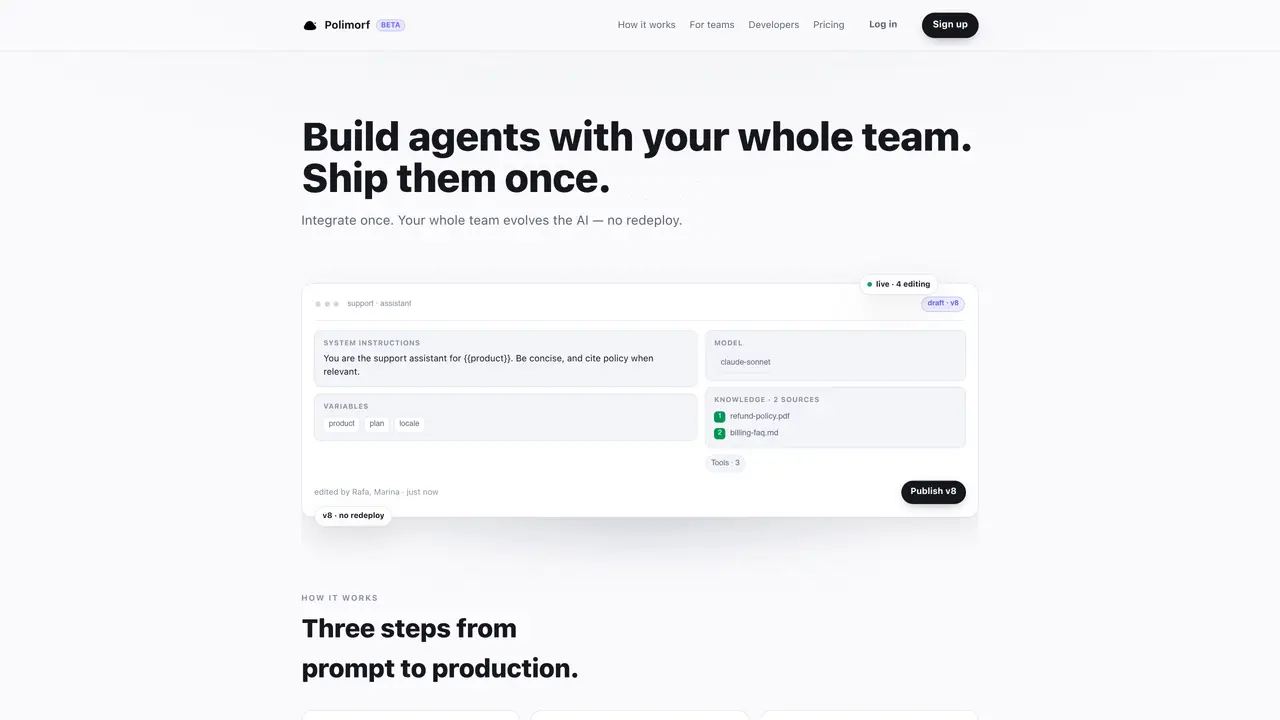
Polimorf is a collaborative platform designed for teams to build, test, deploy, and evolve AI agents without requiring redeployment of application code. The platform features a visual studio called Prompt Studio, where teams can compose assistants by defining system instructions, variables, knowledge sources, and tools. Drafts can be tested in a shared playground before publishing, enabling cross-functional collaboration among product, support, compliance, and engineering teams. Once integrated via a single SDK call using an assistant’s slug, the application continues to reference the same endpoint while the team iteratively refines the agent’s behavior, model, knowledge, or tools across versions and environments. Polimorf supports role-based access control, allowing different team members to contribute based on their roles, such as Owner, Admin, Developer, Product Editor, or Viewer. The platform includes observability features like traces, token usage, cost tracking, and optional content capture, as well as evaluations to score versions against datasets before changes reach users. It is provider-neutral, supporting models from providers like OpenAI and Anthropic, and allows teams to switch models or providers without changing integration code.
Key features
- Visual prompt composition with system instructions and variables
- Knowledge and RAG with source citation
- Versioning and environment management
- Role-based access control (Owner, Admin, Developer, Product editor, Viewer)
- Playground for multi-user testing and multichat
- Traces, token usage and cost observability
- Evaluations against datasets before publishing
- Fine-grained audit logging
Use cases
- Customer support agent refined by product and support teams
- Internal knowledge assistant for HR or compliance policies
- Product documentation assistant for engineering teams
Pros
- Team collaboration on prompts, variables and knowledge without coding
- Single SDK integration that persists across agent updates
- Versioning and environment promotion with rollback capability
- Bring-your-own-model keys with transparent provider billing
- Shared playground for multi-user testing and review
Cons
- Currently in beta with only a free plan available
- Limited to OpenAI and Anthropic models at present
- Knowledge retrieval is metered separately
- No enforced usage caps during beta period
Frequently asked questions about Polimorf
What is Polimorf and who is it designed for?
Polimorf is a platform for teams to collaboratively build, test, and deploy AI agents without redeploying application code. It is designed for cross-functional teams, including product, support, compliance, and engineering, enabling them to refine and evolve AI agents together.
How does Polimorf handle integrations and deployments?
Teams integrate Polimorf via a single SDK call using an assistant’s slug. Once integrated, the application continues to reference the same endpoint, allowing teams to publish new versions and deploy them across environments without redeploying the application code.
Does Polimorf support role-based access control?
Yes, Polimorf supports role-based access control with roles such as Owner, Admin, Developer, Product Editor, and Viewer, allowing teams to manage contributions and permissions effectively.
Can I bring my own model keys to Polimorf?
Yes, Polimorf allows users to bring their own provider keys. Every generation runs against the user’s own OpenAI or Anthropic keys, and users pay the providers directly at cost.
What providers and models does Polimorf support?
Polimorf is provider-neutral and currently supports OpenAI and Anthropic models, with plans to expand support for additional providers in the future.
Is Polimorf free to use?
Polimorf is currently in early access beta and offers a Free plan with no enforced limits during the beta period. The platform plans to introduce paid tiers with advance notice.