
OpenAI builds and deploys advanced AI models like GPT-4o for autonomous agents and workflows.

Qurio
FreeStarting price
874Monthly visits
0Popularity
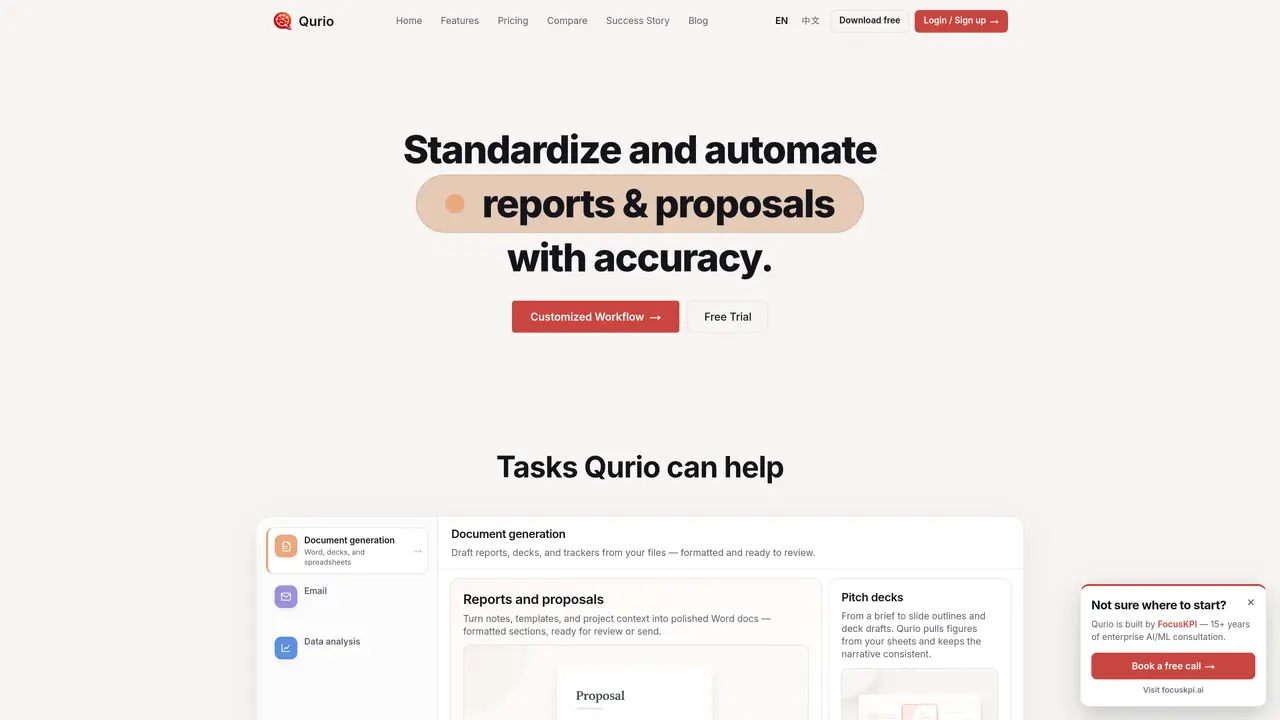
About Qurio
Qurio automates document generation, email campaigns, data analysis, and operational workflows by reading and writing directly to connected tools such as OneDrive, Google Drive, Gmail, Excel, and CRM systems. It transforms raw data, notes, or templates into formatted reports, pitch decks, trackers, and summaries without requiring users to switch applications. Teams trigger workflows through chat commands, and the system handles branches, approvals, and cross-tool routing based on plain-language instructions. Custom workflows are designed and implemented with customer teams, then run autonomously while being monitored and tuned over time. The tool is positioned for sales, marketing, operations, and field teams that need to standardize repetitive processes like lead follow-ups, quote generation, and status tracking. It operates on top of existing software stacks without replacing them, relying on user-authorized connections to files and accounts.
Key features
- Document generation from files into Word, decks, and spreadsheets
- Email campaign automation and triage
- Data analysis and KPI reporting
- Custom workflow design with branches and approvals
- Integration with Salesforce, Excel, and catalog APIs
- Autonomous workflow execution triggered by chat
- Prompt tuning and minor maintenance included in higher tiers
- SMS or voice briefings for field staff
Use cases
- Automating lead recovery and re-engagement workflows
- End-to-end quote intake and drafting from catalogs
- Generating operational briefings and status trackers from live data
Pros
- Connects to common business tools (OneDrive, Google Drive, Gmail, Excel, CRM, Slack, ClickUp)
- Automates document generation, email campaigns, and data analysis from existing files
- Supports custom workflows with branches, approvals, and cross-tool routing
- Operates via chat commands without requiring new software installations for end users
- Provides add-on consultation for workflow design and implementation
Cons
- No free tier beyond a trial; paid plans start at $29/month
- Requires desktop app installation for account connections
- Custom workflows are built and maintained by the vendor, not self-service
- Limited to integrations explicitly listed on the site
Frequently asked questions about Qurio
How is Qurio different from Zapier?
Zapier requires users to define triggers, actions, and maintain a visual diagram, whereas Qurio operates from plain-language instructions like 'follow up on leads from last week' without needing manual setup or maintenance.
How is Qurio different from Microsoft Copilot or ChatGPT?
Unlike Copilot or ChatGPT, which provide responses in a chat window, Qurio reads and writes directly to connected tools such as OneDrive, Google Drive, or Gmail, and updates files or tasks in place based on user instructions.
Do my team members need to install a new app to use Qurio?
Field and floor staff can receive briefings via SMS or voice without installing a new app. A desktop app is required only to connect accounts, while users can continue using their existing tools and devices.
Do I need to be technical to use Qurio?
No technical expertise is required. Users can operate Qurio by typing plain-language instructions such as 'status on Acme' or 'draft Monday's ops brief,' similar to sending an email or opening a shared folder.
Does Qurio work with my existing tools?
Yes, Qurio integrates with tools like OneDrive, Teams, Gmail, Google Drive, Calendar, ClickUp, Airtable, Slack, and more, operating on top of existing software stacks without replacing them.
Is my data secure when using Qurio?
Data remains within your connected accounts, and Qurio only accesses what you authorize. You can disconnect integrations at any time, and the company does not sell user data.
Qurio Website Engagement
Last Update: 9 days ago
Total Monthly Visits
0
Bounce Rate
0%
Visit Duration (avg)
—
Pages Per Visit
0
Country Rank
—
Unknown
Global Rank
—