
OpenAI builds and deploys advanced AI models like GPT-4o for autonomous agents and workflows.

RuView
$0.07Starting price
0Popularity
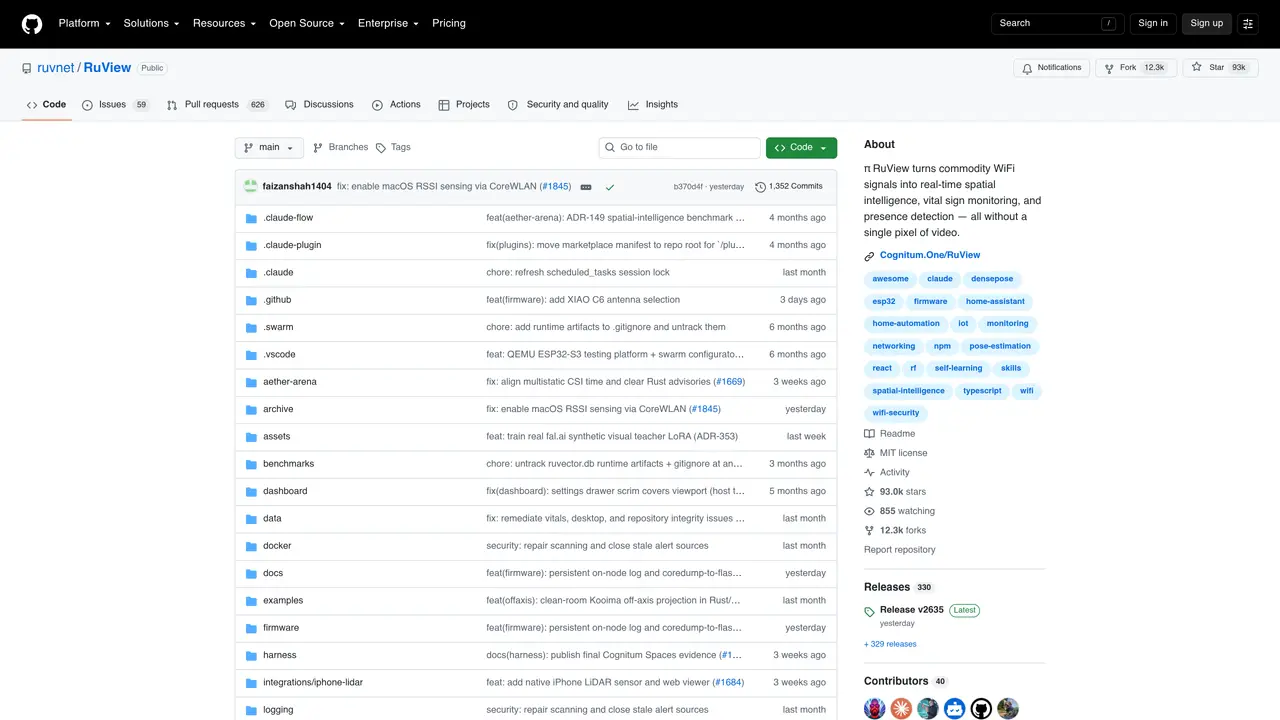
About RuView
RuView is an open-source WiFi sensing and edge AI perception platform that transforms ordinary WiFi signals into spatial intelligence without relying on cameras or wearables. It enables developers and researchers to build camera-free sensing systems by analyzing WiFi Channel State Information (CSI) and deploying ESP32 sensor nodes for real-time presence detection, pose estimation, vital sign monitoring, fall detection, and room activity awareness. The platform emphasizes privacy-first sensing, making it suitable for applications in smart homes, elder care, healthcare, security, and building automation where visual monitoring is undesirable or prohibited. RuView supports edge AI processing pipelines, allowing for local signal analysis to maintain data privacy while delivering real-time environmental intelligence. It provides tools for experimenting with signal processing, pose estimation, and vital sign monitoring, along with visualization and calibration utilities to ensure reliable performance in indoor environments. The project includes documentation, Docker workflows, Rust components, and Python modules to facilitate integration with existing hardware and development environments.
GitHub, Inc.
San Francisco, California, US · Founded 2008
- Founders
- Tom Preston-Werner, Chris Wanstrath, PJ Hyett, Scott Chacon
- Founded
- 2008
- Headquarters
- San Francisco, California, US
- Legal status
- Subsidiary of Microsoft (NASDAQ: MSFT)
Key features
- WiFi Channel State Information (CSI) analysis for presence and movement detection
- Camera-free and wearable-free pose estimation and movement tracking
- Vital sign monitoring including breathing patterns and heart rate
- Fall detection and sleep monitoring capabilities
- Privacy-first spatial intelligence for room awareness and activity tracking
- ESP32 sensor node integration for edge AI perception pipelines
- Real-time signal processing and edge AI workflows
- Docker and Rust/Python module support for development and deployment
- Visualization tools for monitoring and calibration
- Multi-sensor spatial intelligence experiments
Use cases
- Develop privacy-sensitive smart home monitoring systems without cameras
- Create elder care solutions for fall detection, vital sign monitoring, and room awareness
- Build occupancy analytics and building automation tools using WiFi sensing
Pros
- Enables camera-free and wearable-free sensing using commodity WiFi signals
- Supports real-time presence detection, pose estimation, and vital sign monitoring
- Integrates with major smart-home ecosystems like Home Assistant, Apple Home, Google Home, and Alexa
- Emphasizes privacy-first sensing by avoiding visual or wearable data collection
- Provides open-source tools for signal processing, model training, and visualization
Cons
- Requires compatible ESP32 sensor nodes for data collection and processing
- Performance may vary based on environmental factors and WiFi signal quality
- Setup and calibration may demand technical expertise in WiFi sensing and edge AI
Frequently asked questions about RuView
What does RuView do?
RuView transforms ordinary WiFi signals into spatial intelligence, enabling real-time presence detection, pose estimation, vital sign monitoring, and room activity awareness without using cameras or wearables.
Who is RuView suitable for?
RuView is designed for developers, researchers, and organizations interested in privacy-first sensing applications such as smart homes, elder care, healthcare, security, and building automation.
How does RuView integrate with smart home systems?
RuView works natively with Home Assistant via MQTT, Apple Home as a HAP-1.1 bridge, and can integrate with Google Home, Amazon Alexa, and SmartThings through Matter endpoints or the Home Assistant bridge.
What kind of hardware is required to use RuView?
RuView requires low-cost ESP32 sensor nodes to capture WiFi Channel State Information (CSI) and process signals locally for edge AI applications.
Does RuView support model training and customization?
Yes, RuView includes built-in workflows for recording CSI data, training models, and loading custom RVF files to adapt sensing capabilities to specific use cases.
How do I get started with RuView?
Start by setting up ESP32 sensor nodes, deploying the RuView software stack, and integrating with your preferred smart home ecosystem using the provided documentation and integration guides.