
Unleash creativity: edit photos, videos, and designs with AI-enhanced tools.

NVIDIA DeepStream SDK
0Popularity
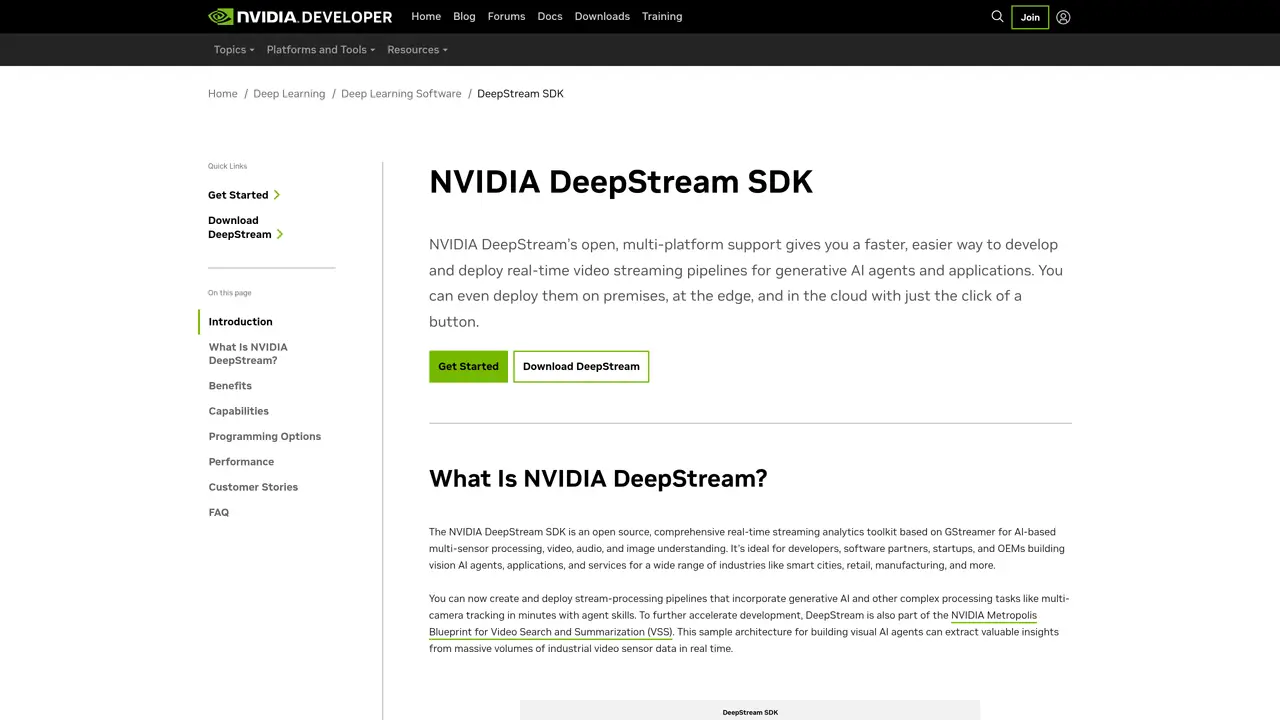
About NVIDIA DeepStream SDK
NVIDIA DeepStream SDK is a comprehensive software development kit designed for building high-performance AI-powered video analytics applications. It enables developers to create applications that perform deep learning inference, object detection, tracking, and real-time analytics on video streams from multiple sources. The SDK is optimized for NVIDIA GPUs, ensuring efficient processing and scalability for edge and cloud deployments. It supports real-time video analytics across industries such as smart cities, retail, industrial automation, and autonomous vehicles. DeepStream SDK integrates with NVIDIA’s AI platform, including TensorRT for optimized inference, and provides tools for multi-stream processing, metadata handling, and visualization. Developers can leverage pre-built plugins and sample applications to accelerate development and deployment. The platform is widely used for applications requiring low-latency, high-throughput video analysis, such as surveillance, traffic monitoring, and quality control in manufacturing. It is particularly suited for scenarios where real-time insights from video data are critical.
Nvidia
Santa Clara, United States · Founded 1993
- Founders
- Jensen Huang, Chris Malachowsky, Curtis Priem
- Founded
- 1993
- Headquarters
- Santa Clara, United States
- Legal status
- Public company
Key features
- Quickly build and deploy AI-enabled video analytics applications
- Process real-time video from multiple sources at the edge
- Optimized for GPUs for high-performance video analytics
Use cases
- Developing high-performance AI-powered video analytics applications
- Processing real-time video from multiple sources at the edge
- Creating AI-enabled applications with deep learning inference and object tracking capabilities
Pros
- Open-source and multi-platform support for flexible deployment across edge, cloud, and on-premises environments
- Accelerates development with pre-built, GPU-accelerated plug-ins and sample applications for rapid pipeline creation
- Supports multimodal data processing, including video, audio, images, and LiDAR, for comprehensive real-time analytics
- Integrates with NVIDIA Metropolis and TAO Toolkit for end-to-end AI solution development and optimization
- Enables multi-camera tracking with tools like MV3DT and AutoMagicCalib for distributed, real-time 3D tracking
Cons
- Requires familiarity with NVIDIA’s ecosystem, including CUDA and GStreamer, for advanced customization
- Dependent on NVIDIA GPU hardware for optimal performance, limiting flexibility for non-NVIDIA deployments
NVIDIA DeepStream SDK videos
Frequently asked questions about NVIDIA DeepStream SDK
What is NVIDIA DeepStream SDK?
NVIDIA DeepStream SDK is an open-source, real-time streaming analytics toolkit based on GStreamer for AI-based multi-sensor processing, including video, audio, and image understanding. It enables developers to build and deploy vision AI applications across edge, on-premises, and cloud environments.
Who should use NVIDIA DeepStream SDK?
The tool is ideal for developers, software partners, startups, and OEMs building vision AI agents, applications, and services for industries such as smart cities, retail, manufacturing, logistics, and more.
What programming languages does DeepStream SDK support?
DeepStream SDK supports multiple programming languages, including C/C++ and Python, for creating vision AI applications.
Can DeepStream SDK integrate with other NVIDIA tools?
Yes, DeepStream SDK integrates with NVIDIA Metropolis, TAO Toolkit, TensorRT, and Dynamo for end-to-end AI solution development, model optimization, and high-performance inference.
Does DeepStream SDK support multi-camera tracking?
Yes, DeepStream SDK includes features like Multiview 3D tracking (MV3DT) and AutoMagicCalib for distributed, real-time multi-camera tracking and calibration.
How does DeepStream SDK accelerate development?
DeepStream SDK accelerates development through agent skills that generate complete video analytics pipelines from natural language prompts, reducing development time from weeks to hours.