
OpenAI builds and deploys advanced AI models like GPT-4o for autonomous agents and workflows.

Unity ML-Agents
$0.07Starting price
0Popularity
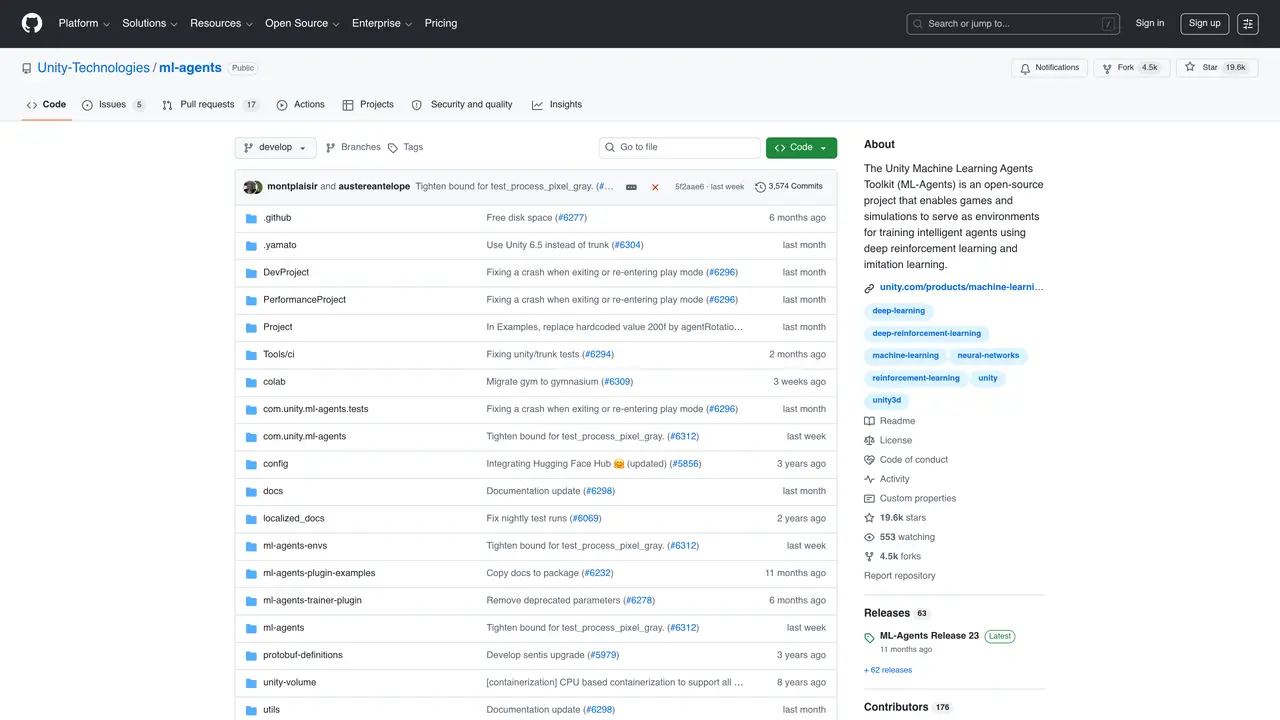
About Unity ML-Agents
Unity ML-Agents is a powerful tool designed to help developers create intelligent agents powered by machine learning. With ML-Agents, developers can create simulated environments for their agents to navigate and interact with, and use reinforcement learning to train and optimize their agents’ behavior. ML-Agents is an easy-to-use, open-source toolkit that provides developers with an array of powerful tools and features, including a custom Python API, a flexible C# API, and a range of pre-trained models. Its intuitive user interface makes it simple to customize and configure settings, so developers can quickly create and deploy intelligent agents that meet their specific needs. With Unity ML-Agents, developers can create complex and intelligent agents that can learn and adapt to dynamic environments and situations. It’s the perfect tool for developers seeking to create smart, powerful agents for their projects.
GitHub, Inc.
San Francisco, California, US · Founded 2008
- Founders
- Tom Preston-Werner, Chris Wanstrath, PJ Hyett, Scott Chacon
- Founded
- 2008
- Headquarters
- San Francisco, California, US
- Legal status
- Subsidiary of Microsoft (NASDAQ: MSFT)
Key features
- Train intelligent agents using reinforcement learning
- Create simulated environments for agents to interact with
- Customize and configure settings with an intuitive UI
- Open-source toolkit
- Custom Python API
- Flexible C# API
- Range of pre-trained models
Use cases
- Training intelligent agents for game development
- Creating simulated environments for robotics research
- Developing autonomous systems for industrial applications
Pros
- Enables training of intelligent agents using deep reinforcement learning and imitation learning within Unity environments
- Supports multiple training scenarios including single-agent, multi-agent cooperative, and competitive setups
- Provides a flexible Unity SDK and Python API for integration and customization
- Includes pre-built example environments and supports curriculum learning for complex tasks
- Facilitates research and game development by bridging AI advances with Unity’s simulation capabilities
Cons
- Requires familiarity with Unity and machine learning concepts for effective implementation
- May involve a learning curve for developers new to reinforcement learning algorithms
- Performance and scalability depend on the complexity of the Unity environment and agent tasks
Frequently asked questions about Unity ML-Agents
What is Unity ML-Agents and what does it do?
Unity ML-Agents is an open-source toolkit that enables games and simulations built in Unity to serve as environments for training intelligent agents using machine learning techniques such as reinforcement learning and imitation learning.
Who should use Unity ML-Agents?
The toolkit is designed for game developers, hobbyists, and AI researchers who want to train intelligent agents for 2D, 3D, or VR/AR environments, control NPC behavior, or evaluate game design decisions.
What machine learning algorithms does Unity ML-Agents support?
It supports multiple algorithms including reinforcement learning methods like PPO, SAC, MA-POCA, and self-play, as well as imitation learning algorithms such as BC and GAIL.
Can Unity ML-Agents be used for multi-agent scenarios?
Yes, the toolkit supports training single-agent, multi-agent cooperative, and multi-agent competitive scenarios through its flexible SDK and algorithms.
How do I get started with Unity ML-Agents?
Users can begin by downloading the open-source toolkit from GitHub, integrating the Unity SDK into their Unity project, and following the provided documentation to set up training environments and agents.
Does Unity ML-Agents support custom training algorithms?
Yes, the toolkit allows users to easily add their own custom training algorithms and components, providing flexibility for advanced users.