
Unify customer data, automate workflows, and scale experiences with Einstein AI, Copilot, and Data Cloud in one CRM platform.

Stakpak
$5Starting price
1.2KMonthly visits
1Popularity
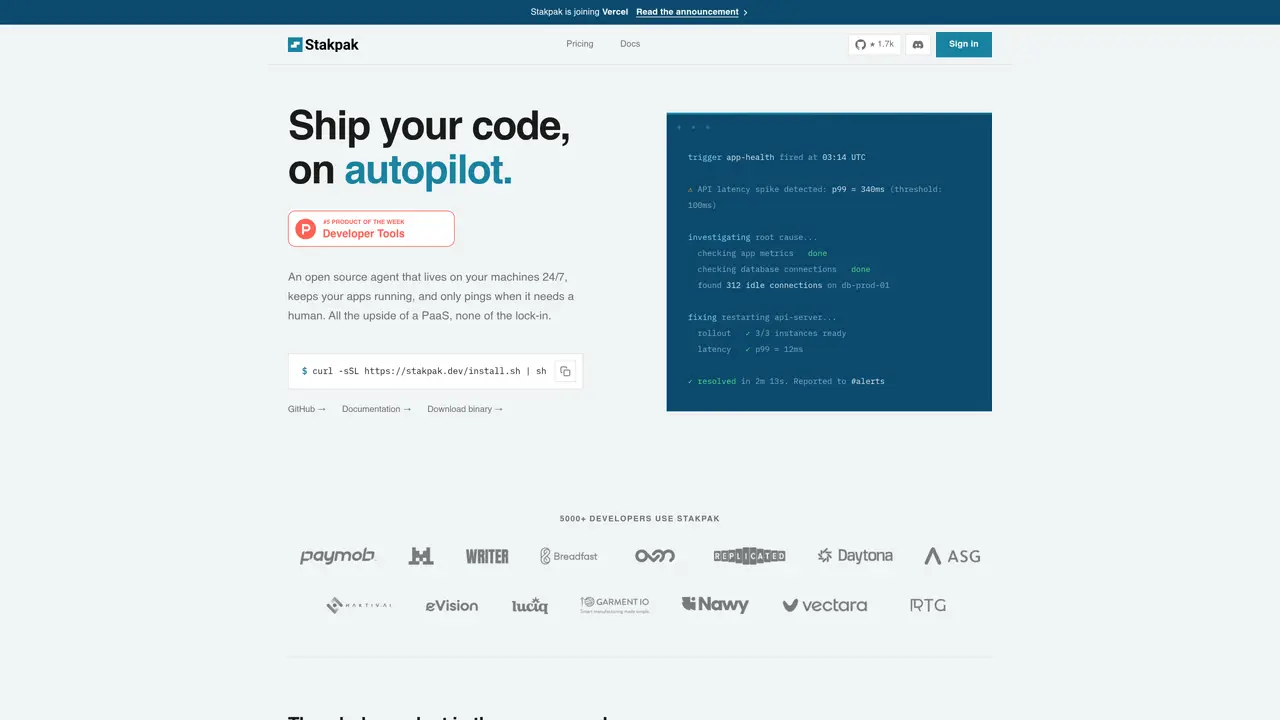
About Stakpak
Stakpak is an open-source AI-driven DevOps agent designed for developers and DevOps teams to secure, deploy, and maintain production infrastructure from a terminal-first workflow. It operates autonomously 24/7 as a system service, handling incident response, ongoing maintenance, and real-time monitoring through CLI and interactive TUI interfaces. The tool generates and validates Infrastructure as Code (IaC) configurations with real-time schema checks, offering contextual recommendations for production-ready setups. Security features include mTLS encryption, secret detection and redaction across 210+ types, full session audit logs, and Warden policy enforcement to prevent destructive operations. Stakpak integrates with AWS, Azure, Kubernetes, and Docker, providing an API-first design with local API and web IDE support, and compatibility with IDE workflows via Model Context Protocol (MCP). It emphasizes data control by running entirely on user machines, ensuring no data leaves the environment through secret substitution and encrypted transport, while delivering PaaS-like operational automation without vendor lock-in. The tool supports both free open-source and paid plans, with enterprise options available for teams and businesses seeking scalable solutions.
Key features
- Autonomous incident handling and ongoing maintenance
- Infrastructure as Code generation and validation with real-time schema checks
- Security guardrails including mTLS encryption and secret detection
- Full session audit logs and Warden policy enforcement
- Integrations with AWS, Azure, Kubernetes, and Docker
- API-first design with local API and web IDE support
- Model Context Protocol (MCP) support for IDE workflows
- CLI and interactive TUI interfaces for system operations
- Secret substitution and encrypted transport for data control
- Free open-source plan with paid tiers for individuals and teams
Use cases
- Automating infrastructure management and incident response
- Enforcing security policies and monitoring threats in production environments
- Generating and validating Infrastructure as Code configurations
Pros
- Operates autonomously 24/7 as a system service, handling incident response and real-time monitoring without manual intervention
- Provides security features such as mTLS encryption, secret detection and redaction across 210+ types, and Warden policy enforcement to prevent destructive operations
- Runs entirely on user machines with no data leaving the environment, ensuring full data control and compliance
- Offers local API and web IDE support, integrating with AWS, Azure, Kubernetes, and Docker for seamless infrastructure management
- Supports both free open-source and paid enterprise plans, with compatibility for IDE workflows via Model Context Protocol (MCP) and local API access
Cons
- Requires installation as a system service, which may involve setup complexity for users unfamiliar with DevOps tools
- Limited to environments where the agent can run as a long-running process, potentially excluding certain restricted or air-gapped systems
- Security features, while robust, may introduce overhead in configuration and policy management for large-scale deployments
Frequently asked questions about Stakpak
What is Stakpak and who is it designed for?
Stakpak is an open-source AI-driven DevOps agent designed for developers and DevOps teams to automate the deployment, maintenance, and security of production infrastructure. It operates autonomously from a terminal-first workflow, handling tasks such as incident response, real-time monitoring, and infrastructure maintenance.
How does Stakpak work?
Stakpak runs as a single long-running system service on user machines, combining scheduling, messaging, and a local API. It installs via a single binary and can be controlled through CLI and interactive TUI interfaces. The agent autonomously manages infrastructure by detecting issues, applying fixes, and generating reports without requiring constant human oversight.
What security features does Stakpak include?
Stakpak includes mTLS encryption, secret detection and redaction for over 210 secret types, full session audit logs, and Warden policy enforcement to prevent destructive operations. It uses a network sandbox with Cedar policies and secret substitution to ensure sensitive data never leaves the user's environment.
Does Stakpak integrate with cloud providers and tools?
Yes, Stakpak integrates with AWS, Azure, Kubernetes, and Docker. It supports an API-first design with local API and web IDE support, and is compatible with IDE workflows via the Model Context Protocol (MCP).
How do I get started with Stakpak?
Getting started with Stakpak involves installing the tool via a single command, initializing it to discover your stack, and then running it in autonomous mode. The process is designed to be simple, with clear steps provided in the documentation.
Is Stakpak open-source and auditable?
Yes, Stakpak is open-source under the Apache 2.0 license and written in Rust. It runs entirely on user machines with no data leaving the environment, ensuring full transparency and control over the agent and its operations.
Stakpak Website Engagement
Last Update: 9 days ago
Total Monthly Visits
0
Bounce Rate
0%
Visit Duration (avg)
0.00s
Pages Per Visit
0
Country Rank
—
Unknown
Global Rank
0