GitHub hosts HunyuanVideo, Tencent's open-source framework for large-scale video generation models, enabling AI-driven video creation.

Sedai
$1.20Starting price
35KMonthly visits
26Popularity
About Sedai
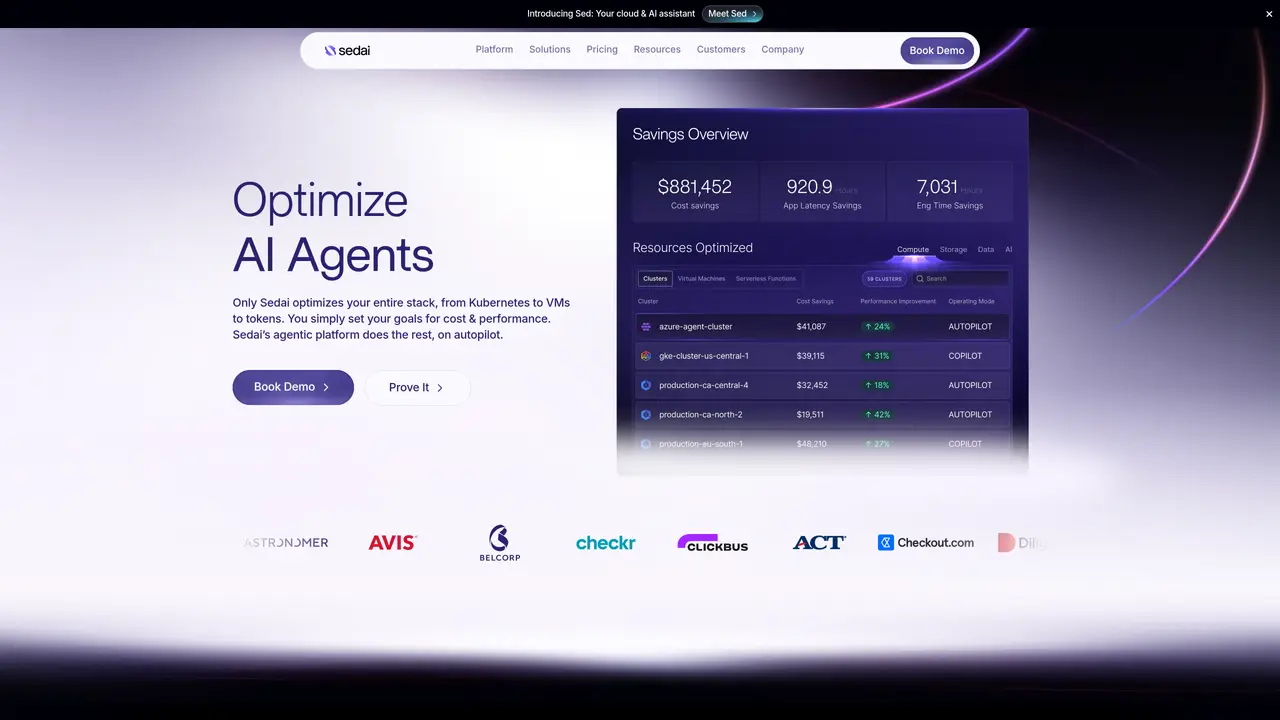
Sedai is an AI-powered autonomous cloud management platform that streamlines operations by continually optimizing cloud resources for cost, performance, and availability. Sedai’s dedicated AI operations copilot, Sed, independently manages 98% of optimization tasks—work equivalent to a team of cloud engineers, enabling operation teams to concentrate on issues that require a human touch. Sed performs extensive safety checks before every operation, eliminating production issues related to optimization incidents. Sed also uses reinforcement learning to continuously improve over time. As a result, Sedai helps companies transition from traditional, static rules-based automation to cutting-edge AI-powered autonomous operations. Sedai supports a wide variety of compute, storage and data services, including containers, serverless, and VMs.
Key features
- AI-powered cloud management
- Autonomous optimization of cloud resources
- Cost optimization without manual effort
- Performance and availability optimization without manual effort
- Automated scoring of new releases
- Support for various compute, storage, and data services
Use cases
- Optimizing cloud costs without manual effort
- Improving cloud performance and availability without manual effort
- Automating the scoring of new releases
Pros
- Autonomously optimizes cloud resources across Kubernetes, VMs, serverless, storage, and AI workloads without manual intervention.
- Performs continuous safety checks before executing any optimization to prevent production incidents.
- Uses reinforcement learning to improve optimization decisions over time based on real-time data.
- Supports a wide range of cloud providers and services, including AWS, Azure, GCP, and Kubernetes distributions.
- Reduces cloud waste and operational toil, enabling engineering teams to focus on higher-value tasks.
Cons
- Transitioning to fully autonomous mode may require initial oversight to ensure alignment with organizational goals.
- Dependence on autonomous actions may limit granular control for teams preferring manual adjustments.
Sedai videos
Frequently asked questions about Sedai
How does Sedai ensure optimizations never cause availability issues or degrade performance?
Sedai performs extensive safety checks before every operation and holds patents on autonomous action without causing incidents. It uses reinforcement learning to continuously improve while maintaining real-time monitoring and gradual optimization steps.
Which cloud providers and services does Sedai support?
Sedai supports major cloud providers including AWS, Azure, and GCP, as well as Kubernetes services like Amazon EKS, Azure AKS, and Google GKE. It also optimizes serverless, VMs, storage, data workloads, GPUs, and AI agents.
What is the difference between an automated system and Sedai’s autonomous system?
Automated systems follow predefined rules, while Sedai’s autonomous system uses agentic AI to learn application behavior and take independent actions without manual intervention, continuously optimizing in real time.
How does Sedai integrate with CI/CD pipelines?
Sedai is designed to integrate with existing CI/CD workflows, allowing teams to incorporate its optimizations into their deployment processes without causing infrastructure-as-code drift.
Can I control Sedai’s actions or roll back changes?
Yes, Sedai offers control options such as starting in Copilot mode for approval-based actions and switching to Autopilot for full autonomy. It also supports rollback capabilities for any changes made.
Does Sedai require installing agents to function?
No, Sedai operates without requiring agents to be installed on your infrastructure, simplifying deployment and reducing operational overhead.
Sedai Website Engagement
Last Update: 9 days ago
Total Monthly Visits
0
Bounce Rate
0%
Visit Duration (avg)
0.00s
Pages Per Visit
0
Country Rank
0
India
Global Rank
0
Category Rank
#0
Graphics Multimedia & Web Design
Monthly Traffic
Traffic Sources
Traffic Share By Country
- United States36.6%
- India13.2%
- Vietnam12.2%
- United Kingdom6.8%
- Canada4.7%