
Unify customer data, automate workflows, and scale experiences with Einstein AI, Copilot, and Data Cloud in one CRM platform.

Zenbot
$0.07Starting price
0Popularity
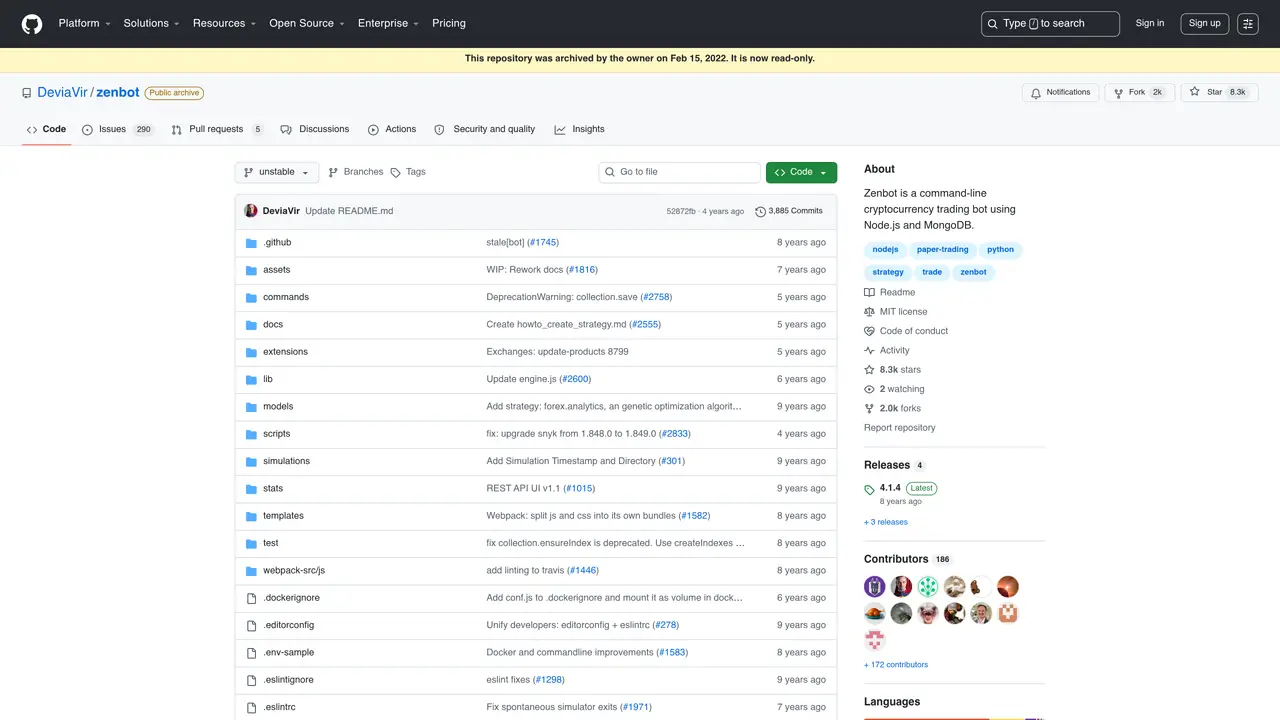
About Zenbot
Zenbot is an open-source automated trading bot built to provide traders with an easy-to-use yet powerful trading platform. This versatile trading tool is designed to help traders maximize their profits and minimize their losses. With its user-friendly interface, Zenbot offers a range of features that make it an ideal choice for beginner and experienced traders alike. Zenbot offers advanced features such as backtesting and paper trading, as well as real-time and automated trading. This helps traders test their strategies and hone their skills in a risk-free environment. Additionally, the bot’s built-in indicators and market analysis tools enable traders to make informed decisions and stay on top of market trends. Zenbot also allows traders to customize their trading strategies to fit their preferences and risk tolerance. With its support for multiple exchanges and digital currencies, Zenbot provides traders with the ability to diversify their investments.
GitHub, Inc.
San Francisco, California, US · Founded 2008
- Founders
- Tom Preston-Werner, Chris Wanstrath, PJ Hyett, Scott Chacon
- Founded
- 2008
- Headquarters
- San Francisco, California, US
- Legal status
- Subsidiary of Microsoft (NASDAQ: MSFT)
Key features
- Automate trading decisions
- Backtesting and paper trading
- Real-time and automated trading
- Built-in indicators and market analysis tools
- Customizable trading strategies
- Support for multiple exchanges and digital currencies
Use cases
- Automating trading decisions to maximize profits and minimize losses
- Testing trading strategies through backtesting and paper trading
- Customizing trading preferences and risk tolerance
Pros
- Open-source and customizable trading bot with a plugin architecture for exchange support and strategy implementation
- Supports multiple cryptocurrency exchanges including Binance, Bitfinex, Kraken, and Poloniex
- Includes a simulator for backtesting strategies against historical data and a paper trading mode for risk-free testing
- Command-line interface built with Node.js and MongoDB for technical-analysis-based automated trading
- Flexible configuration for trade frequency, sampling periods, and stop-loss mechanisms
Cons
- No longer actively maintained, requiring users to update dependencies independently
- Lacks a graphical user interface, relying solely on command-line operations
- Trading carries inherent risks, and incorrect settings may lead to significant financial losses
Frequently asked questions about Zenbot
What is Zenbot and what does it do?
Zenbot is a command-line cryptocurrency trading bot built using Node.js and MongoDB. It automates trading based on technical analysis, supports multiple exchanges, and allows users to backtest strategies or trade in a simulated environment.
Who is Zenbot suitable for?
Zenbot is designed for traders of all experience levels who want to automate cryptocurrency trading strategies. It is particularly useful for those comfortable with command-line interfaces and technical trading concepts.
How does Zenbot support trading strategies?
Zenbot offers a plugin architecture for implementing exchange support and writing new strategies. It includes configurable parameters for buy stops, sell stops, trailing stops, and flexible sampling periods to adapt to different trading styles.
Can Zenbot be used for backtesting and paper trading?
Yes, Zenbot includes a simulator for backtesting strategies against historical data and a paper trading mode that operates on a simulated balance while monitoring live market conditions.
What exchanges does Zenbot support?
Zenbot supports multiple exchanges including Binance, Bitfinex, Bitstamp, Bittrex, CEX.IO, GDAX, Gemini, HitBTC, Kraken, Poloniex, and TheRockTrading, with ongoing work to add further exchange support.
Is Zenbot actively maintained?
As of February 15, 2022, the Zenbot repository has been archived and is no longer actively maintained. Users are advised to update dependencies if they choose to use it.