An AI-driven experience management platform for enterprises to collect multi-channel feedback, analyze structured and unstructured data, and deliver actionable insights.

CiteBrief
$79/moStarting price
0Popularity
About CiteBrief
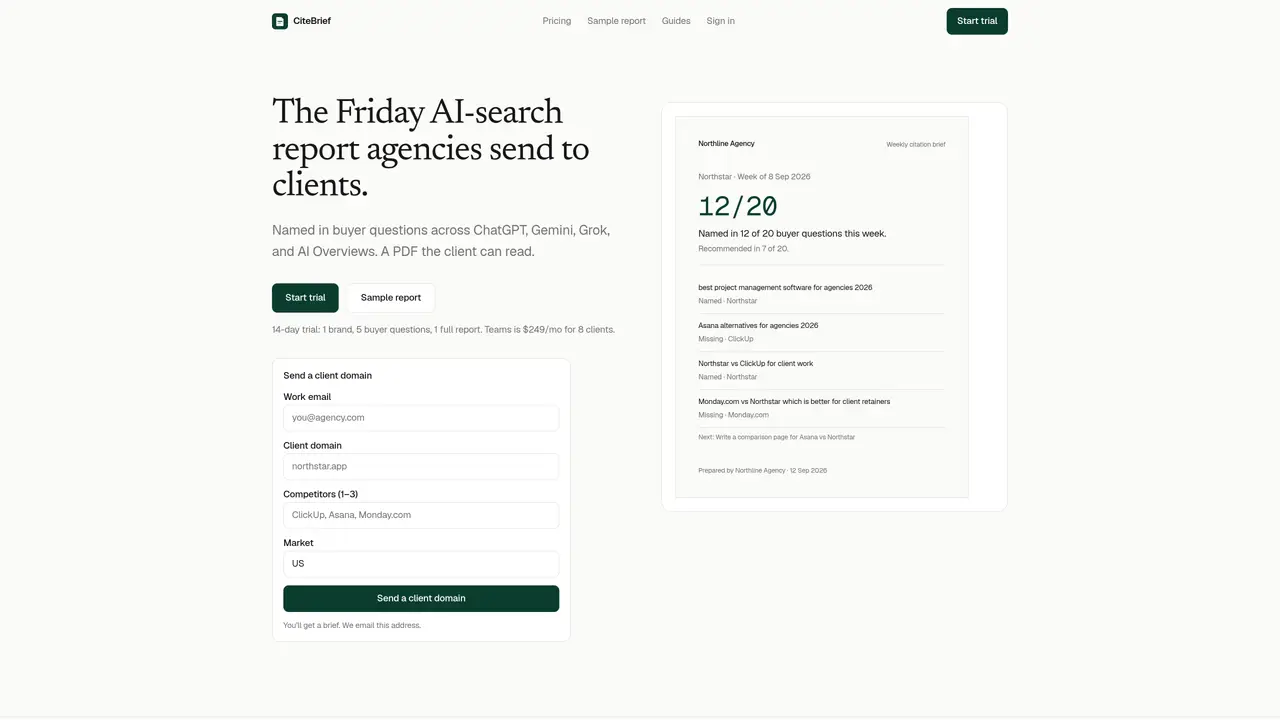
CiteBrief generates weekly AI-search visibility reports for agencies, converting unbranded buyer questions from ChatGPT, Gemini, Grok, and Google AI Overviews into a client-ready PDF delivered every Friday. The tool tracks how often a client’s brand appears in AI responses versus competitors, providing a dated named score and identifying gaps where competitors are recommended instead. Each report includes five concrete next actions for content, PR, or site improvements, along with anonymized examples of the brief for reference. The PDF is white-labeled, private, and accessible without a client account, expiring after 90 days. Agencies use the tool to demonstrate AI-search visibility to clients without pitching traditional SEO tactics. The platform supports manual re-checks for specific queries and provides a dashboard for tracking trends, competitors, and opportunities across tracked questions.
Key features
- AI-search visibility tracking across four engines
- Weekly Friday PDF delivery with client-ready format
- Named score and competitor comparison per question
- Five recommended next actions per report
- White-label and private client links
- Manual re-check credits for specific queries
- Dashboard for trends, competitors, and opportunities
- Cited pages included in reports
Use cases
- Agencies demonstrating AI-search visibility to clients
- Marketing teams tracking competitor mentions in AI responses
- PR teams identifying gaps where competitors are recommended
Pros
- Tracks visibility across ChatGPT, Gemini, Grok, and Google AI Overviews
- Delivers client-ready PDFs without requiring client accounts
- Provides five actionable next steps per report
- Supports white-label delivery for agencies
- Includes manual re-check credits for specific queries
Cons
- No free tier available
- Limited to tracked buyer questions; not a full SEO tracker
- Requires manual setup for each client domain
- Reports expire after 90 days
Frequently asked questions about CiteBrief
What is CiteBrief and what does it do?
CiteBrief generates weekly AI-search visibility reports for agencies by tracking how often a client’s brand appears in unbranded buyer questions across ChatGPT, Gemini, Grok, and Google AI Overviews. Each Friday, it delivers a client-ready PDF that includes a named score, competitor comparisons, and five actionable next steps for content, PR, or site improvements.
Who is CiteBrief designed for?
CiteBrief is built for agencies, including SEO, PR, and marketing teams, to demonstrate AI-search visibility to clients without pitching traditional SEO tactics. It is also suitable for teams looking to track competitor performance and identify gaps in AI-driven search results.
How does the pricing model work?
CiteBrief offers a tiered pricing model starting with a 14-day trial for one brand and five buyer questions. Paid plans include Starter, Teams, Scale, and Enterprise tiers, with options for monthly or annual billing. Teams and Scale plans include white-label delivery, while Enterprise offers custom limits and SSO.
What integrations or features are included in the reports?
Each report includes a named score, competitor comparisons, five actionable next steps, and anonymized examples of the brief. The PDF is white-labeled, private, and accessible without a client account, expiring after 90 days. Teams and Scale plans also include a dashboard for tracking trends and manual re-check credits.
Can clients access the report without creating an account?
Yes, every plan includes a private report link that clients can access without logging in. The report expires after 90 days, and client CC options are available on Teams and Scale plans.
What happens if an AI engine fails to return data?
CiteBrief soft-fails if an engine does not return data. The PDF still ships if at least three of the four engines (ChatGPT, Gemini, Grok, and Google AI Overviews) provide results. Failed sources are excluded from the client-facing report unless fewer than three succeed.