An AI-driven experience management platform for enterprises to collect multi-channel feedback, analyze structured and unstructured data, and deliver actionable insights.

GEO Workspace
$299/moStarting price
0Popularity
About GEO Workspace
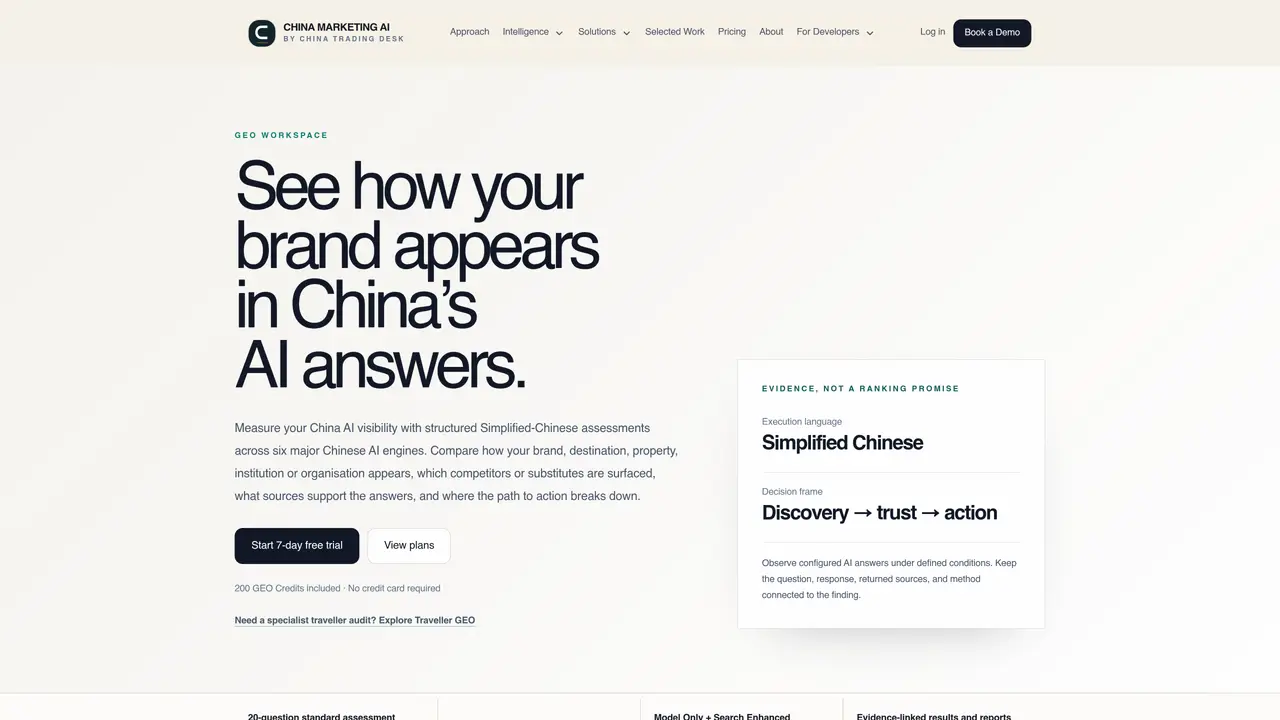
GEO Workspace measures how a brand, destination, property or institution appears in answers from six major Chinese AI engines. It provides structured Simplified-Chinese assessments that compare visibility, surface competitors or substitutes, and identify where the path to action breaks down. Users define the entity, market, audience and competitors, then generate natural Simplified-Chinese decision questions rather than brand-name prompts. The tool runs approved questions across selected AI engines while preserving the exact answer, returned sources and execution conditions. Results are presented as evidence-linked findings and opportunities, enabling teams to review, rerun specific questions or escalate to specialist support. Projects retain a frozen scope, versioned question plan, configured engines and immutable reports, keeping the assessment record, evidence-backed readout and next decisions connected. Evidence views allow side-by-side comparison of captured answers and citations across engines, supporting deeper analysis of patterns, competitor signals and action-path gaps.
Key features
- Formal assessment with versioned question plans
- Model Only and Search Enhanced modes
- Cross-engine agreement and disagreement analysis
- Competitor and substitute pattern detection
- Source and factual-risk gap identification
- Query Lab for ad-hoc Chinese question testing
- Immutable project reports
- Estimated usage and reconciled billing
Use cases
- Brand visibility diagnostics in Chinese AI search results
- Competitor and substitute analysis for market positioning
- Action-path gap identification for conversion optimization
Pros
- Structured Simplified-Chinese assessments across six Chinese AI engines
- Preserves exact answers, sources and execution conditions for evidence-based review
- Side-by-side comparison of answers and citations across engines
- Versioned question plans and immutable reports for consistent tracking
- Query Lab for ad-hoc investigation without altering formal assessments
Cons
- No free tier beyond a 7-day trial with 200 GEO Credits
- Requires Simplified Chinese for execution and analysis
- Limited to six specific Chinese AI engines
- Credit-based pricing model with rollover caps
Frequently asked questions about GEO Workspace
What does GEO Workspace measure?
GEO Workspace measures how a brand, destination, property, or institution appears in answers from six major Chinese AI engines, providing structured Simplified-Chinese assessments that compare visibility, surface competitors or substitutes, and identify where the path to action breaks down.
Who is GEO Workspace designed for?
The tool is designed for brands, destinations, properties, institutions, or organizations seeking to understand their visibility and performance in China’s AI decision environment, including teams managing multiple entities or markets.
How does the pricing model work?
GEO Workspace uses a credit-based system called GEO Credits, where each question executed across an AI engine consumes a set number of credits. Unused credits roll over up to three times the monthly allowance, and pricing plans vary by capacity and features.
What integrations or AI engines does GEO Workspace support?
GEO Workspace supports six major Chinese AI engines: DeepSeek, Doubao, Yuanbao, Qwen, ERNIE, and Kimi. It executes questions in Simplified Chinese and preserves the exact answers, sources, and execution conditions for analysis.
Can I customize the questions or analysis in GEO Workspace?
Yes, users can define the entity, market, audience, category, and competitors, then generate natural Simplified-Chinese decision questions. The tool also offers a Query Lab for investigating specific questions without altering a formal assessment.
How do I get started with GEO Workspace?
Users can start with a 7-day free trial that includes 200 GEO Credits and one project. After the trial, they can upgrade to a paid plan based on their needs, such as Core, Pro, Business, or Enterprise tiers.