
Efficiently create and manage cases, streamline workflows, securely store and share documents, and collaborate with colleagues.

Lexnus
0Popularity
About Lexnus
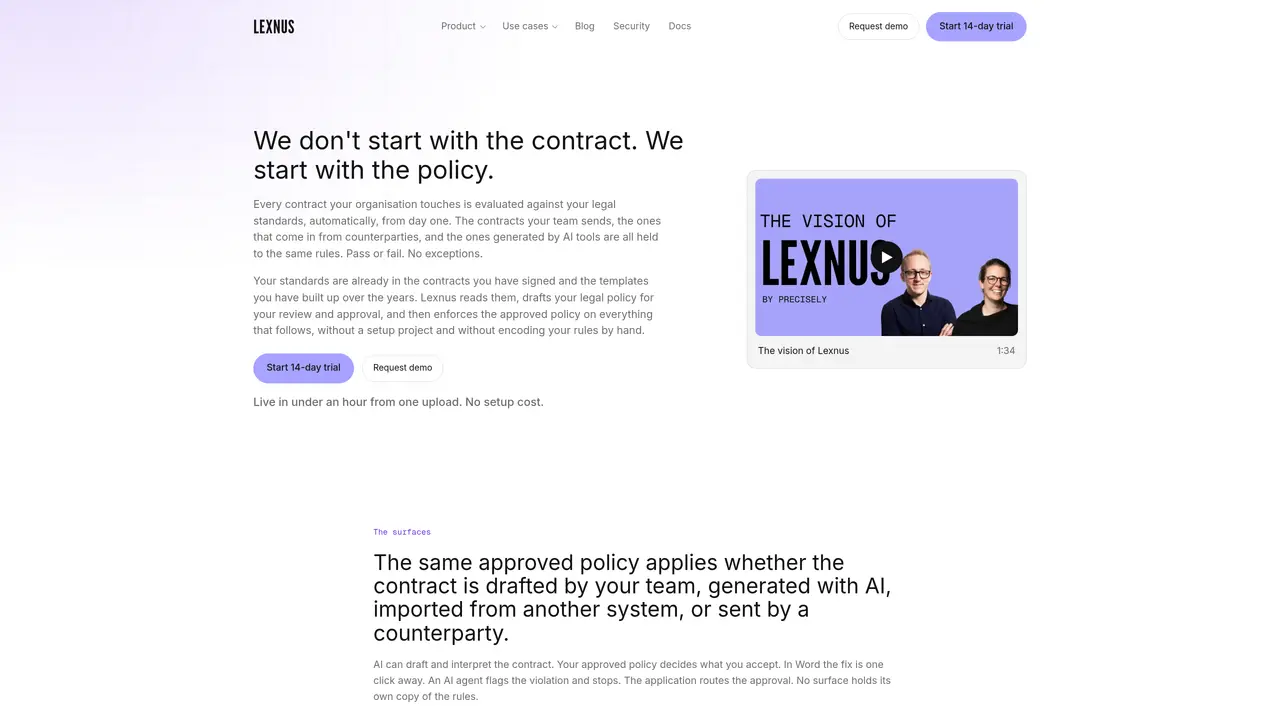
Lexnus applies an organization’s legal policy to contracts across drafting, review, and negotiation workflows. It reads existing contracts and templates to draft a formal legal policy for approval, then enforces that policy on every subsequent contract regardless of source—whether drafted by internal teams, generated by AI assistants, imported from other systems, or received from counterparties. The tool integrates with Microsoft Word, Outlook, and AI agents via MCP, as well as CRM systems like HubSpot and collaboration platforms like Slack and Google Drive. Contracts are evaluated against the approved policy, with violations flagged and approved fixes inserted automatically. All evaluations and decisions are logged with policy version references for auditability. The system operates without requiring manual rule encoding or complex setup projects, aiming to reduce policy drift and ensure consistent legal standards across all contract interactions.
Key features
- Policy drafting from existing contracts and templates
- Automated policy enforcement across multiple surfaces
- AI agent integration via MCP for pre-drafting checks
- Microsoft Word and Outlook integration with side-panel verdicts
- CRM integration with HubSpot for deal record evaluation
- Slack and Google Drive contract evaluation on arrival
- Direct API for policy enforcement from external systems
- Automatic fix insertion with tracked changes
Use cases
- Enforcing approved liability caps and governing law clauses across all contracts
- Standardizing contract review processes for sales and legal teams
- Ensuring compliance with EU-hosted policies for GDPR-sensitive contracts
Pros
- Applies a single approved policy across multiple contract surfaces and tools
- Automatically flags violations and inserts approved fixes
- Integrates with Word, Outlook, AI agents via MCP, CRM, Slack, and Google Drive
- Reads existing contracts to draft formal legal policies for approval
- Logs all evaluations with policy version references for auditability
Cons
- Limited to policy enforcement rather than full contract lifecycle management features
- Integration availability varies by platform, with some listed as 'coming soon'
- Requires policy approval before enforcement can begin
Lexnus videos
Frequently asked questions about Lexnus
What does Lexnus do?
Lexnus starts with an organization’s existing legal policy embedded in signed contracts and templates, drafts a formal policy for approval, and then enforces that policy across all contract workflows—whether contracts are drafted internally, generated by AI, imported from other systems, or received from counterparties.
Who is Lexnus designed for?
Lexnus is designed for organizations that need consistent legal standards across all contract interactions, including legal teams, sales teams, procurement, and compliance officers who rely on approved policies to govern contracts.
How does Lexnus enforce legal policies?
Lexnus extracts contract facts, evaluates them against the approved policy, and returns a pass/fail verdict with approved fixes inserted automatically. The policy is enforced across integrated tools like Microsoft Word, Outlook, AI agents, CRM systems, Slack, and Google Drive.
Does Lexnus require manual rule encoding?
No, Lexnus reads existing contracts and templates to draft the legal policy for review and approval, then enforces it without requiring manual rule encoding or complex setup projects.
What integrations does Lexnus support?
Lexnus integrates with Microsoft Word, Outlook, AI agents via MCP, CRM systems like HubSpot, collaboration platforms like Slack and Google Drive, and offers a direct API for connecting to other systems.
Is Lexnus GDPR compliant?
Yes, Lexnus is EU-hosted and GDPR compliant, ensuring no exposure to the US CLOUD Act.