
AI chatbot for conversation, work, research, coding, and content creation.

turbopuffer
$16/moStarting price
63KMonthly visits
30Popularity
About turbopuffer
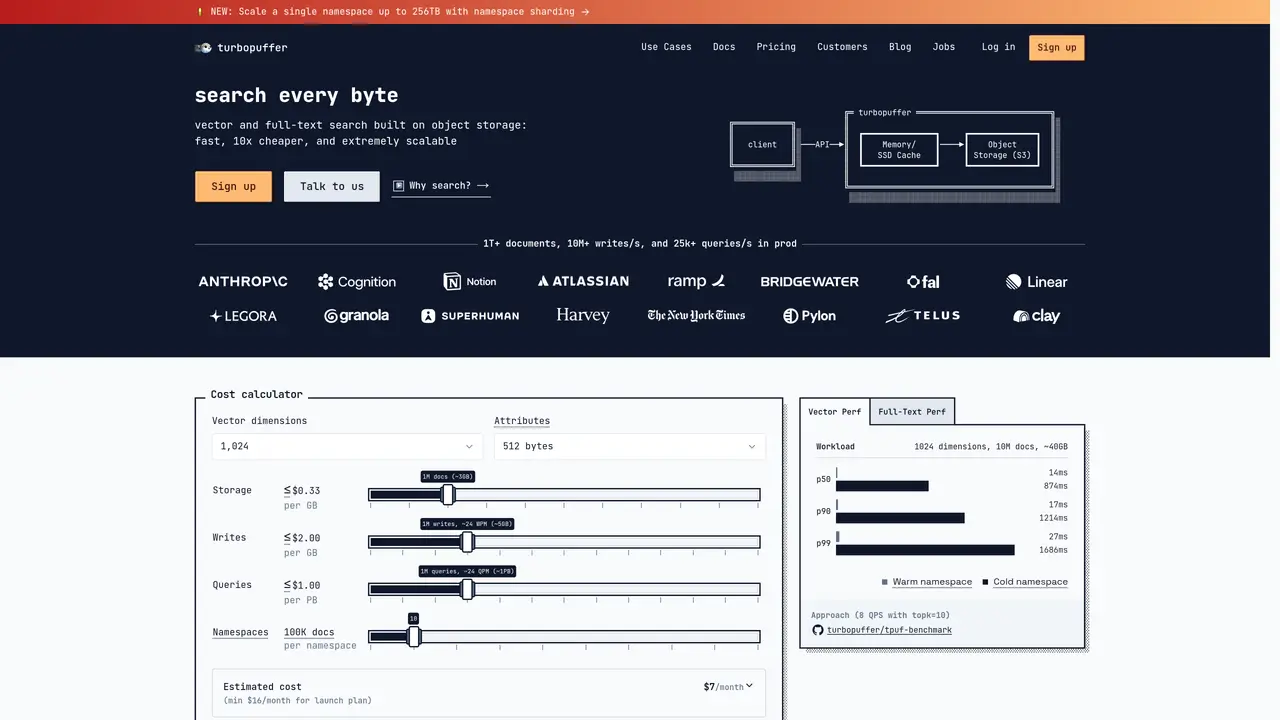
turbopuffer is a search engine that supports both vector and full-text search operations. It is designed to handle large-scale datasets by leveraging object storage (such as S3) for data persistence, with optional memory or SSD caching for performance. The system is structured to scale horizontally, allowing for sharding up to 256TB per index and supporting high write and query throughput. It is positioned for AI applications, semantic search, recommendation systems, and other use cases requiring fast similarity search and low-latency retrieval. turbopuffer provides hybrid search capabilities, combining vector and full-text search methods, and supports metadata filtering for more precise results. The architecture separates compute and storage, enabling cost-effective scaling without the need for dedicated hardware.
Key features
- Vector search with approximate nearest neighbor
- Full-text search using BM25
- Hybrid search combining vector and full-text
- Metadata filtering for refined results
- Automatic scaling and sharding
- Multi-tenancy support
- SOC2 and GDPR compliance
- Audit logging and IP allowlisting
Use cases
- AI-powered semantic search
- Recommendation systems
- Large-scale document retrieval
Pros
- Supports both vector and full-text search
- Built on object storage for cost efficiency
- Handles petabyte-scale datasets with sharding
- Low-latency queries (sub-10ms p50)
- Hybrid search combining multiple retrieval methods
Cons
- No free tier available
- Minimum monthly usage commitments required
- Limited to 4 embedded attributes per namespace
- Enterprise plan required for BYOC and CMEK
Frequently asked questions about turbopuffer
What is turbopuffer and what does it do?
turbopuffer is a vector and full-text search database designed for AI applications, semantic search, and recommendation systems. It supports both vector similarity search and traditional full-text search, enabling hybrid search capabilities with metadata filtering for precise results.
Who should use turbopuffer?
turbopuffer is suitable for organizations requiring scalable, low-latency search capabilities, particularly those handling large-scale datasets in AI, semantic search, or recommendation systems. It is trusted by leading companies across various industries.
How does turbopuffer achieve cost efficiency?
turbopuffer is built on object storage (such as S3) with optional memory or SSD caching, separating compute and storage to reduce costs. Its architecture enables 10x cost savings compared to traditional vector databases while maintaining high performance.
What are the key performance metrics of turbopuffer?
turbopuffer delivers sub-10ms latency (p50) for vector searches and supports high throughput, with documented performance of over 10 million writes per second and 25,000 queries per second in production systems.
Does turbopuffer support hybrid search?
Yes, turbopuffer supports hybrid search, combining vector and full-text search methods to improve result relevance and accuracy. It also allows metadata filtering to refine search outcomes.
How do I get started with turbopuffer?
Users can get started with turbopuffer by visiting the Quickstart guide on the official documentation page, which provides step-by-step instructions for setting up and querying the database in minutes.
turbopuffer Website Engagement
Last Update: 4 days ago
Total Monthly Visits
0
Bounce Rate
0%
Visit Duration (avg)
0.00s
Pages Per Visit
0
Country Rank
0
United States
Global Rank
0
Category Rank
#0
Programming & Developer Software
Monthly Traffic
Traffic Sources
Traffic Share By Country
- United States61.2%
- India10.4%
- Canada6.1%
- Brazil4.5%
- Germany3.6%