
Create and interact with AI companions and virtual characters using GPT-4o on Chub AI's platform.

BrainyBear
$1Starting price
0Popularity
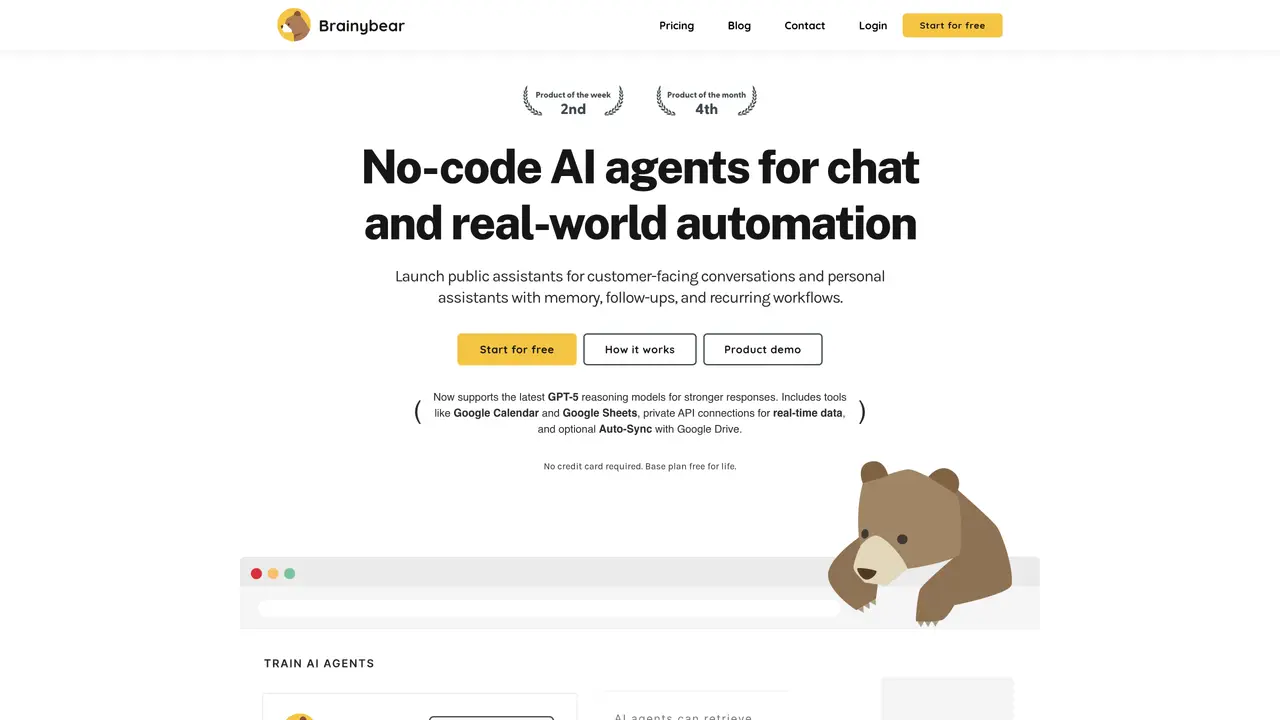
About BrainyBear
BrainyBear lets users build and train AI chatbots for customer service with minimal setup. The process takes as few as three steps to configure and three clicks to train. By scanning a website or uploaded documents, BrainyBear generates accurate responses to customer questions, aiming to resolve up to 80% of queries instantly. Businesses use it to shorten response times, cut support costs, and improve user experience without writing code or performing extensive manual training. The tool integrates with platforms such as Facebook Messenger, WhatsApp, and Telegram, enabling intelligent assistants to engage visitors where they already are. It also supports multiple languages, helping companies serve global audiences without building separate bots for each region. No programming expertise is required, making it accessible to teams focused on customer experience rather than technical development.
Key features
- Website and file scanning for instant chatbot training
- One-click deployment to Facebook Messenger, WhatsApp, and Telegram
- Multilingual support for global customer bases
- No-code setup and training workflow
- Aim to resolve up to 80% of customer questions automatically
- Reduces response times and support costs
- No programming or technical expertise required
- Quick three-step configuration and three-click training
Use cases
- Add an AI assistant to a company website to answer FAQs instantly
- Deploy a chatbot on WhatsApp to handle order inquiries and support tickets
- Create multilingual bots to serve international customers across regions
Pros
- No-code setup allows users to create and deploy AI agents without programming expertise
- Supports multi-channel delivery across web chat, WhatsApp, Telegram, email, and Slack
- Offers memory and context retention for personalized and recurring interactions
- Includes direct integrations with tools like Google Calendar, Google Sheets, and private APIs
- Provides a free-for-life base plan with 50 message credits and one AI agent
Cons
- Limited flexibility for highly technical teams requiring custom orchestration
- May struggle with complex or highly unpredictable user queries beyond scripted flows
Frequently asked questions about BrainyBear
What is BrainyBear and what does it do?
BrainyBear is a no-code platform for creating, training, and deploying AI agents for customer-facing conversations and internal workflows. It enables users to build assistants that can engage visitors across multiple channels, remember context, and handle recurring tasks without requiring programming skills.
Who is BrainyBear best suited for?
BrainyBear is ideal for businesses and teams focused on customer experience and support efficiency, particularly those without technical development resources. It suits companies looking to automate customer interactions, reduce response times, and improve user engagement across platforms like WhatsApp, Telegram, and web chat.
How does BrainyBear handle pricing and plans?
BrainyBear offers a free-for-life base plan with 50 message credits and one AI agent. Paid plans include Basic, Growth, and Business tiers, with options for monthly or annual billing and varying credit allowances. Pricing scales with the number of credits and features required.
What integrations does BrainyBear support?
BrainyBear integrates directly with messaging platforms such as Facebook Messenger, WhatsApp, Telegram, and Slack. It also supports tools like Google Calendar, Google Sheets, and private APIs for real-time data access, as well as optional Auto-Sync with Google Drive.
Can BrainyBear handle multi-language support?
Yes, BrainyBear supports multiple languages, allowing businesses to deploy AI agents that serve global audiences without building separate bots for each region.
How do I get started with BrainyBear?
Users can start by creating a free account on the BrainyBear website. The process involves customizing an AI agent in three steps, training it with knowledge or tools, and embedding it on a website or connecting it to supported channels for deployment.