GitHub hosts HunyuanVideo, Tencent's open-source framework for large-scale video generation models, enabling AI-driven video creation.

Guardana
0Popularity
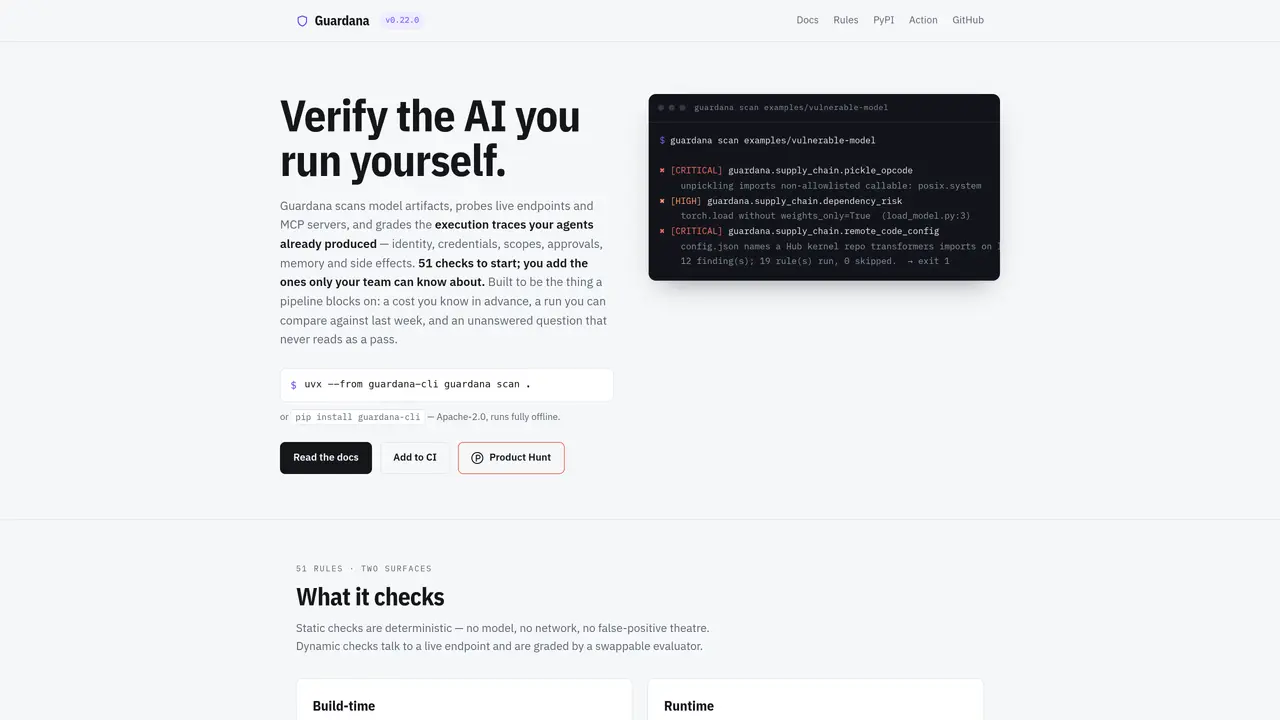
About Guardana
Guardana provides customizable security gates for AI systems by scanning model artifacts, probing live endpoints and MCP servers, and grading execution traces. It performs 51 built-in checks covering identity, credentials, scopes, approvals, memory and side effects, with the ability to add custom rules specific to an organization’s threat model. The tool operates both at build time—running deterministic static checks without model execution—and at runtime—interacting with live endpoints through swappable evaluators. Guardana is designed to integrate into CI pipelines, blocking runs based on predefined security contracts that define allowed behaviors in a versioned, human-readable format. It supports targeting endpoints, MCP servers, recorded traces, or custom AI stack components, and enforces security policies through declarative YAML rules or Python plugins. The engine avoids domain-specific assumptions, treating all rules uniformly, and ensures findings are graded with outcomes, rationales, and measurable scores rather than binary passes or fails.
Key features
- Static and dynamic security scanning
- 51 built-in checks with custom rule support
- CI pipeline integration
- Offline operation capability
- Swappable evaluators for grading findings
- Declarative YAML and Python plugin rule definitions
- Execution trace analysis
- Security contract enforcement
Use cases
- Validating AI model artifacts before deployment
- Monitoring live AI endpoints for runtime vulnerabilities
- Enforcing multi-tenant isolation policies in customer-facing agents
Pros
- Supports both static and dynamic security checks
- Allows custom rule definition via YAML or Python
- Integrates with CI pipelines and offline environments
- Provides graded findings with outcomes and rationales
- Designed for extensibility with organization-specific threat models
Cons
- No explicit mention of free tier or open-source availability beyond Apache-2.0 license
- Limited to Python-based AI systems and MCP servers
- Requires custom rule definition for domain-specific threats
Frequently asked questions about Guardana
What does Guardana do?
Guardana provides customizable security gates for AI systems by scanning model artifacts, probing live endpoints and MCP servers, and grading execution traces. It performs built-in checks for identity, credentials, scopes, approvals, memory, and side effects, with support for adding custom rules tailored to an organization’s threat model.
Who is Guardana designed for?
Guardana is designed for teams running AI systems who need to enforce security policies, whether in development, CI pipelines, or production. It suits organizations that require versioned, human-readable security contracts and granular control over AI agent behaviors.
How does Guardana integrate with existing workflows?
Guardana integrates into CI pipelines as a blocking step, allowing teams to enforce security contracts before or after model execution. It supports static checks at build time and dynamic checks at runtime, with swappable evaluators for grading findings.
Can Guardana be used offline?
Yes, Guardana can run fully offline. It is distributed as a CLI tool that can be installed via package managers like uv or pip, and it operates without requiring network access for static checks.
What types of targets can Guardana scan?
Guardana can target endpoints, MCP servers, recorded traces, or custom AI stack components. It supports both live systems and previously recorded runs, enabling comprehensive security validation across different stages of AI deployment.
How are security policies defined in Guardana?
Security policies are defined as declarative YAML rules or Python plugins, which are versioned and human-readable. These policies are enforced through security contracts that specify allowed behaviors, ensuring consistency and auditability.