GitHub hosts HunyuanVideo, Tencent's open-source framework for large-scale video generation models, enabling AI-driven video creation.

Openlayer
47KMonthly visits
28Popularity
About Openlayer
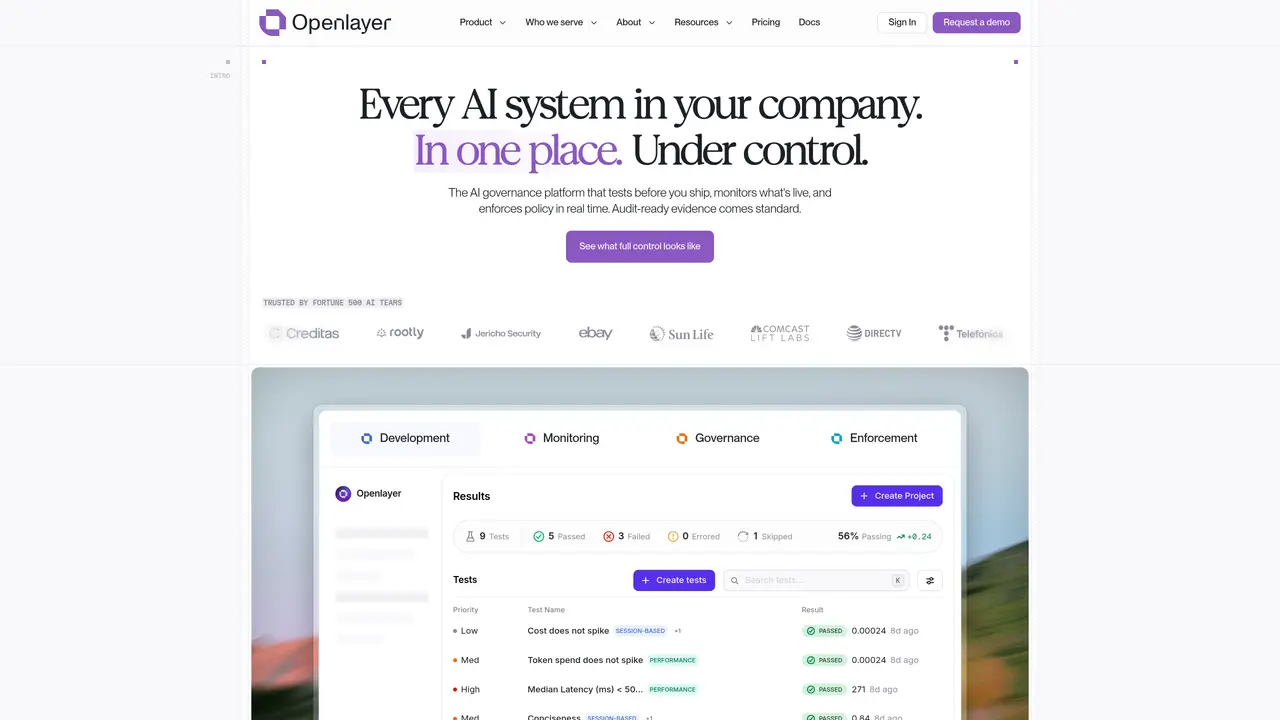
Openlayer is an AI governance and observability platform designed to provide organizations with full control over their AI systems from development to production. The platform consolidates an organization-wide inventory of AI systems, including automatic detection of shadow AI, to ensure nothing operates outside governance. It enables teams to register each AI system with contextual details such as purpose, data sensitivity, and risk tier, creating a centralized registry for accountability. Openlayer facilitates pre- and post-deployment testing with a suite of over 175 built-in evaluations, allowing teams to benchmark changes, block regressions in CI/CD pipelines, and diagnose root causes of issues. In production, the platform continuously monitors AI behavior, tracing inputs, outputs, tool calls, and performance metrics to detect drift or anomalies in real time. Security and guardrails features enforce policies at the gateway level, preventing prompt injection, jailbreaks, and unauthorized data exposure before they reach users. The platform also supports compliance mapping to regulatory frameworks, generating audit-ready evidence to demonstrate adherence to standards. By integrating governance, testing, monitoring, and enforcement into a single platform, Openlayer helps organizations reduce risk, maintain trust, and meet regulatory requirements while scaling AI deployments responsibly.
Key features
- Automated behavioral testing with over 100 checks
- Proactive detection of hallucinations, bias, and toxicity
- Real-time guardrails against prompt injection and other risks
- Risk classification and compliance workflow automation
- Continuous monitoring from development to production
- Centralized governance and observability dashboard
- Actionable insights for model improvement
- Integration with existing AI development pipelines
Use cases
- Ensuring AI models comply with regulatory standards
- Detecting and mitigating bias in machine learning models
- Monitoring AI systems for hallucinations and toxicity in production
Pros
- Provides centralized visibility into all AI systems across an organization, including shadow AI detection.
- Offers pre- and post-deployment testing with over 175 built-in evaluations to catch issues early.
- Enables real-time monitoring and enforcement of security policies, such as blocking prompt injection or PII leakage.
- Supports audit-ready evidence generation for compliance with regulatory frameworks.
- Integrates with major AI development kits (ADKs) for seamless workflow adoption.
Cons
- May require significant setup effort to configure custom intake forms, risk assessments, and policies.
- Real-time enforcement features could introduce latency in high-throughput AI systems.
Frequently asked questions about Openlayer
What does Openlayer do?
Openlayer is an AI governance and observability platform that helps organizations test, monitor, secure, and prove compliance for their AI systems throughout the entire lifecycle. It provides visibility into AI deployments, automated testing, real-time enforcement of security policies, and continuous monitoring of performance and behavior.
Who is Openlayer designed for?
Openlayer is designed for enterprises and AI teams that deploy multiple AI systems, including copilots, agents, and models, across business units. It suits organizations that need to meet regulatory requirements, maintain high standards for AI performance, and mitigate risks such as hallucinations, bias, or data leakage.
How does Openlayer integrate with existing workflows?
Openlayer integrates with major AI development kits (ADKs) and supports custom intake forms, lifecycle management, and versioning of models and datasets. It can be embedded into CI/CD pipelines for testing and provides APIs for real-time monitoring and enforcement.
Can Openlayer help with compliance and audits?
Yes, Openlayer maps AI systems to regulatory frameworks and generates audit-ready evidence to demonstrate compliance. It supports risk assessment, policy enforcement, and documentation of AI behavior for regulatory scrutiny.
What types of risks can Openlayer detect or prevent?
Openlayer can detect or prevent issues such as hallucinations, bias, PII or PHI leakage, toxicity, prompt injection, jailbreaks, unauthorized tool calls, and performance regressions. It also monitors for cost spikes, latency issues, and session-based anomalies.
How do I get started with Openlayer?
To get started, organizations can request a demo or sign up to explore the platform. Openlayer provides discovery tools to inventory existing AI systems, followed by registration, testing, and monitoring workflows tailored to the organization's policies and risk frameworks.
Openlayer Website Engagement
Last Update: 9 days ago
Total Monthly Visits
0
Bounce Rate
0%
Visit Duration (avg)
0.00s
Pages Per Visit
0
Country Rank
0
United Kingdom
Global Rank
0
Category Rank
#0
Computers Electronics & Technology
Monthly Traffic
Traffic Sources
Traffic Share By Country
- United States31.7%
- Vietnam13%
- India8.6%
- Germany4.1%
- Brazil4%