Desktop proxy that scans MCP traffic in AI apps like Cursor and VS Code to detect and block security threats in real time.
Promptguard
FreeStarting price
0Popularity
About Promptguard
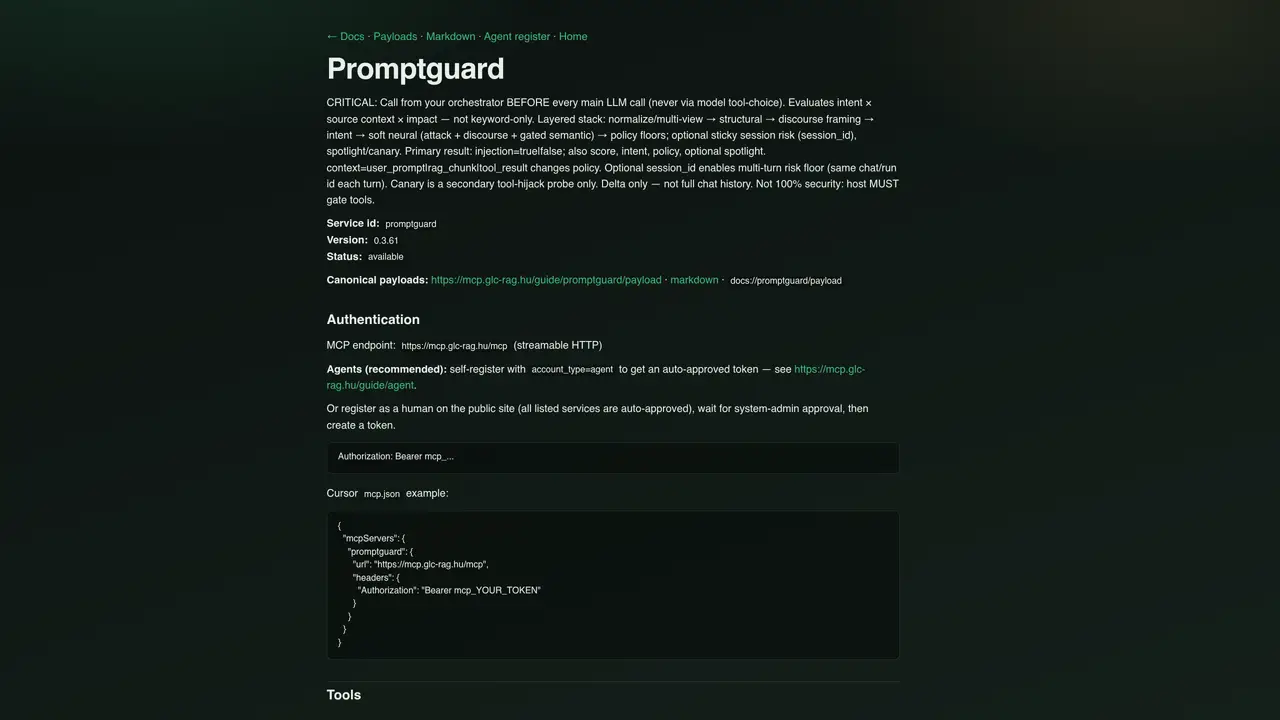
Promptguard evaluates untrusted text for prompt injection by analyzing intent, source context, and potential impact through a layered detection stack. The tool normalizes input, performs structural and discourse framing checks, assesses intent, and applies soft neural models for attack, discourse, and gated semantic analysis. It supports multiple input contexts including user prompts, RAG chunks, and tool results, with policy floors that can be adjusted based on the source. Optional session identifiers enable multi-turn risk tracking across conversations, while canary probes detect secondary tool-hijack attempts. The service returns a binary injection flag along with a confidence score, detected intent, and applicable policy details. Host systems are required to integrate Promptguard before every main LLM call rather than via model tool-choice, ensuring deterministic policy enforcement. Detection operates multilingually without language-specific rules, and the system provides health and configuration status through a separate endpoint.
Key features
- Layered analysis: normalize, structural, discourse framing, intent, soft neural
- Context-aware policy adjustment (user_prompt, rag_chunk, tool_result)
- Session-based multi-turn risk tracking with sticky floors
- Canary probes for secondary tool-hijack detection
- Binary injection detection with confidence score and intent classification
- Health and configuration status endpoint
- Multilingual detection without language constraints
- Policy floors for hard blocking untrusted content
Use cases
- Preventing prompt injection in user prompts before LLM processing
- Securing RAG systems by screening retrieved chunks for embedded instructions
- Validating tool results to prevent command injection or data exfiltration
Pros
- Layered detection stack combining structural, discourse, and neural analysis
- Supports multiple input contexts (user prompts, RAG chunks, tool results)
- Optional session-based multi-turn risk tracking
- Multilingual detection without language-specific models
- Provides injection flag, score, intent, and policy details
Cons
- Requires integration before every main LLM call rather than via model tool-choice
- No free tier; token-based authentication required
- Session identifier limited to 128 characters
- Must be combined with host-side tool policy engine for full security
Frequently asked questions about Promptguard
What does Promptguard do?
Promptguard evaluates untrusted text for prompt injection by analyzing intent, source context, and potential impact through a layered detection stack. It returns a binary injection flag, confidence score, detected intent, and applicable policy details.
Who should use Promptguard?
Promptguard is designed for developers and organizations integrating LLMs into applications where untrusted input (user prompts, RAG chunks, or tool results) must be screened for prompt injection risks before being passed to the main model.
How does Promptguard integrate with an LLM system?
Promptguard must be called by the host system before every main LLM call, not via model tool-choice. It requires integration as a separate service endpoint, with the host responsible for enforcing policy based on the returned injection flag.
Does Promptguard support multilingual detection?
Yes, Promptguard operates multilingually without language-specific rules. The optional locale field is for logging only and does not affect detection performance.
What are the supported input contexts for Promptguard?
Promptguard supports three input contexts: user prompts, RAG chunks, and tool results. The context type influences the policy applied during detection.
How does multi-turn risk tracking work in Promptguard?
Optional session identifiers enable multi-turn risk tracking by maintaining a sticky risk floor across conversation turns. The same session_id must be passed on every check for consistent policy enforcement.