
AI-powered code assistant that generates, reviews, optimises, and debugs code with natural language prompts and editor integrations.

GPT Engineer
$0.07Starting price
0Popularity
About GPT Engineer
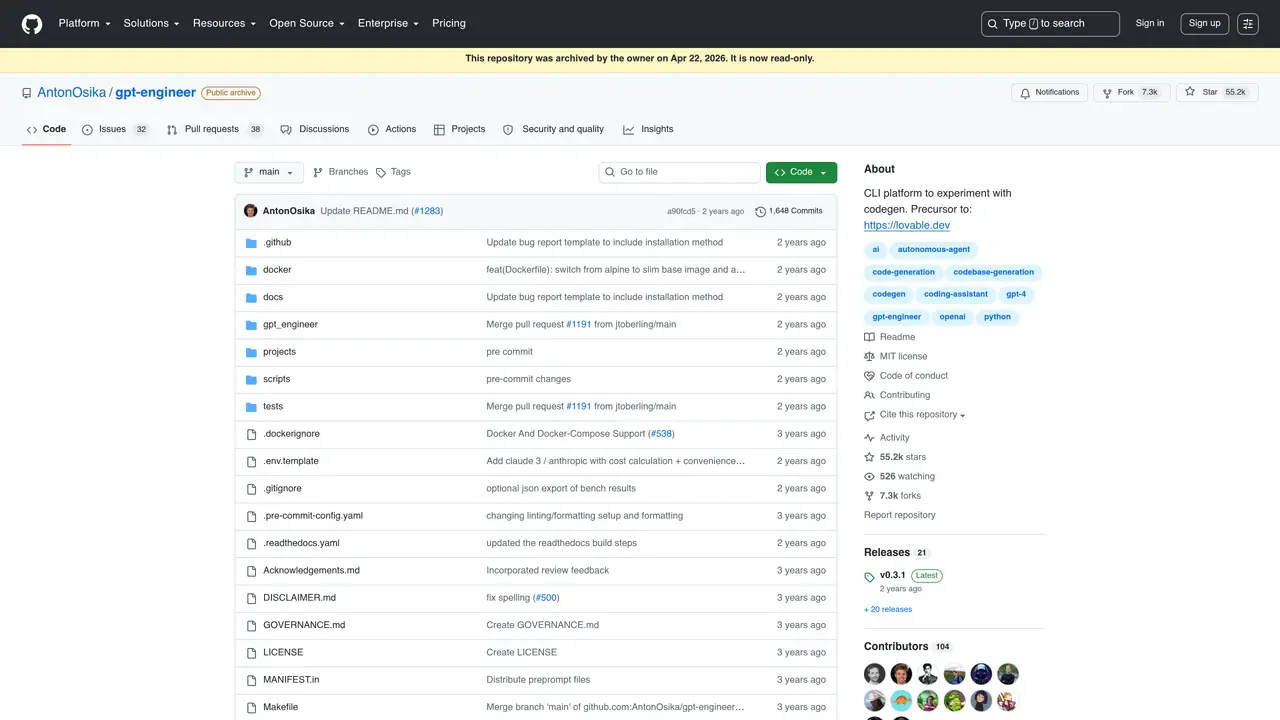
GPT Engineer is an intriguing tool that seems to be straight out of a developer’s sci-fi dream. It’s designed to transform natural language instructions into functioning software, streamlining the development process in a way that could potentially revolutionize how we approach programming. Its core functionality revolves around interpreting user specifications, engaging in dialogue for clarifications, and then proceeding to build the requested software. Key Features: Natural Language Understanding: Interprets user input written in everyday language to understand the software requirements. Interactive Clarification Process: Engages with users to refine and clarify development instructions. Automated Code Generation: Transforms clarified instructions into executable code. Support for Multiple Python Versions: Compatible with Python versions 3.10 to 3.12, with legacy support for versions 3.8 and 3.9 up to release 0.2.6. Customizable AI Identity: Allows users to specify the ‘identity’ of the AI agent for a personalized development assistant. Open Source Model Compatibility: Offers the flexibility to run with open-source models like WizardCoder. GPT Engineer is particularly beneficial for rapid prototyping and automating routine coding tasks, making it an indispensable tool for those looking to streamline their development workflows.
GitHub, Inc.
San Francisco, California, US · Founded 2008
- Founders
- Tom Preston-Werner, Chris Wanstrath, PJ Hyett, Scott Chacon
- Founded
- 2008
- Headquarters
- San Francisco, California, US
- Legal status
- Subsidiary of Microsoft (NASDAQ: MSFT)
Key features
- Natural Language Understanding
- Interactive Clarification Process
- Automated Code Generation
- Support for Multiple Python Versions
- Customizable AI Identity
- Open Source Model Compatibility
Use cases
- Streamlining the coding process for new projects or enhancements
- Quickly prototyping software solutions
- Teaching coding and software development
Pros
- Interprets software requirements specified in natural language for accessible development
- Supports interactive clarification to refine instructions before code generation
- Generates and executes code autonomously based on user prompts
- Compatible with multiple Python versions (3.10 to 3.12) and supports legacy versions (3.8 and 3.9) up to release 0.2.6
- Offers flexibility to run with open-source models or custom configurations
Cons
- Requires an API key setup for core functionality, adding dependency on external services
- Archived repository with read-only status, indicating potential lack of active maintenance or updates
Frequently asked questions about GPT Engineer
What is GPT Engineer?
GPT Engineer is an open-source CLI platform designed for code generation experimentation. It allows users to specify software requirements in natural language, after which an AI writes and executes the code accordingly.
Who is GPT Engineer suitable for?
The tool is suitable for developers and teams looking to rapidly prototype software, automate routine coding tasks, or experiment with AI-driven code generation workflows.
How does GPT Engineer work?
Users create a project folder, add a 'prompt' file with instructions in natural language, and run the gpte command to generate and execute code. The AI can also implement improvements based on further instructions.
What programming languages or frameworks does GPT Engineer support?
GPT Engineer primarily generates Python code but can be adapted for other languages through customization. It supports Python versions 3.10 to 3.12, with legacy support for 3.8 and 3.9 up to version 0.2.6.
Can GPT Engineer be used with local or alternative AI models?
Yes, GPT Engineer supports custom models, including local models, Azure, and other alternatives, beyond the default OpenAI API. Documentation provides guidance on configuration.
Is there a way to benchmark custom AI agents using GPT Engineer?
Yes, GPT Engineer includes a 'bench' binary for benchmarking custom agent implementations against public datasets like APPS and MBPP. A template repository provides instructions for setup.