
OpenAI builds and deploys advanced AI models like GPT-4o for autonomous agents and workflows.

ACE
FreeStarting price
0Popularity
About ACE
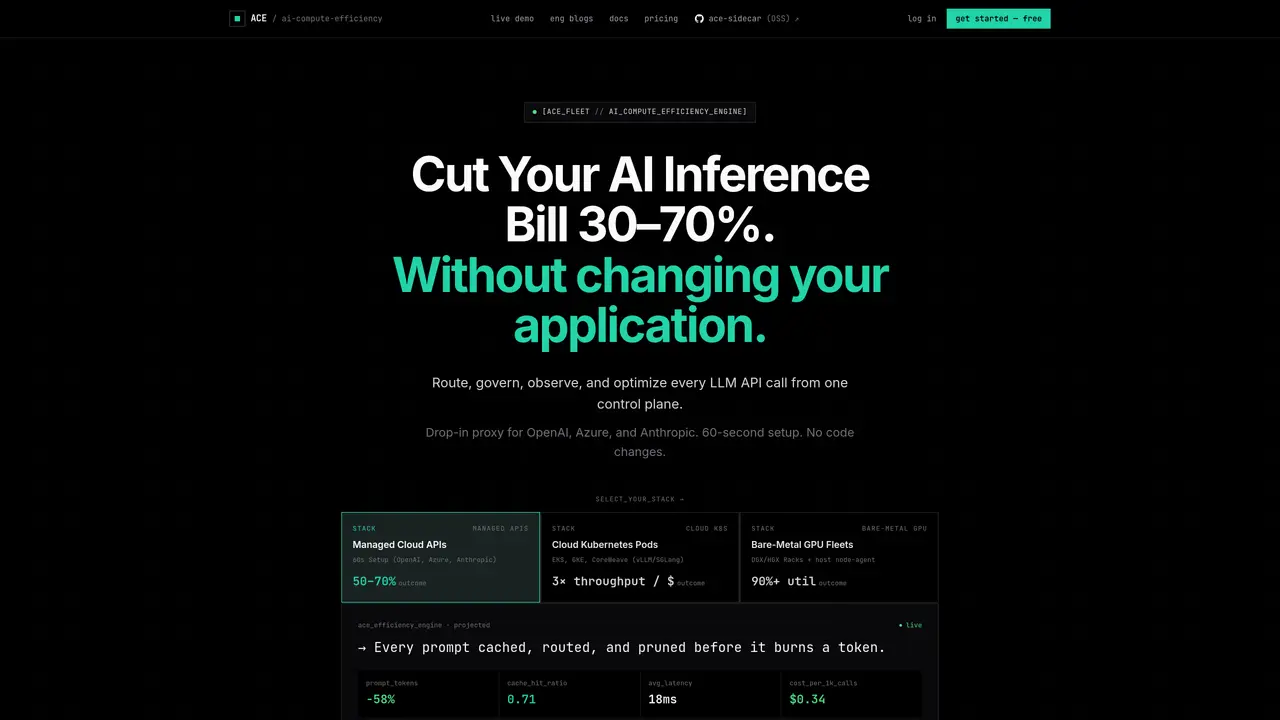
ACE is a control plane that routes, governs, observes, and optimizes every LLM API call without requiring code changes. It operates across hardware accelerators, inference engines, cloud providers, orchestration layers, and agent frameworks to reduce costs, latency, and fragility in AI stacks. The tool integrates with managed APIs and cloud services such as OpenAI, Azure, and Anthropic, as well as self-hosted Kubernetes pods and bare-metal GPU fleets. ACE uses techniques like semantic caching, intent-aware model routing, and context pruning to minimize token usage and maximize throughput. It supports dynamic merit-order arbitrage, where requests are cascaded to the most cost-effective API or self-hosted resource based on real-time pricing and availability. The system is designed for production workloads, offering live telemetry, zero-downtime guarantees, and SOC2 Type II compliance. Users can start with a free developer tier and scale to enterprise deployments with advanced governance and custom SLAs.
Key features
- Semantic caching with sub-20ms hit times
- Intent-aware model routing to cheaper-tier APIs
- Context and prompt compression using LLMLingua-2
- Dynamic merit-order arbitrage across APIs and self-hosted GPUs
- Live cost-savings calculator and telemetry dashboards
- Zero-downtime guarantees with shadow mode passthrough
- Support for NVIDIA, Groq, Cerebras, and AMD accelerators
- VPC and on-premise deployment options
Use cases
- Optimizing costs for production chatbots and copilots
- Reducing expenses for RAG and knowledge search workloads
- Managing autonomous agent loops with multi-turn state compression
Pros
- Reduces LLM API costs by 30–70% through caching, routing, and pruning
- Supports managed APIs, Kubernetes, and bare-metal GPU fleets
- Zero code changes required for integration
- Live telemetry and cost-savings dashboards
- SOC2 Type II compliant with zero data retention
Cons
- No free tier beyond developer key limits
- Enterprise tier requires contact for pricing
- Limited to LLM inference optimization
ACE videos
Frequently asked questions about ACE
What is ACE and what does it do?
ACE is a control plane that routes, governs, observes, and optimizes every LLM API call without requiring code changes. It operates across hardware accelerators, inference engines, cloud providers, orchestration layers, and agent frameworks to reduce costs, latency, and fragility in AI stacks.
Who should use ACE?
ACE is designed for teams managing production AI workloads, including those using managed APIs like OpenAI or Azure, Kubernetes-based inference engines, or bare-metal GPU fleets. It suits organizations looking to reduce inference costs and improve throughput without slowing development.
How does ACE reduce AI inference costs?
ACE uses techniques like semantic caching, intent-aware model routing, and context pruning to minimize token usage and maximize throughput. It also supports dynamic merit-order arbitrage, routing requests to the most cost-effective API or self-hosted resource based on real-time pricing and availability.
Does ACE require code changes to implement?
No, ACE can be implemented with zero code refactoring. Users can switch to ACE by changing a single line in their code, such as updating the base URL to ACE's endpoint.
What integrations does ACE support?
ACE integrates with managed APIs like OpenAI, Azure, and Anthropic, as well as self-hosted Kubernetes pods and bare-metal GPU fleets. It also supports inference engines like vLLM, SGLang, and TensorRT-LLM, and agent frameworks such as CrewAI and LangChain.
How can I get started with ACE?
Users can start with a free developer tier or request a free compute audit on their real traffic. ACE offers a 60-second setup for managed APIs and provides tools like an interactive cost calculator and sizing calculator to help users evaluate potential savings.